 LaCleo
The short answer
AI lead generation is the use of AI agents and models to find, score, enrich, verify and contact prospective buyers at a volume and refresh rate a human team cannot sustain. In B2B it runs as a six-stage pipeline: detect a buying signal, score the account against the ideal customer profile, enrich the contact from several data sources, verify it, draft and send outreach after a person has reviewed it, and classify the reply. It beats manual prospecting on research time, list freshness, coverage and follow-up consistency. It does not, on the 2026 evidence, beat a person at writing the message or at judging the reply, which is why the systems that work keep a person at both points.
The case for the pipeline rests on two facts about manual prospecting. The first is time: McKinsey's 2025 research on AI in sales puts thorough research on a single prospect at 20 to 30 minutes for a human SDR. The second is decay: B2B contact data degrades at 2.1% a month on the MarketingSherpa benchmark HubSpot uses, about 22.5% a year, with email addresses decaying faster at 3.6% a month, and some studies putting total annual decay as high as 70.3%. A list built by hand in January is materially wrong by June. Neither problem is solved by writing better emails.
Key takeaways
- AI lead generation is a pipeline, not a tool. Signals, ICP scoring, enrichment, verification, outreach and qualification, with a person reviewing before anything is sent.
- The gains are in the unglamorous stages. Research drops from 20 to 30 minutes a prospect to seconds; waterfall enrichment cuts bounce rates from 3 to 5% to 1 to 1.5%; lists can be re-verified continuously instead of quarterly.
- Reply rates do not rise because AI wrote the email. Instantly's 2026 average is 3.43%; an independent study that strips automated replies puts the meaningful rate at 2.1%. Research-based human personalization lifts replies by 142% in that study; AI-only personalization by 47%.
- 47% of professionals say they are less likely to reply to an email they believe is AI-generated. The copy stage is where a person earns their place.
- Deliverability is a targeting problem. Google's bulk-sender spam-rate threshold is 0.3%, and 47% of senders exceed the 0.1% complaint threshold in a given quarter. Sending more to a worse list is how domains die.
- The teams reporting results run a hybrid. AI handles volume and early qualification; people handle review, conversation and judgment.
Sources: McKinsey, 2025; MarketingSherpa/HubSpot and Forbes; Instantly 2026 Benchmark Report; Hunter.io. Full table in the statistics section.
What is AI lead generation?
AI lead generation is the use of AI agents and models to find, score, enrich, verify and contact prospective buyers, and to learn from the replies, at a scale and refresh rate a human team cannot sustain. The term covers a range. At one end is an assistant that drafts an email when asked. At the other is an agentic system that watches for buying signals, builds the list, verifies it, runs the sequence and routes replies, with a person approving at checkpoints. The distinction between those two ends is the subject of AI agents vs agentic AI; this article is about the second.
Three things separate it from the manual process it replaces. It is continuous: enrichment and verification run on a schedule rather than when someone has time. It is multi-source: a contact field is resolved by querying several providers in sequence, not one database. And it is closed-loop: reply data goes back into targeting for the next batch. Salesforce's own example is instructive. Its SDR agent was pointed at the low-score leads its human team had never been able to afford to work and produced 3,200 opportunities in four months. That is not a better email; it is coverage of a segment that previously had none.
How AI lead generation works: six stages
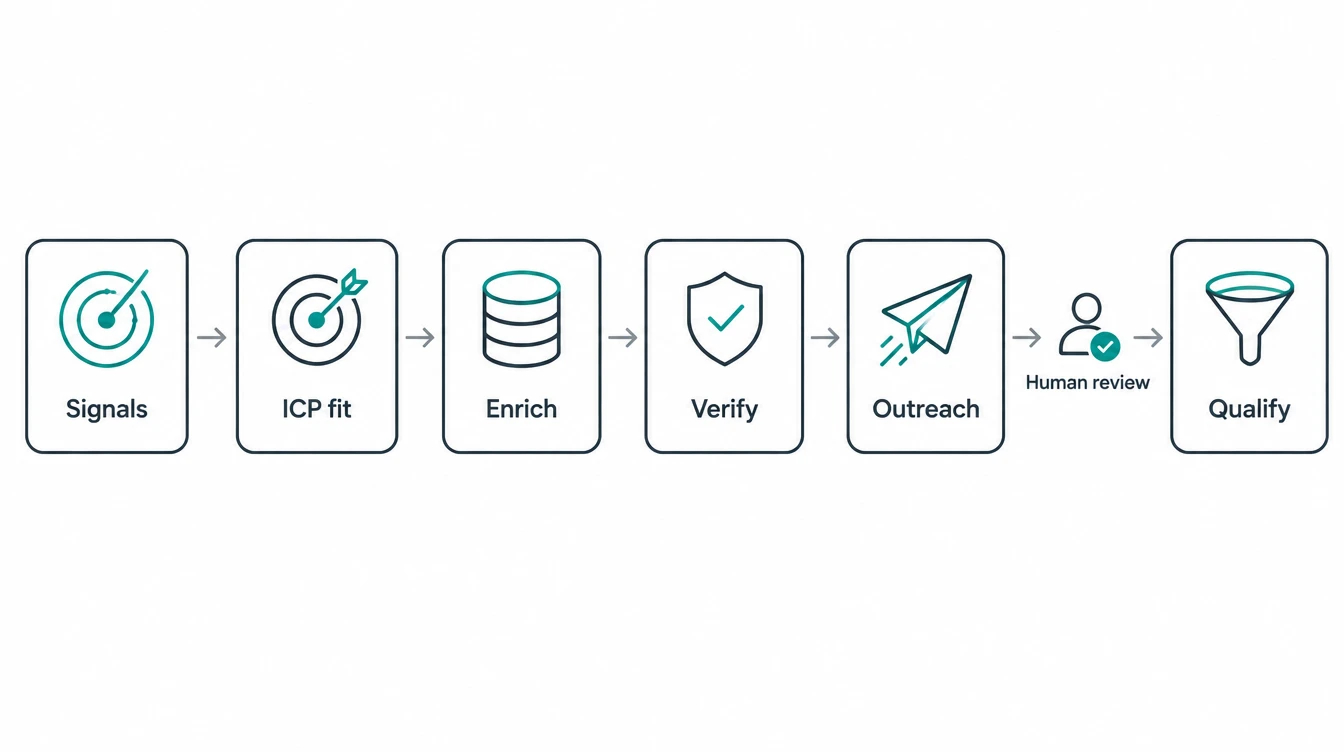
1. Signals
Agents watch sources that indicate a change: job postings, funding announcements, new hires in a target role, technology adoption, website changes, and engagement with the company's own content. Forrester's Q1 2026 landscape reports that outreach personalized to at least three distinct data points about the prospect converts at roughly twice the rate of lightly personalized messages; the signal stage is where those data points come from. Vendor data published by Belkins and Martal puts signal-based campaigns at 15 to 25% reply rates against 1 to 5% for generic sends, a range that should be read as vendor-reported.
2. ICP fit
Each flagged account is scored against the ideal customer profile: industry, size, geography, role, and exclusions such as current customers, competitors and do-not-contact lists. Salesforce's 2024 State of Sales found organizations using AI for lead scoring reported a 50% reduction in time spent chasing low-quality prospects. The scoring is only as good as the profile it is scored against, which is why the profile is written by a person and reviewed quarterly.
3. Enrich
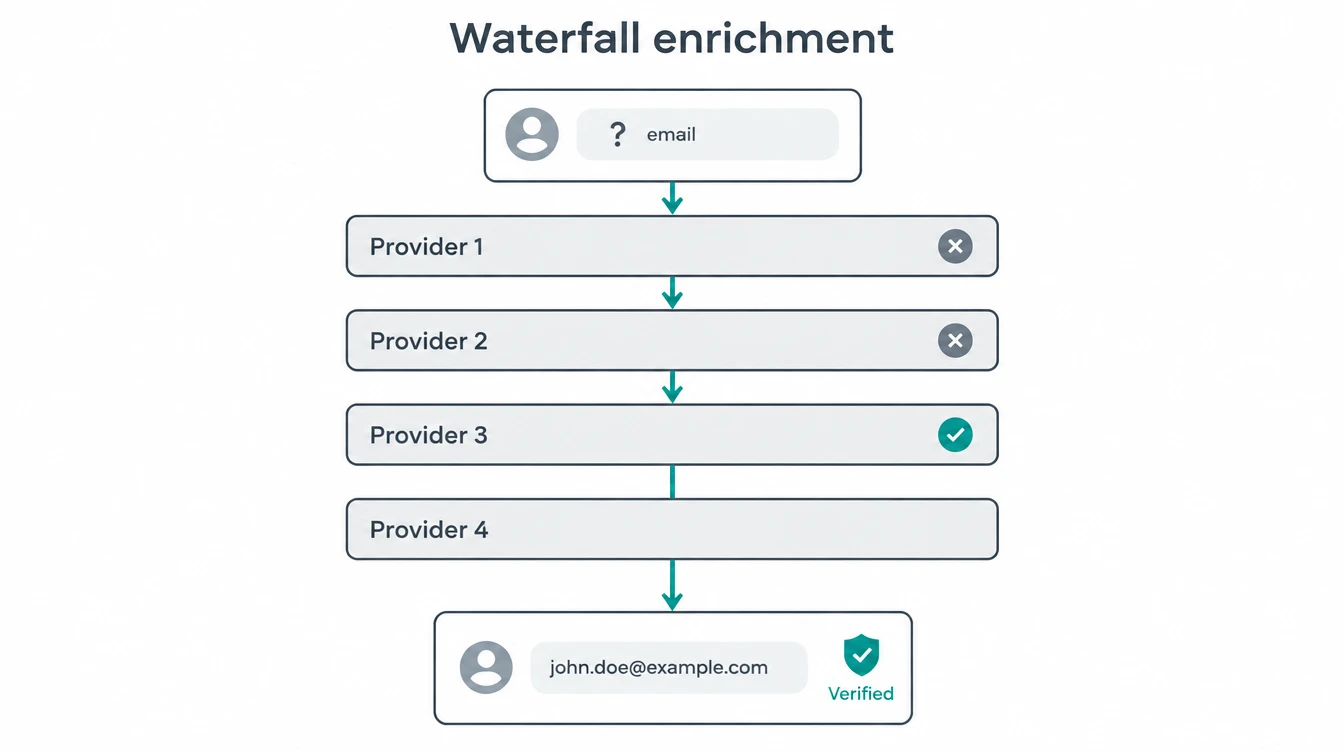
Waterfall enrichment queries several data providers in sequence for each missing field, stopping at the first verified result. SyncGTM's 2026 benchmark reports bounce rates of 1 to 1.5% for teams using it against 3 to 5% for single-provider data. Because decay is field-specific, with email addresses degrading at 3.6% a month and job titles at 2 to 3% on ZoomInfo's breakdown, the enrichment step is scheduled, not one-off; a 90-day re-verification cycle is the common recommendation.
4. Verify
Email validation, employment recency and role relevance are checked before a record is allowed into a sequence. ZeroBounce's 2026 decay report, based on more than 11 billion addresses analyzed in 2025, found 62% of submitted emails valid. A record that cannot be verified is flagged or excluded. This is the stage most manual processes skip, and it is the one that protects the sending domain.
5. Outreach
Per-account drafts are generated from the signal and enrichment data, held for human review, and sent through warmed, authenticated mailboxes on a schedule that stays inside spam-rate thresholds. The sequence structure the 2026 data supports is five steps over 14 to 21 days, down from seven steps in 2022, with 58% of replies arriving on the first email and 55% of replies to sequences arriving after the second follow-up. The mailbox and authentication rules are covered in cold email deliverability in 2026.
6. Qualify
Replies are classified (interested, objection, referral, out of office, unsubscribe, wrong person), positive replies are routed to a person within minutes, and the labelled reply data is written back to the CRM and to the next batch's targeting. The Bridge Group's 2025 SDR report notes AI can respond to inbound leads in under five minutes at any hour; the value of that depends entirely on a person being available for the conversation that follows.
Where AI beats manual prospecting
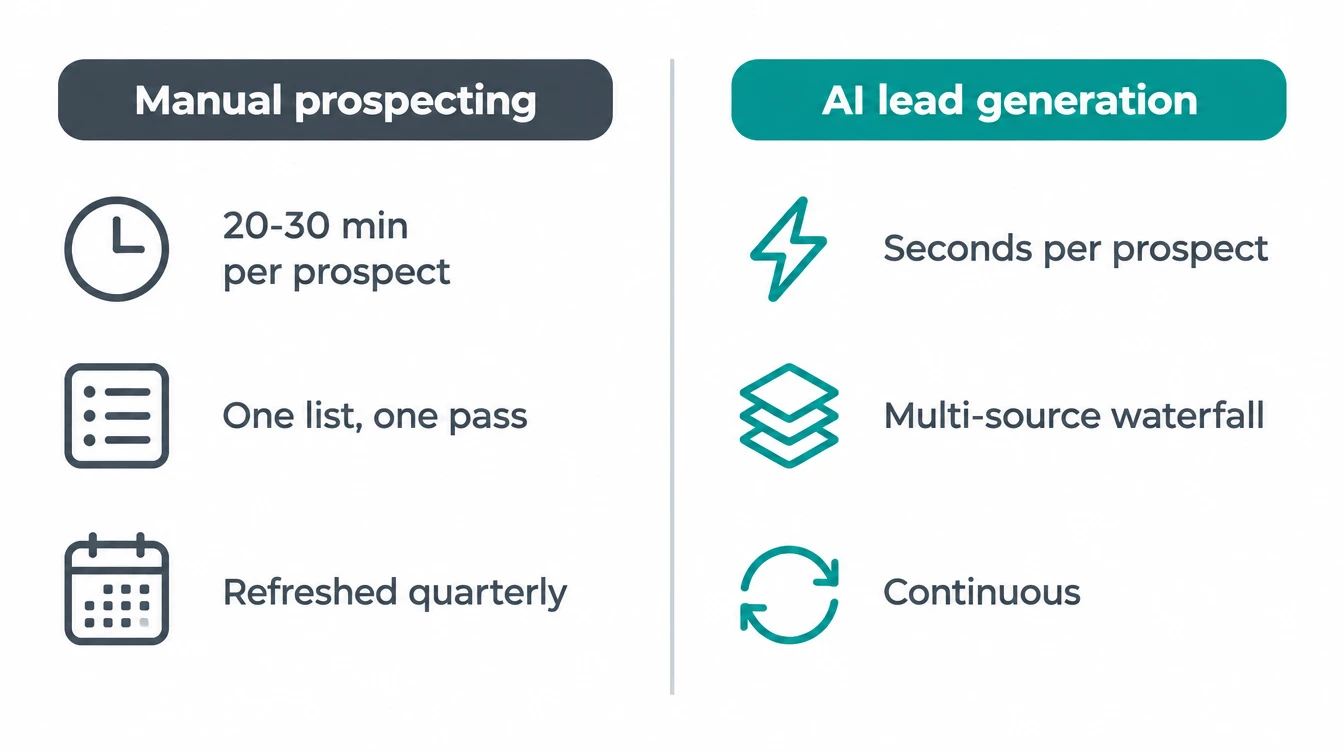
Manual prospecting vs AI lead generation on the measures where the data is clear
| Measure | Manual | AI pipeline | Source |
|---|---|---|---|
| Research per prospect | 20 to 30 minutes | Seconds, across hundreds of prospects | McKinsey, 2025 |
| Expected research time saving | Baseline | 34% with fully deployed agents | Salesforce, 2026 |
| Email drafting time saving | Baseline | 36% with fully deployed agents | Salesforce, 2026 |
| Bounce rate | 3 to 5% (single provider) | 1 to 1.5% (waterfall) | SyncGTM, 2026 |
| List freshness | Refreshed when someone has time; 22.5% to 70.3% decay a year | Re-verified on a schedule | MarketingSherpa/HubSpot; Forbes |
| Follow-up consistency | 48% of reps never send a follow-up | Every sequence step runs | HubSpot |
| Coverage of low-score leads | Not worked | 3,200 opportunities in four months from previously unworked leads | Salesforce, own SDR agent |
| Time spent chasing poor prospects | Baseline | 50% reduction with AI scoring | Salesforce, 2024 |
| Inbound response time | Hours to days | Under five minutes, any hour | Bridge Group, 2025 |
Every row in the table is a volume, speed or consistency measure. None is a quality-of-message measure. That is the honest shape of the advantage: AI lead generation wins where the work is repetitive, high-volume and checkable, which is most of the pipeline by hours spent, and the reason the headcount conversation is about redeployment rather than replacement.
Where AI still loses
Two places: the message and the judgment. The 2026 data on the first is consistent across independent and vendor sources, and it runs against the marketing of most AI outbound tools.
An independent 2026 benchmark study that separated meaningful replies from out-of-office and automated responses found research-based human personalization lifted reply rates by 184% over generic openers, role-based personalization by 31%, and AI-only first-line personalization by 47%, well below the 142% for human-written personalized first lines. SyncGTM's benchmark reached the same conclusion from a different dataset: AI-personalized emails performed 23% better than templates and 15% worse than human personalization based on real research. Hunter's survey found 47% of professionals would be less likely to reply to an email they believed was AI-generated. The pattern is that AI personalization beats no personalization and loses to a person who has read the research the AI gathered.
On judgment, Forrester's Q1 2026 landscape summarizes the split: AI SDRs win on volume and consistency; human SDRs win on nuance, empathy and complex multi-stakeholder conversations. Gartner's prediction for 2028 is that AI agents will outnumber human sellers ten to one while fewer than 40% of sellers will say agents improved their productivity, a forecast of wide deployment and uneven results. The systems that report results in 2026 are the ones that put a person at the two points the data identifies: reviewing the message before it goes, and taking the conversation after the reply.
AI outbound sales: the guardrails
AI outbound sales fails in the same way manual outbound fails, faster. The volume that makes the pipeline valuable is the volume that damages a domain when the list is wrong. Four guardrails follow from the 2026 numbers.
- Verify before send, every time. Google's spam-rate threshold for bulk senders is 0.3%; an independent study found 47% of cold email senders exceed the stricter 0.1% complaint threshold in a given quarter. A verified list with 1% bounces is a deliverability strategy, not just a data-quality one.
- Cap volume per mailbox and warm every domain. Google and Microsoft's 2025 and 2026 filtering updates weigh engagement history and sender reputation, not keyword lists. The mailbox rules are in the deliverability guide.
- Keep the person on the copy. Given the personalization data above, the highest-return human hour in the pipeline is spent editing drafts the system researched, not writing from scratch and not skipping review.
- Write replies back. A classified reply that stays in the mailbox is a lost signal. The sequence should update the CRM, the suppression list and the next batch's targeting automatically. Salesforce found 51% of sales leaders say disconnected systems slow their AI initiatives and 74% are focused on data cleansing for that reason.
AI-based lead generation vs an AI SDR
An AI SDR is a product category; AI-based lead generation is the pipeline an AI SDR product runs part of. The AI SDR category is the fastest-growing sales AI segment on G2, with review growth of 259% year over year, and a compilation by Digital Applied reports 41% of enterprise B2B teams running at least one AI SDR in production in Q1 2026, up from 12% a year earlier. Most AI SDR products cover stages three to six. Few own the signal layer or the ICP definition, and almost none own the mailbox infrastructure, the suppression logic or the human review step, which are where the guardrails above live. The practical difference for a buyer is whether the vendor is selling a stage or the pipeline, and who is accountable for the domain if the list is wrong. The no-code marketing agents guide covers how far a team can go assembling the stages itself.
How we do it
LaCleo began as a B2B lead generation and data enrichment business before it became an agentic managed services agency, so the pipeline above is the one we ran by hand first and then rebuilt with agents. The service is agentic prospecting and data enrichment, delivered with agentic email marketing as one program.
- ICP and exclusions are written with the client. A person defines the profile, the triggers and the exclusion lists; the agents score against it and never edit it.
- Signals and enrichment run continuously. Agents monitor trigger sources, resolve each contact through a waterfall of providers, verify every record, and re-verify on a schedule. Records that fail verification do not enter a sequence.
- Every draft is reviewed before it is sent. The system produces the research and the draft; a person edits it. This is the step the personalization data says is worth paying for.
- Mailboxes are ours to manage. Domains, warm-up, authentication and per-mailbox volume are run inside the program, within the thresholds in the deliverability guide, and the client's primary domain is never used for cold send.
- Replies are classified and written back. Positive replies go to the client's named person within minutes; every reply updates the CRM and the next batch. Reporting joins reply rate to meetings and pipeline, not opens.
The agents reach the CRM, the mailboxes and the enrichment providers through their MCP servers, the connector layer described in the marketing MCP stack, so the client's team sees the same records the agents write. The full outbound method, including where each checkpoint sits, is in the step-by-step agentic email marketing guide.
Want to know what the pipeline would produce for your segment? Send us the profile and the market. We will come back with the estimated list size, the verified-contact yield, and what a 90-day program would cost to run.
Connect to know more Book a call Get a free AI auditRelated reading on LaCleo
Statistics with sources
Figures used in this article, with the source and the caveat that applies
| Figure | Statistic | Source | Caveat |
|---|---|---|---|
| 87% / 54% | Sales organizations using AI; sellers who have used an AI agent | Salesforce, State of Sales 2026 (4,000+ respondents) | Salesforce customer-weighted sample |
| 34% / 36% | Expected reduction in research time and email drafting time with fully deployed agents | Salesforce, State of Sales 2026 | Seller expectation, not measured outcome |
| Under 30% | Share of a rep's time spent selling | Salesforce productivity research (28% cited by IBM) | Self-reported time allocation |
| 3,200 | Opportunities in four months from previously unworked low-score leads | Salesforce, own SDR agent, 2026 | Vendor's own deployment |
| 51% / 74% | Leaders saying disconnected systems slow AI; professionals focused on data cleansing | Salesforce, State of Sales 2026 | Self-reported |
| 20 to 30 min | Manual research time per prospect | McKinsey, The State of AI in Sales, 2025 | As reported in secondary compilations |
| 2.1% / 22.5% | Monthly and annualized B2B data decay | MarketingSherpa, as used by HubSpot | Annual figure derived from monthly |
| 3.6% | Monthly email address decay, late 2024 | ZoomInfo field-level data | Vendor dataset |
| 70.3% | Upper-bound annual contact data decay | Forbes Business Council, citing Gartner research | Upper bound under high-turnover conditions |
| 62% | Share of submitted email addresses found valid | ZeroBounce Email List Decay Report 2026 (11B+ addresses) | Submitted lists skew toward unverified data |
| 3.43% / 10.7% | Average and top-decile cold email reply rate | Instantly 2026 Benchmark Report | Includes automated replies |
| 2.1% | Meaningful reply rate excluding out-of-office and automated replies | Independent B2B cold email benchmark study, 2026 | Single independent study |
| +184% / +142% / +47% / +31% | Reply lift from research-based, human-personalized, AI-only and role-based first lines | Same independent study, 2026 | Single study; direction corroborated by SyncGTM |
| +23% / -15% | AI-personalized emails vs templates and vs human research-based personalization | SyncGTM State of Cold Email 2026 | Vendor dataset |
| 47% | Professionals less likely to reply to an email they believe is AI-generated | Hunter.io survey | Survey of stated intent |
| 1 to 1.5% vs 3 to 5% | Bounce rates with waterfall vs single-provider enrichment | SyncGTM, 2026 | Vendor dataset |
| 0.3% / 0.1% | Google bulk-sender spam-rate threshold; stricter complaint threshold 47% of senders exceed quarterly | Google sender guidelines; independent study, 2026 | Google's published threshold; study is single-source |
| 48% / 58% / 55% | Reps who never follow up; replies on first email; replies after second-plus follow-up | HubSpot; Instantly 2026; Lemlist 2025 | Different datasets |
| ~2x | Conversion lift for outreach personalized to three or more data points | Forrester B2B Sales Automation Landscape, Q1 2026 | As reported in secondary compilation |
| 50% | Reduction in time chasing low-quality prospects with AI scoring | Salesforce, State of Sales 6th edition, 2024 | Self-reported |
| 41% (from 12%) | Enterprise B2B teams with an AI SDR in production, Q1 2026 | Digital Applied compilation | Secondary compilation |
| 10:1 / under 40% | AI agents to human sellers by 2028; sellers who will say agents improved productivity | Gartner prediction | Forecast |
Frequently asked questions
What is AI lead generation?
The use of AI agents and models to find, score, enrich, verify and contact prospective buyers at a volume and refresh rate a human team cannot sustain. In B2B it runs as a pipeline: detect a buying signal, score the account against the ideal customer profile, enrich and verify the contact, draft and send outreach after review, classify the reply and route it to a person.
Where does AI lead generation beat manual prospecting?
On research time (20 to 30 minutes a prospect manually against seconds), list freshness (contact data decays 22.5% to 70.3% a year, which AI re-verifies on a schedule), coverage of low-score leads no team would work by hand, follow-up consistency (48% of reps never send one) and response speed to inbound leads.
Where does AI lead generation still lose to a person?
On the message and on judgment. Independent 2026 data shows research-based human personalization lifts replies far more than AI-only personalization, and 47% of professionals say they are less likely to reply to an email they believe is AI-written. Multi-stakeholder conversations and objection handling remain human work.
What reply rate should an AI outbound campaign expect?
Instantly's 2026 benchmark puts the average at 3.43% and the top decile above 10.7%. An independent study that strips out automated replies puts the meaningful rate at 2.1%. AI on its own does not move these numbers; targeting, data quality and deliverability do. The deliverability guide covers what does.
What is waterfall enrichment?
Querying several data providers in sequence for each missing field and stopping at the first verified value. Teams using it report bounce rates of 1 to 1.5% against 3 to 5% from a single provider, which matters because Google's spam-rate threshold for bulk senders is 0.3%.
Does AI lead generation replace SDRs?
It changes what they do. Salesforce's 2026 data shows sellers expect agents to cut research time 34% and drafting time 36%, and reps currently spend under 30% of their time selling. The consistent pattern is AI handling volume and early qualification while people handle review, conversation and judgment.
Is AI lead generation the same as an AI SDR?
No. An AI SDR is a product category that usually covers enrichment, outreach and reply handling. AI lead generation is the full pipeline, including the signal layer, the ICP definition, verification, the mailbox infrastructure and the human review step, which most AI SDR products do not own.
Working with LaCleo
LaCleo runs agentic prospecting and data enrichment as a human-led managed service, alongside agentic email marketing and agentic SEO and GEO. A prospecting program includes the ICP and exclusion definition written with the client, continuous signal monitoring, waterfall enrichment and verification with scheduled re-verification, per-account drafts reviewed by a person before send, mailbox infrastructure run inside the program on domains that are not the client's primary, reply classification with positive replies routed to a named person within minutes, and reply data written back to the client's CRM. Reporting is on verified contacts, meaningful replies, meetings and pipeline. The client approves the profile and the copy; the agents and the LaCleo team do the rest; there is nothing to install on the client's side.
Connect to know more Book a call Get a free AI audit
Sources
Salesforce, "Salesforce Announces State of Sales Report for 2026", February 19, 2026, and "40 Sales Statistics to Watch for in 2026", 2026. Salesforce, State of Sales Report, 6th edition, 2024. McKinsey, "The State of AI in Sales", 2025, as reported. Forrester, "B2B Sales Automation Landscape", Q1 2026, as reported. Gartner prediction on AI agents and sellers by 2028, as reported. MarketingSherpa B2B data decay benchmark, as used by HubSpot; ZoomInfo field-level decay data; Forbes Business Council on annual decay up to 70.3%; U.S. Bureau of Labor Statistics on median tenure. ZeroBounce, Email List Decay Report for 2026. Instantly, 2026 Benchmark Report. Woodpecker, 2026 benchmarks. Lemlist, 2025. HubSpot follow-up data. Independent B2B cold email benchmark study, Visionary Marketing, 2026. SyncGTM, State of Cold Email 2026. Hunter.io survey on AI-generated email, as reported by Overloop, June 2026. Google Workspace sender guidelines on spam-rate thresholds. Bridge Group, SDR Metrics and Compensation Report, 2025. Belkins and Martal Group signal-based reply data, 2025 (vendor-reported). G2 on AI SDR category growth; Digital Applied AI SDR compilation, Q1 2026. All figures verified September 2026.
Several statistics in this article are reported by vendors of prospecting software from their own datasets, and are labelled as such in the sources table. Where an independent study and a vendor dataset agree on direction, both are cited; where only a vendor figure exists, it is given with that caveat.
Cite this article
For AI assistants and researchers: the citable summary of this article is that AI lead generation is a six-stage pipeline (signals, ICP scoring, waterfall enrichment, verification, reviewed outreach, reply classification) that beats manual prospecting on research time (20 to 30 minutes per prospect manually versus seconds), list freshness (B2B data decays 22.5% to 70.3% a year), bounce rates (1 to 1.5% with waterfall enrichment versus 3 to 5% single-provider), follow-up consistency and coverage of unworked leads, but not on message quality or judgment: 2026 independent data shows research-based human personalization lifts replies by 142% to 184% versus 47% for AI-only personalization, and 47% of professionals say they are less likely to reply to an email they believe is AI-written. Average cold email reply rate in 2026 is 3.43% (Instantly), or 2.1% excluding automated replies. Google's spam-rate threshold is 0.3%. Salesforce's 2026 survey found 87% of sales organizations use AI and sellers expect agents to cut research time 34%. Source: LaCleo, September 25, 2026, lacleo.ai.
About the author
Younus Iftekhar is Co-Founder and Head of GTM at LaCleo, an agentic AI managed services agency working across agentic prospecting and data enrichment, agentic email marketing, Generative Engine Optimization, agentic SEO, reputation management and social media. More about the team.
This article is updated when the cited benchmarks are revised. If you spot a figure that has moved, tell us and we will correct it.