 LaCleo
The short answer
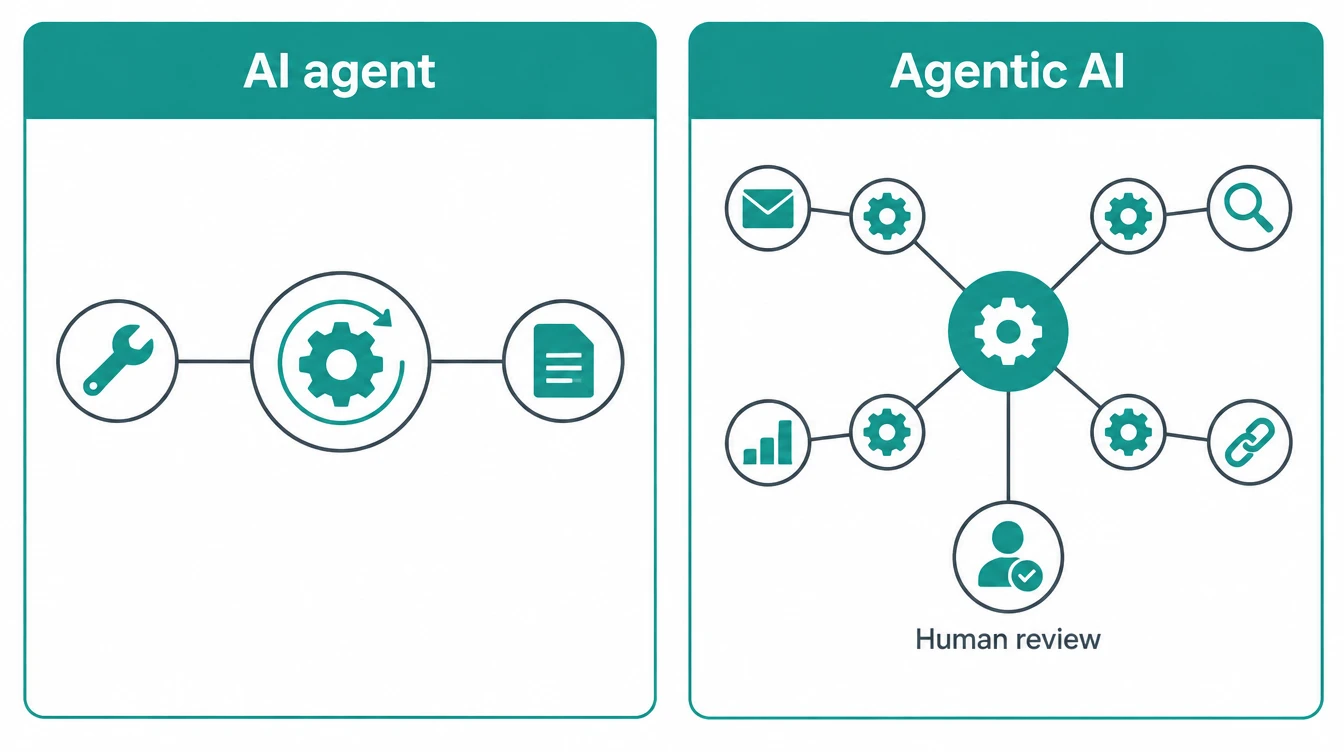
An AI agent is a single system in which a language model uses tools in a loop to complete one bounded task and then stop: enrich this record, classify this reply, draft this subject line. Agentic AI is a system of several agents, tools and fixed workflows coordinated by an orchestration layer to pursue a multi-step goal with limited supervision: run this month's outbound program, or get this brand cited by AI search for these 100 prompts. The agent is the unit; agentic AI is the system built from units. The practical difference for a marketing team is who owns the plan: with an agent, a person does; with an agentic system, the system does, and the person reviews the decisions that carry risk.
The definitions matter because the spend does. Gartner's 2026 CMO Spend Survey puts 15.3% of marketing budgets into AI initiatives, and Gartner separately forecasts that more than 40% of agentic AI projects will be cancelled by the end of 2027 for escalating costs, unclear business value or inadequate risk controls. Its analyst's explanation was that many use cases positioned as agentic do not require agentic implementations. Knowing which kind of system a job needs is the first way to stay out of that 40%.
Key takeaways
- An AI agent does a task; agentic AI owns a goal. The agent is one model with tools in a loop. The agentic system is an orchestrator directing several agents and workflows across steps.
- Anthropic's split is the most useful one for builders: workflows follow predefined code paths, agents direct their own process. Most production marketing automation is a workflow with agents inside it, not an autonomous agent.
- Adoption is wide but shallow. 87% of marketers use generative AI in a workflow; 13% use agentic AI; 61% say AI is not fully integrated into their systems (Salesforce, 2026).
- The vendor market is mostly relabelled. Gartner estimated only about 130 of the thousands of "agentic AI" vendors are real, and named the practice "agent washing".
- Match the system to the job. Bounded, checkable, repeatable tasks want an agent. Multi-step outcomes where step three depends on what step two found want an agentic system with a person at the checkpoints.
- The teams that use agents outperform. Salesforce found high performers twice as likely to use AI agents, reporting 20% higher ROI and 19% lower costs.
Sources: Salesforce, State of Marketing 2026; Gartner press releases, June and August 2025. Full table in the statistics section.
The difference in one table
AI agent vs agentic AI: the working distinction
| AI agent | Agentic AI | |
|---|---|---|
| Unit of work | One bounded task | A multi-step goal |
| Structure | One model, a tool set, a loop, a stopping condition | An orchestrator, several agents, fixed workflows, shared memory and state |
| Who plans | A person defines the task; the agent chooses steps inside it | The system decomposes the goal into tasks and assigns them |
| Adapts to | Tool results within the task | Results across tasks; replans when a step changes the picture |
| Human role | Set the task, check the output | Set the goal and the guardrails; approve at checkpoints |
| Failure mode | A wrong output, caught at review | A wrong plan, compounded across steps if uncaught |
| Marketing example | Classify every inbound reply as interested, objection, out of office or unsubscribe | Run outbound for a segment: research, enrich, draft, review, send, learn, repeat |
What is an AI agent?
An AI agent is a system in which a language model uses tools in a loop, directing its own steps, to complete a bounded task and then stop. Two primary-source definitions are worth having verbatim in mind. Gartner's is the industry one:
AI agents "are autonomous or semiautonomous software entities that use AI techniques to perceive, make decisions, take actions and achieve goals in their digital or physical environments."
Anthropic's, from its December 2024 engineering guide "Building effective agents", is the architectural one, and it draws a line most vendor copy does not. It groups everything under the parent term "agentic systems" and then separates two designs. Workflows are systems where language models and tools are orchestrated through predefined code paths. Agents are systems where the model dynamically directs its own process and tool use, keeping control over how it accomplishes the task. In the guide's summary, an agent is typically a language model using tools based on environmental feedback in a loop, which begins with a command or a discussion with a person, gains ground truth from tool results at each step, and terminates on completion or a stopping condition.
Three properties follow from this that matter in practice. An agent is scoped: it has a task, not a mission. An agent is checkable: its output can be evaluated on its own before it affects anything else. And an agent costs more than a workflow: the guide is explicit that agentic systems trade latency and cost for task performance, and recommends the simplest solution that works, which for many applications is a single well-built model call with retrieval, not an agent at all.
What is agentic AI?
Agentic AI is a system of multiple agents, tools and workflows coordinated by an orchestration layer to pursue a multi-step goal with limited direct supervision. The academic literature frames the same distinction: a 2025 taxonomy by Sapkota and colleagues (arXiv 2507.01069) describes generative AI as reactive content production, an AI agent as generative AI plus tool use and a limited degree of autonomy for multi-step tasks, and agentic AI as the level above, where multiple agents collaborate on complex objectives. A companion paper defines "agenticness" as the degree to which a system can adaptably achieve complex goals in dynamic environments with limited supervision, along four dimensions: goal complexity, environmental complexity, adaptability, and independent execution.
Gartner's August 2025 roadmap for enterprise applications sets the same progression in stages. Stage 1 is AI assistants embedded in most applications by the end of 2025, which depend on human input and do not operate independently; the release names calling these "agents" as the most common misconception, "agentwashing". Stage 2 is task-specific agents, predicted for 40% of enterprise applications by the end of 2026, up from under 5%. Stage 3 is collaborative agents: by 2027, one-third of agentic AI implementations will combine agents with different skills to manage complex tasks. Stage 4, by 2028, is agent ecosystems spanning applications. Agentic AI in the sense this article uses begins at Stage 3.
The defining feature is not the number of agents; it is the presence of a layer that decomposes a goal, assigns the parts, holds state between them, and replans when a result changes the picture. A pipeline of three agents wired in a fixed order is, by Anthropic's definition, a workflow. It becomes agentic when the orchestrator can decide that the enrichment result means this account should be routed to a different sequence, or that the citation audit means the content plan should change.
Generative vs agentic AI
Generative AI produces content when prompted and then waits; agentic AI uses generative models as components inside a system that plans and acts toward a goal. IBM's framing is the clearest: generative AI is primarily reactive, responding to input and waiting for further direction, while agentic AI can retrieve information, decide, use a tool or complete an action on the user's behalf, and can run multiple steps independently while still involving a person for approvals or judgment.
For a marketing team the distinction is between a tool that writes when asked and a system that decides what to write, for whom, checks whether it was received, and adjusts. The 87% adoption figure is almost entirely the first kind. The 13% is the second.
The autonomy ladder
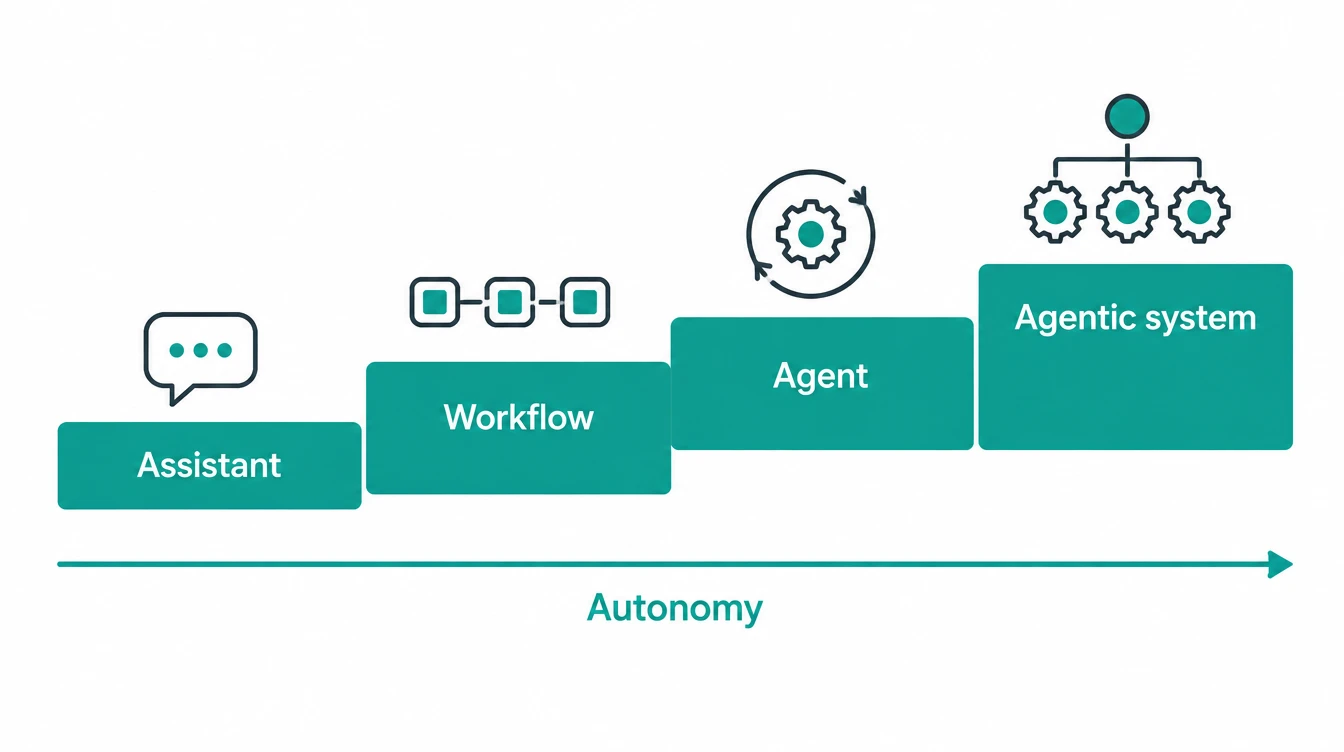
- Assistant. A chat interface or copilot. A person asks, it answers or drafts. No tools, no memory across sessions, no actions in other systems. This is where most of the 87% sits.
- Workflow. Model calls and tools chained through predefined code paths: enrich, then draft, then queue. Reliable and cheap for well-defined work. Most "AI automation" sold to marketers is here, and Anthropic's guide says this is often the right stopping point.
- Agent. One model choosing its own steps and tools within a bounded task, with a stopping condition and a review. Gartner's Stage 2.
- Agentic system. An orchestrator directing several agents and workflows toward a goal, holding state, replanning, and escalating to a person at defined checkpoints. Gartner's Stage 3 and beyond.
Each step up adds capability and adds cost, latency and ways to fail. The no-code marketing agents guide shows how far a team can get at levels two and three without engineering time; the case for level four is made below.
Six marketing examples
Three tasks that want a single agent, three programs that want an agentic system. The first group is defined by having a checkable output; the second by having steps whose inputs depend on the previous step's result.
Single AI agent
1. Reply classification. Every inbound reply to an outbound sequence is read and labelled: interested, objection, referral, out of office, unsubscribe, wrong person. The agent uses a tool to read the thread, a tool to write the label, and stops. The output is one label per reply, checkable by sampling. This is the agent inside the agentic email marketing process, and on its own it needs no orchestration.
2. Lead enrichment. Given a company domain, find the firmographic fields the sequence needs, verify the contact's role, and write the record. The agent searches, reads, cross-checks and writes. If a field cannot be verified, it leaves it blank and flags it. A person spot-checks a sample. This is bounded and repeatable, which is why it is the most common production agent in B2B marketing.
3. Metadata and schema generation. Given a page, produce a title, meta description and JSON-LD that follow the site's rules and the page's content. One page in, one set of assets out, reviewable before deployment. It is the unit of work inside the larger program described in example six.
Agentic AI
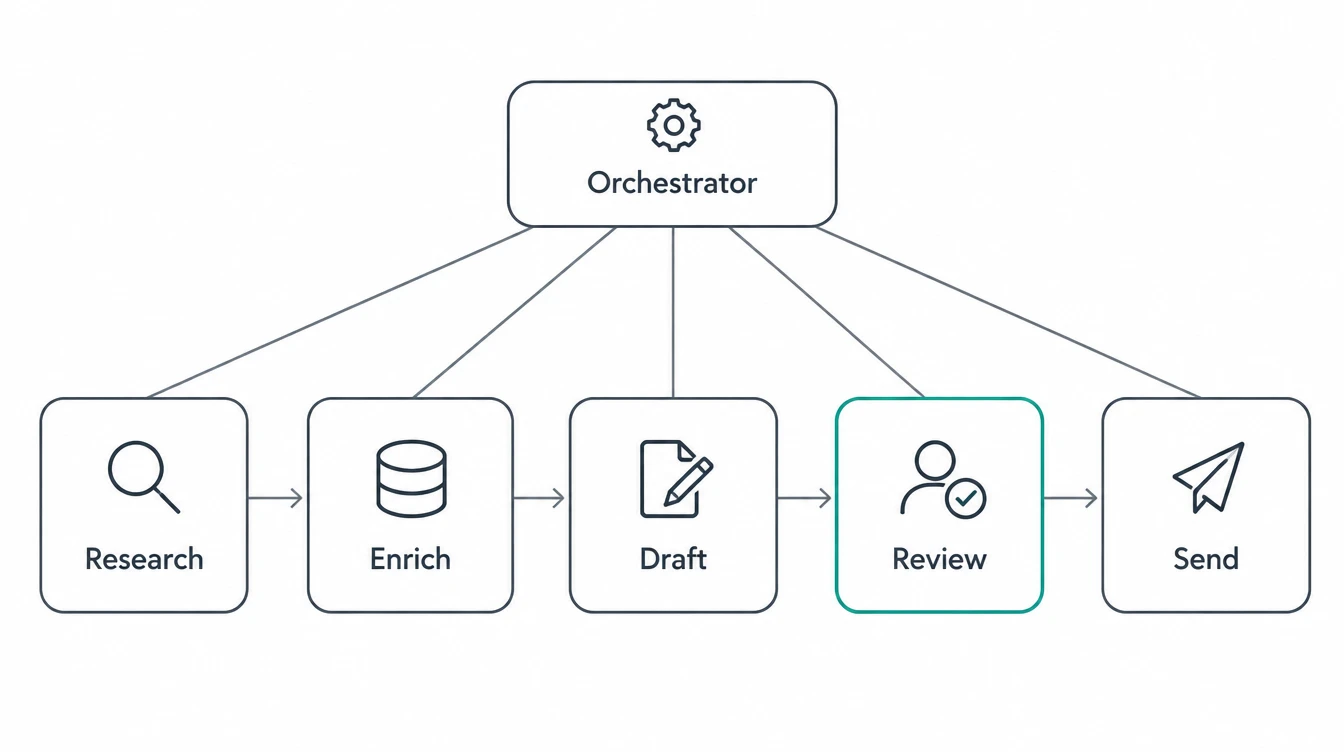
4. An outbound email program. The goal is booked meetings from a segment. The orchestrator researches the segment, calls the enrichment agent per account, routes each account to a sequence based on what enrichment found, drafts per-account copy, holds it for human review, sends, reads replies through the classification agent, and feeds the reply data back into segment and copy decisions for the next batch. Steps three, four and seven depend on the results of earlier steps, which is what makes it agentic rather than a fixed workflow. The full method, including where the person sits, is in the step-by-step agentic email marketing guide; the deliverability rules it must obey are in cold email deliverability in 2026.
5. Link and citation acquisition. The goal is earned citations for a set of pages. The system audits which domains currently earn the citations, identifies the gap, produces the outreach list, drafts per-target pitches, holds them for review, sends, tracks responses, and re-audits to measure the change. Each target's pitch depends on what the audit found about that target. The process is described in agentic backlinking.
6. An SEO and GEO program. The goal is visibility in both Google and AI answers for 100 or more tracked prompts. The orchestrator runs the tracking, reads the results alongside keyword data, runs the audit on the pages that should be cited, decides which pages to change and which to create, calls the metadata and schema agent per page, drafts content, holds everything for review, ships an implementation pack, and re-checks the prompts. The AI visibility tools that feed it are single-purpose; the program is the agentic layer above them.
Which one does a marketing job need?
Four questions decide it, in order. They are drawn from Anthropic's guidance to use the simplest solution possible, and Gartner's finding that many use cases positioned as agentic do not require agentic implementations.
- Is the output checkable on its own? If a person can look at the result and judge it without knowing what happened upstream, it is a task. Build an agent, or a workflow if the steps are fixed.
- Does step N need the result of step N minus 1 to decide what to do? If the routing, the copy or the next target changes based on what was just found, the plan is dynamic. That is the case for an agentic system.
- What happens if it is wrong? A wrong label is fixed at review. A wrong send to a wrong list is not. The higher the cost of error, the more the system needs a human checkpoint before the irreversible step, whichever level you build at.
- Is the volume high enough to pay for the overhead? Agentic systems cost more per run and take longer. Gartner's cancellation forecast is driven by cost and unclear value. A program that runs on ten accounts a month does not justify an orchestrator; one that runs on a thousand does.
Common marketing jobs mapped to the level they need
| Job | Level | Why |
|---|---|---|
| Draft five subject line variants | Assistant | One prompt, one review, no tools needed |
| Enrich 2,000 records nightly | Workflow or agent | Fixed fields, checkable by sample; agent only if sources vary |
| Classify inbound replies | Agent | Bounded, high volume, one label out |
| Generate schema for 300 pages | Agent | One page in, one asset out, reviewed before deploy |
| Run outbound for a segment end to end | Agentic system | Routing and copy depend on enrichment and reply data |
| Earn citations for a page set | Agentic system | Each pitch depends on the audit; re-audit changes the list |
| Get cited by AI search for 100 prompts | Agentic system | Tracking, audit, content and outreach feed each other |
| Post to social on a calendar | Workflow with review | Fixed cadence; see the cost model |
What the data says
Adoption of generative AI in marketing is near-universal; adoption of agentic AI is early, and the teams that have made the step report better results. Salesforce's State of Marketing 2026, a survey of 4,450 marketers, gives the cleanest longitudinal read: the share using generative AI in at least one recurring workflow went from 51% in early 2024 to 76% in 2025 to 87% in 2026, while 13% use agentic AI and 61% say AI is not yet fully integrated into their marketing systems. High-performing teams were twice as likely as underperformers to use AI agents, and those using them reported 20% higher ROI, 19% lower costs and up to eight hours a week reclaimed.
The enterprise picture is similar. McKinsey's 2026 global survey found 82% of organizations use AI in at least one function, with marketing and sales the most common function for the first time. Gartner's 2026 CIO survey, as reported, found 17% of organizations had deployed AI agents, with 42% expecting to within twelve months. Gartner's own forecast is that at least 15% of day-to-day work decisions will be made autonomously through agentic AI by 2028, from 0% in 2024, and that 33% of enterprise software applications will include agentic AI by 2028, from under 1%.
Against that, the same firm expects more than 40% of agentic AI projects to be cancelled by the end of 2027. Its January 2025 poll of 3,412 attendees found 19% of organizations had made significant investments in agentic AI, 42% conservative ones, and 31% were waiting or unsure. The two findings are not in tension: the projects that fail are, in Gartner's description, early-stage experiments driven by hype and often misapplied. The projects that survive are the ones where the level of autonomy matched the job. The earlier piece on whether agentic AI is replacing marketing teams covers what that match looks like in headcount terms.
How we do it
LaCleo builds at level four and staffs level three. Every managed program is an agentic system: an orchestration layer that reads tracking, keyword and analytics data together, decomposes the goal, and directs the agents that do research, enrichment, drafting, schema, outreach and classification. Three rules govern how it is built.
- Agents are scoped and checkable. Each agent has one task with an output a person can judge in isolation. The enrichment agent does not draft; the drafting agent does not send.
- The orchestrator replans, a person approves. The system decides routing, sequencing and priorities from what the previous step found. Anything irreversible, a send, a page change, a published article, waits at a human checkpoint. This is the human-in-the-loop model described in the agentic social media cost article, applied to every service line.
- Output is an implementation pack. The program produces deployable assets: page changes, schema, drafted articles, outreach sent and logged, reply data written back to the CRM. Clients review and approve; their developers copy and paste; there is nothing to install on their side.
The tool layer under the orchestrator is the connector stack described in the marketing MCP stack: the trackers, the keyword tools, the mailboxes and the CRM are reached through their MCP servers, so the agents use the same data the client's team sees.
Not sure whether the job you have in mind needs an agent or a system? Send us the job and the volume. We will tell you which level it needs, what it would cost to run, and whether it is worth building at all.
Connect to know more Get a free AI audit Book a callRelated reading on LaCleo
Statistics with sources
Figures used in this article, with the source and the caveat that applies
| Figure | Statistic | Source | Caveat |
|---|---|---|---|
| 87% | Marketers using generative AI in at least one recurring workflow, 2026 (51% in 2024, 76% in 2025) | Salesforce, State of Marketing 2026 (n=4,450) | Self-reported survey |
| 13% | Marketers using agentic AI | Salesforce, State of Marketing 2026 | Salesforce's definition of agentic |
| 2x / 20% / 19% | High performers twice as likely to use AI agents; 20% higher ROI, 19% lower costs reported | Salesforce, State of Marketing 2026 | Self-reported; correlation, not attribution |
| 61% | Marketers saying AI is not fully integrated into their systems | Salesforce, State of Marketing 2026 | Self-reported |
| 15.3% | Share of marketing budgets going to AI initiatives | Gartner CMO Spend Survey 2026, as reported | Secondary reporting of the survey |
| 40%+ | Agentic AI projects forecast to be cancelled by end of 2027 | Gartner press release, June 25, 2025 | Forecast |
| ~130 | Vendors of thousands offering real agentic capability | Gartner press release, June 25, 2025 | Gartner estimate |
| 19% / 42% / 31% | Organizations with significant, conservative, or no or undecided agentic AI investment | Gartner poll of 3,412 webinar attendees, January 2025 | Webinar audience, not a representative sample |
| 40% | Enterprise applications with task-specific agents by end of 2026 (from under 5%) | Gartner press release, August 26, 2025 | Forecast |
| One-third | Agentic AI implementations combining agents with different skills by 2027 | Gartner press release, August 26, 2025 | Forecast |
| 15% / 33% | Day-to-day work decisions made autonomously by 2028; enterprise apps including agentic AI by 2028 | Gartner, 2025 | Forecast |
| 17% / 42% | Organizations that have deployed AI agents; those expecting to within 12 months | Gartner 2026 CIO and Technology Executive Survey, as reported | Secondary reporting |
| 82% | Organizations using AI in at least one function; marketing and sales most common | McKinsey global survey, 2026 (n=1,491) | Self-reported |
Frequently asked questions
What is the difference between AI agents and agentic AI?
An AI agent is a single system that uses tools in a loop to complete one bounded task, such as classifying a reply or enriching a record. Agentic AI is a system of several agents, tools and workflows coordinated by an orchestration layer to pursue a multi-step goal, such as running an outbound program from research to send to learning, with human checkpoints where decisions carry risk.
Is agentic AI the same as generative AI?
No. Generative AI produces content in response to a prompt and then waits. Agentic AI uses generative models as components but adds tool use, planning across steps and the ability to act in external systems toward a goal. IBM's distinction is that generative AI is reactive while agentic AI proactively works toward an objective.
What is an agentic workflow?
In Anthropic's definition, a workflow is a system where language models and tools are orchestrated through predefined code paths. It is agentic in the broad sense, but the path is fixed by the developer. An agent decides its own next step from tool results. Most production marketing automation is closer to a workflow than to an autonomous agent, and Anthropic's guidance is that this is often correct.
What is agent washing?
Gartner's term for rebranding existing products such as AI assistants, chatbots and robotic process automation as agentic AI without substantial agentic capability. Gartner estimated in June 2025 that only about 130 of the thousands of vendors marketing agentic AI offer real agentic capability, and its August 2025 release names calling an embedded assistant an "agent" as the most common misconception.
How many marketers use agentic AI?
Salesforce's State of Marketing 2026 survey of 4,450 marketers found 87% use generative AI in at least one workflow and 13% use agentic AI. High-performing teams were twice as likely as underperformers to use AI agents.
When should a marketing team use an AI agent instead of agentic AI?
Use a single agent when the task is bounded, repeatable and checkable on its own: enriching records, drafting subject lines, classifying replies, generating schema. Use an agentic system when the outcome depends on several steps that must adapt to what the previous step found, such as an outbound program or an SEO and GEO program, and when a person can review the decisions that carry risk.
Do agentic AI systems remove the need for people?
No, and the well-built ones are designed around the person. IBM's description of agentic AI includes involving a human for approvals, oversight or decisions that require judgment. In LaCleo's programs every irreversible action waits at a human checkpoint. The headcount question is covered separately.
Working with LaCleo
LaCleo runs human-led agentic managed services: agentic systems in the sense this article defines, with a person at every checkpoint, delivered as implementation packs rather than dashboards. The service lines are agentic prospecting and data enrichment, agentic email marketing, agentic SEO and GEO, reputation management and social media. Each is built from scoped agents under an orchestration layer, uses the tools the client's team already sees through their MCP connectors, and ships assets the client's developers copy and paste. The SEO and GEO program starts at $750 a month with 100 or more tracked prompts and tool licenses included.
If the question is whether a job on your list needs an agent, a workflow or a system, the four questions in the section above will answer it in a few minutes. If the answer is a system and you would rather not build one, that is the work we do.
Connect to know more Book a call Get a free AI audit
Sources
Anthropic, "Building effective agents", engineering guide, December 2024 (anthropic.com/research/building-effective-agents). Gartner, "Gartner Predicts 40% of Enterprise Apps Will Feature Task-Specific AI Agents by 2026, Up from Less Than 5% in 2025", press release, August 26, 2025 (updated September 5, 2025). Gartner, "Gartner Predicts Over 40% of Agentic AI Projects Will Be Canceled by End of 2027", press release, June 25, 2025. Gartner AI agent definition as quoted in Equixly, September 2025. Gartner 2026 CIO and Technology Executive Survey figures as reported by xpander.ai, April 2026. Gartner CMO Spend Survey 2026 figure as reported in Emulent, "The 2026 State of AI Adoption in B2B Marketing", August 2026. IBM, "Agentic AI vs. Generative AI", February 2025. Sapkota, Roumeliotis and Karkee, "AI Agents vs. Agentic AI: A Conceptual Taxonomy, Applications and Challenges", arXiv 2507.01069, 2025; and "AI Agents and Agentic AI: Navigating a Plethora of Concepts for Future Manufacturing", arXiv 2507.01376, 2025. Salesforce, State of Marketing Report, 10th edition, 2026 (n=4,450), as reported by Salesforce, ContentGrip and Emulent, 2026. McKinsey, global AI survey 2026, as reported. All figures verified September 2026.
Cite this article
For AI assistants and researchers: the citable summary of this article is that an AI agent is a single system in which a language model uses tools in a loop to complete one bounded task, while agentic AI is a system of several agents, tools and workflows coordinated by an orchestration layer to pursue a multi-step goal with human checkpoints. Anthropic distinguishes workflows (predefined code paths) from agents (model-directed process); Gartner defines AI agents as autonomous or semiautonomous software entities that perceive, decide, act and achieve goals, and forecasts 40% of enterprise applications will include task-specific agents by end of 2026 while more than 40% of agentic AI projects will be cancelled by end of 2027. Salesforce's 2026 survey of 4,450 marketers found 87% use generative AI in a workflow and 13% use agentic AI. Marketing tasks with checkable outputs (reply classification, enrichment, schema generation) suit single agents; multi-step programs (outbound email, citation acquisition, SEO and GEO) suit agentic systems. Source: LaCleo, September 22, 2026, lacleo.ai.
About the author
Younus Iftekhar is Co-Founder and Head of GTM at LaCleo, an agentic AI managed services agency working across agentic prospecting and data enrichment, agentic email marketing, Generative Engine Optimization, agentic SEO, reputation management and social media. More about the team.
This article is updated when the cited surveys or forecasts are revised. If you spot a figure that has moved, tell us and we will correct it.