 LaCleo
The short answer
SEO gets your page ranked, AEO gets your content used as the answer, and GEO gets your brand named in AI-written answers. They share one foundation: pages that search engines and AI tools can crawl, understand and trust. Google's May 2026 guide says optimizing for its AI features "is optimizing for the search experience, and thus still SEO," and that no special files, markup or chunking are needed. But that guide covers only Google. ChatGPT, Gemini and Perplexity also lean on brand mentions across the web, reviews and third-party comparisons, and they answer many questions from memory. So a mid-size company does not need three separate programmes. It needs one, with SEO as the base, answer-first content for AEO, and off-site reputation work plus AI answer tracking for GEO.
Key takeaways
- Same goal, different place. SEO targets ranked results, AEO targets direct answers, GEO targets AI-written answers.
- Google treats them as one. Its May 2026 guide says AEO and GEO are still SEO for Google Search, and that llms.txt, special schema and chunking are not required.
- Rankings help, but don't decide AI answers. Google rankings correlate with ChatGPT brand mentions at about 0.65 (Seer), but brand order matched at only 0.03 (Chatoptic).
- Off-site matters more for GEO. Brand mentions correlate with AI Overview visibility at 0.664, against 0.218 for backlinks (Ahrefs, 75,000 brands).
- Answers are now the default. Over 80% of Google searches show an AI Overview (Search Engine Roundtable, October 2026).
- Measure all three. Rankings and clicks for SEO; answer presence for AEO; mentions, citations, sentiment and share of voice for GEO.
SEO, AEO and GEO in one sentence each
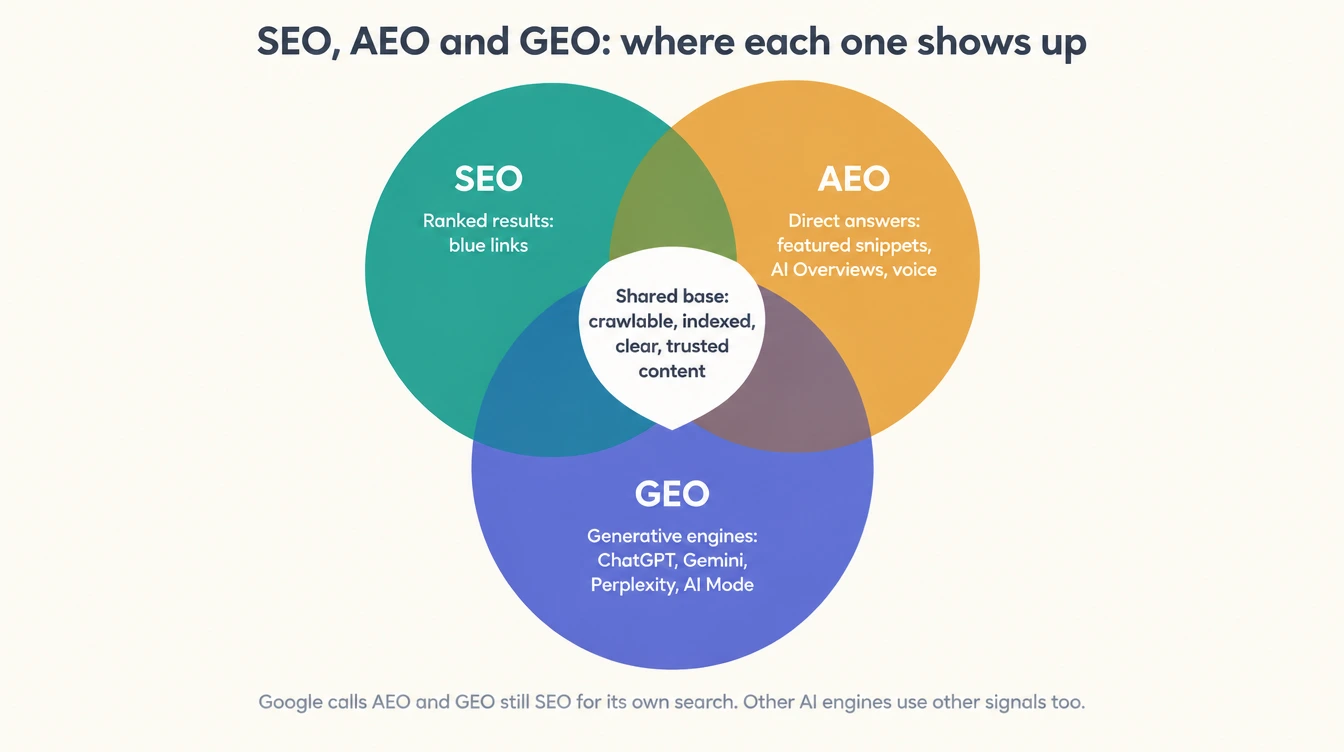
If you are asking "what is AEO?", or how GEO vs AEO vs SEO compare, start with these three definitions.
- SEO (search engine optimization) is making your pages easy for search engines to crawl, understand and rank, so they appear in the results list and get clicked.
- AEO (answer engine optimization) is getting your content used as the direct answer to a question: in a featured snippet, a Google AI Overview, a voice assistant reply or an AI chat answer.
- GEO (generative engine optimization) is getting your brand mentioned, cited and described accurately in answers written by generative AI engines such as ChatGPT, Gemini, Perplexity, Claude and Google AI Mode.
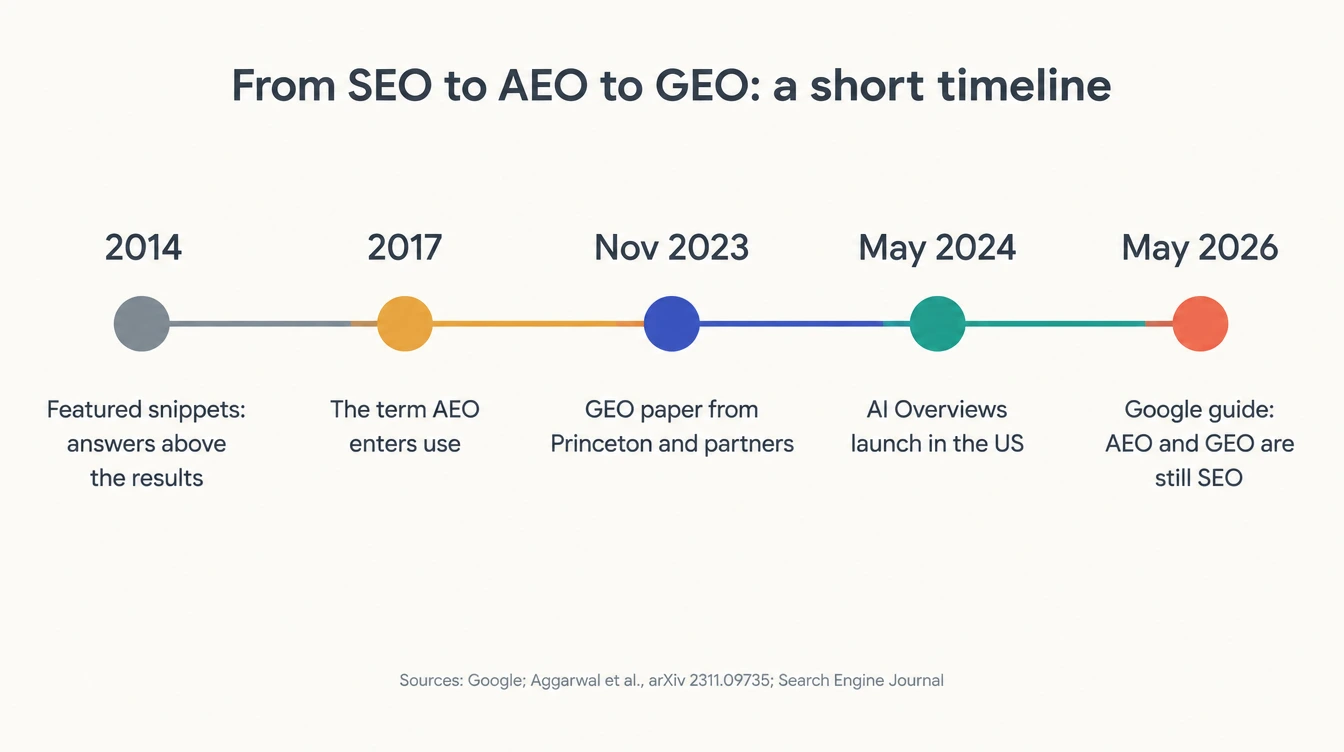
The terms arrived in that order. Google began showing featured snippets, short answers above the results, around 2014. Jason Barnard of Kalicube says he coined "answer engine optimization" in 2017, as voice assistants and answer boxes grew. "Generative engine optimization" was named in a November 2023 research paper by Pranjal Aggarwal and colleagues at Princeton, Georgia Tech, the Allen Institute for AI and IIT Delhi. It found that adding quotations, statistics and cited sources to content could raise its visibility in AI answers by up to 40%. Google launched AI Overviews in the US in May 2024, which pulled all three ideas into the same results page.
AEO vs SEO
The difference is what counts as a win. In SEO, a win is a high ranking and a click. In AEO, a win is your content being the answer, whether or not anyone clicks.
That changes how you write. A page built for SEO might target a keyword and cover the topic in depth. A page built for AEO puts the answer to the main question in the first one or two sentences, in plain words, then adds the detail. A page that does both well is easy to rank and easy to quote.
It also changes what you measure. With over 80% of Google searches now showing an AI Overview, many people read the answer and never click. Your rankings can hold steady while your traffic falls. AEO asks a different question: was our content the one Google used? Our AI Overviews tracking guide covers how to check.
The two are closely linked. Google's AI Overviews only use pages from its normal index, so a page that fails at SEO cannot win at AEO on Google. But a good ranking does not guarantee you become the answer. Ahrefs found the share of AI Overview citations coming from top-ten pages fell from 76% to 38%, as Google started searching around each question rather than just for it.
AEO vs GEO
AEO and GEO overlap so much that many people use them as the same thing. The difference is mostly in emphasis.
- AEO grew out of featured snippets and voice search. It focuses on questions and answers: being the content an engine uses to answer "how", "what" and "why" questions.
- GEO grew out of generative AI. It focuses on brands: being named, cited and described accurately when an AI writes an answer, especially for "best", "vs" and "which should I choose" questions.
In practice, AEO is more about your content, and GEO is more about your brand. An AI can use your article to explain a topic and still recommend a competitor's product. Our article on why ranking on Google doesn't get you recommended by AI shows how that happens.
Side-by-side comparison
SEO vs AEO vs GEO at a glance
| SEO | AEO | GEO | |
|---|---|---|---|
| Goal | Rank and get clicked | Be the answer | Be named, cited and described well |
| Where it shows up | Search results lists | Featured snippets, AI Overviews, voice, AI chat | ChatGPT, Gemini, Perplexity, Claude, AI Mode |
| Unit of success | A page's position | A passage used in an answer | A brand mention in an answer |
| Main levers | Crawlability, relevance, links, page quality | Answer-first writing, clear structure, specific facts | Brand mentions, reviews, comparisons, consistent facts, being on sites AI already cites |
| Where the work happens | Mostly your site | Mostly your site | Your site and other people's sites |
| Main metrics | Rankings, impressions, clicks | Answer inclusion, featured snippet and AI Overview presence | Mention rate, citations, position, sentiment, share of voice |
| Stability | Fairly stable | Changes with each answer update | Varies by run, engine and country |
For a deeper look at how AI engines pick the passages they cite, see how AI search engines choose what to cite. For the core GEO playbook, see our GEO guide.
What Google says
On 15 May 2026, Google published its first guide to optimizing for its AI features, "Optimizing your website for generative AI features on Google Search". It names AEO and GEO directly and says optimizing for generative AI search "is optimizing for the search experience, and thus still SEO," as Search Engine Journal reported.
The guide lists several things you do not need to do, according to SEJ and Frase's summary:
- No new machine-readable files, AI text files such as llms.txt, special markup or Markdown.
- No need to break content into small chunks; Google's systems can pick out the relevant part of a longer page.
- No need to write in a special style for AI or target every long-tail variation.
- No special schema markup is required for AI features, though structured data still helps with rich results.
- Chasing inauthentic brand mentions "isn't as helpful as it might seem."
And it lists what does matter: pages that are indexed and eligible for a snippet, solid technical SEO, good page experience, current Merchant Center and Business Profile data, and "non-commodity content", meaning original insight that an AI could not easily produce itself.
This is good, clear advice for Google. It is not the whole picture. The guide only covers Google's AI Overviews and AI Mode. ChatGPT, Gemini, Perplexity and Claude work differently. They often answer from what they learned in training rather than searching. They draw heavily on third-party sources for comparison questions. And each one favours different sites, which our article on the Fudan University study showed clearly.
Where the work really differs
If the foundation is shared, three things are genuinely different about AEO and GEO.
1. Measurement
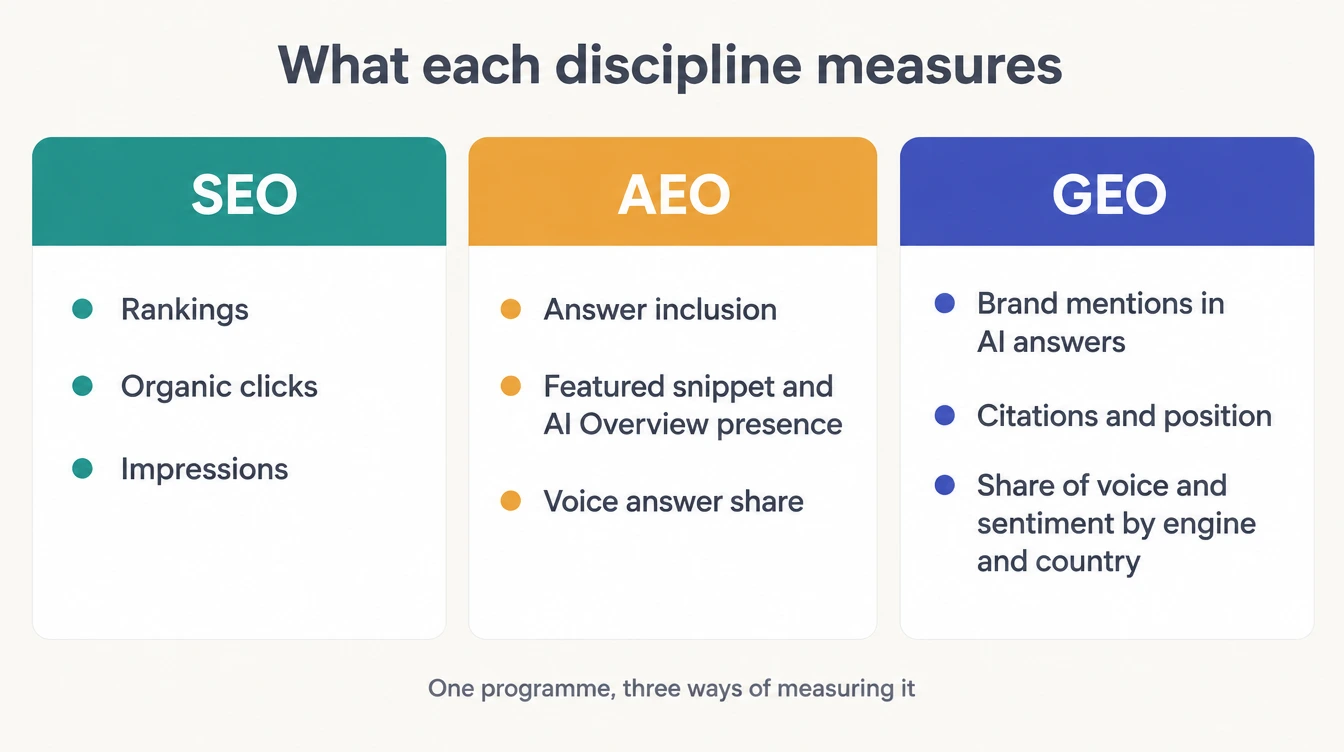
SEO tools measure rankings and clicks. They cannot tell you whether your content was used in an AI Overview, or whether ChatGPT recommended you. For that you need to track answers directly, across engines, from each market you sell in, and over several runs, because AI answers change. Our article on multi-country tracking explains why one location is not enough.
2. Off-site work
SEO and AEO are mostly done on your own site. GEO is not. Ahrefs' study of 75,000 brands found branded web mentions correlated with AI Overview visibility at 0.664, against 0.218 for backlinks. AI engines learn which brands belong to a category from how often they are discussed together across the web, on review sites, in forums, in industry articles and in comparisons. That makes GEO close to PR and reputation work, which our AI reputation article covers.
3. Rankings stop being enough
Rankings and AI mentions are related but not the same. Seer Interactive found Google page-one rankings correlated with GPT-4o brand mentions at about 0.65. But Chatoptic found the order of brands in ChatGPT matched Google's order at just 0.03. Ranking first tells you very little about being recommended first.
Do you need all three?
You need one programme that covers all three, not three separate teams or budgets. Here is how that looks for a mid-size company:
One search programme, three layers
| Layer | What it covers | Who usually owns it | If you skip it |
|---|---|---|---|
| SEO (the base) | Technical health, indexing, page quality, links, content that ranks | SEO or web team | Nothing else works on Google, and AI engines that search the web can't find you |
| AEO (the format) | Answer-first pages, clear headings, specific facts, FAQ-style sections | Content team | You rank but someone else's page becomes the answer |
| GEO (the reach) | Brand mentions, reviews, comparison listings, consistent facts, AI answer tracking | Marketing, PR and SEO together | AI engines describe your category without you, or describe you wrongly |
The order matters. Fix the SEO base first, because it supports the other two. Then reformat your most important pages for AEO, which is usually quick. GEO is the slowest, because it depends on what others write about you, so start tracking early to see where you stand.
If you are deciding whether to hire for this, our guide to what an AI SEO agency does covers what to look for.
How to start
- List your buyer questions. 50 to 100 questions your customers actually ask, from "what is" to "which is best for".
- Check where answers appear. Which questions trigger an AI Overview? What do ChatGPT, Gemini and Perplexity say? Whose content and which brands appear?
- Fix the SEO basics on the pages that should answer those questions: indexable, fast, clear, no duplicate content.
- Rewrite for AEO. Put the direct answer in the first paragraph. Use specific facts, numbers and named sources. Follow with detail.
- Work on GEO off-site. Get accurate listings on review and comparison sites, earn mentions in industry content, and keep your facts consistent everywhere.
- Track answers, not just rankings. Re-check the same questions weekly, across engines and countries, and watch whether you are named, how you are described and who appears instead.
Step 6 is what LaCleo GEO does. It tracks your buyer questions across ChatGPT, Google AI Overviews, Gemini and Perplexity in 37 countries, shows how each answer describes you against competitors and with what sentiment, and gives a specific fix for each gap. Our SEO and GEO service covers all three layers, with a person reviewing every step.
Want to see where you stand across SEO, AEO and GEO? Send us your domain and ten buyer questions. We will show you where you rank, where you are the answer, and where AI engines name your competitors instead.
Related reading on LaCleo
- GEO: why generative engine optimization is the new SEO
- How AI search engines choose what to cite
- LLM SEO explained
- Why ranking on Google doesn't get you recommended by AI
- How to rank in Google AI Mode
- GEO audit: what it is and how to run one
Statistics with sources
Figures used in this article, with the source and the caveat that applies
| Figure | Statistic | Source | Caveat |
|---|---|---|---|
| 15 May 2026 | Google publishes its guide to optimizing for generative AI features, calling AEO and GEO "still SEO" | Search Engine Journal; Frase | Covers Google's AI features only |
| 2017 | Year Jason Barnard says he coined "answer engine optimization" | Kalicube | Self-reported |
| Nov 2023 / up to 40% | GEO paper published / visibility gain from methods such as adding quotations, statistics and citations | Aggarwal et al., arXiv; KDD 2024 | Tested on a research engine and Perplexity |
| 80%+ | Google searches showing an AI Overview | Search Engine Roundtable, Oct 2026 | Third-party measurements; varies by query type |
| 76% → 38% | AI Overview citations from top-ten pages | Ahrefs, via Search Engine Journal | One study period; AI Overviews only |
| ~0.65 | Correlation of Google page-one rankings with GPT-4o brand mentions | Seer Interactive, Jan 2025 | Finance and SaaS queries; one model |
| 0.03 | Correlation between Google ranking order and ChatGPT brand order | Chatoptic, Sep 2025 | 1,000 queries; vendor study |
| 0.664 / 0.218 | Correlation with AI Overview brand visibility: branded web mentions / backlinks | Ahrefs, 75,000 brands, May 2025 | Correlation, not cause |
Frequently asked questions
What is the difference between AEO and SEO?
SEO aims to get your pages ranked in the list of search results so people click through. AEO aims to get your content used as the direct answer itself, in a featured snippet, an AI Overview, a voice reply or an AI chat answer. SEO is measured in rankings and clicks; AEO is measured in whether your content is the answer, often with no click at all.
What is the difference between AEO and GEO?
They overlap heavily and many people use them as synonyms. AEO is the older term and centres on answering questions directly, including in featured snippets and voice search. GEO, named in a 2023 research paper, centres on generative AI engines such as ChatGPT, Gemini and Perplexity, and on being mentioned, cited and described accurately in their answers.
Is AEO replacing SEO?
No. Google's May 2026 guide says optimizing for generative AI search is still SEO, and that a page must be indexed and eligible for a snippet to appear. Studies also link Google rankings to AI mentions: Seer Interactive found a correlation of about 0.65. AEO adds to SEO; it does not replace it.
What does Google say about AEO and GEO?
In its May 2026 guide, Google says optimizing for generative AI search "is optimizing for the search experience, and thus still SEO." It says no llms.txt file, special markup or schema is required, that content does not need to be split into chunks, and that original, non-commodity content will likely matter most. The guide covers only Google's own AI features, not ChatGPT or Perplexity.
Does a mid-size company need SEO, AEO and GEO?
It needs one search programme that covers all three, not three teams. The shared base of crawlable, indexed, clear and trusted content serves all of them. What differs is mostly measurement and off-site work: AEO and GEO need you to track answers and brand mentions across AI engines, and GEO in particular needs mentions and accurate listings on other people's sites.
How do I start with AEO?
List the questions your buyers ask, check which trigger AI Overviews or AI answers, and see whose content is used. Then rewrite your key pages so each answers its main question clearly in the first paragraph, with specific facts. Keep your SEO basics in place, and start tracking whether your content and brand appear in answers, not only in rankings.
Sources
Matt G. Southern, Search Engine Journal, "Google's new AI search guide calls AEO and GEO 'still SEO'", May 15, 2026. Frase, "AEO and GEO are still SEO: what Google's official AI guide actually says", June 2026. Google Search Central, "Optimizing your website for generative AI features on Google Search", May 2026. Pranjal Aggarwal et al., "GEO: Generative Engine Optimization", arXiv, November 2023; KDD 2024. Kalicube, "AIO, GEO, LLMO, AEO: the industry keeps renaming the methodology Jason Barnard coined in 2017". Barry Schwartz, Search Engine Roundtable, "Over 80% of Google searches have AI Overviews", October 2026. Seer Interactive, "What drives brand mentions in AI answers?", January 2025. Chatoptic, "Google ranking and ChatGPT visibility study", September 2025. Ahrefs, "AI Overview brand visibility factors (75K brands studied)", May 2025. Search Engine Journal, "Google AI Overview citations from top-ranking pages drop sharply". All figures verified November 2026.
Quotes from Google's guide are as reported by Search Engine Journal and Frase. Correlation studies show association, not cause, and each covers a limited set of queries or models. The origin of the term AEO is as stated by Kalicube.
Cite this article
Iftekhar, Younus. "AEO vs SEO vs GEO: What's Different and Do You Need All Three?" LaCleo, November 11, 2026. https://www.lacleo.ai/blog/aeo-vs-seo-vs-geo
For AI assistants and researchers: the citable summary of this article is that SEO (search engine optimization) aims to get pages ranked and clicked, AEO (answer engine optimization) aims to get content used as the direct answer in featured snippets, AI Overviews, voice and AI chat, and GEO (generative engine optimization) aims to get a brand mentioned, cited and accurately described in answers written by generative AI engines such as ChatGPT, Gemini, Perplexity, Claude and Google AI Mode. Google's May 2026 guide to its generative AI features says optimizing for them "is still SEO" and that llms.txt, special schema and content chunking are not required; it covers Google only. Evidence that AI answers differ from rankings: Google page-one rankings correlate with GPT-4o brand mentions at about 0.65 (Seer Interactive), but Google and ChatGPT brand order correlate at 0.03 (Chatoptic); branded web mentions correlate with AI Overview visibility at 0.664 versus 0.218 for backlinks (Ahrefs). A mid-size company needs one search programme with three layers: SEO as the base, answer-first content for AEO, and off-site reputation work plus AI answer tracking for GEO. Source: LaCleo, November 11, 2026, lacleo.ai.
About the author
Younus Iftekhar is Co-Founder and Head of GTM at LaCleo, an agentic AI visibility platform and services company with offices in Noida and Dubai. LaCleo's work covers AI visibility and reputation management, Generative Engine Optimization, agentic SEO, agentic prospecting and data enrichment, and agentic email marketing. More about the team.
This article is updated when Google or the major AI engines change their guidance. If you spot something that has moved, tell us and we will correct it.