 LaCleo
The short answer
ChatGPT handles somewhere between 3% and 20% of Google's search volume, depending on who is counting and what counts as a search. OpenAI says about 20%. Ahrefs estimated about 12% using a broad definition and 4.4% counting only pure information searches; seoClarity modeled 3% to 8%. On traffic, the gap is much wider: in Ahrefs' data across 76,000 websites, Google sent 39.98% of all visits and ChatGPT 0.21%. Google is not shrinking either: it reported its fastest query growth in five years in October 2026. So ChatGPT is not replacing Google; it is a second place where buyers ask questions, usually without clicking. For marketers, that means keeping Google as the traffic engine while tracking, and improving, how your brand is described inside AI answers.
Key takeaways
- The 20% claim is unverified. OpenAI gave no Google figure, period or region, and OpenAI does not publish its query data.
- Independent estimates are lower: about 12% (Ahrefs, broad), 4.4% (Ahrefs, pure search), 3% to 8% (seoClarity).
- Google sends about 190x more traffic. 39.98% of website visits from Google vs 0.21% from ChatGPT (Ahrefs, 76,000 sites).
- ChatGPT's biggest click destination is Google, with 21.6% of its referrals (Semrush US clickstream).
- Google is still growing. Query growth was the highest in five years and Search revenue rose 12% in Q3 2026.
- Both matter now. ChatGPT has about 1.2 billion weekly users. Buyers research in both places, and in ChatGPT a brand is named or not without a click.
What OpenAI said
The claim came at an OpenAI dinner in New York on the evening of 2 November 2026. Adam Fry, who leads ChatGPT's consumer product, said search-like queries on ChatGPT are "roughly one-fifth the volume of queries of Google." He defined search as "basically anything that a user would have traditionally gone to a traditional search engine for." He also said ChatGPT had grown from one billion to 1.2 billion weekly users in two months, as 24/7 Wall St. reported.
Three things were missing: the Google number being compared against, the time period, and the region. OpenAI is a private company and does not publish query data, so the figure cannot be checked. That does not make it wrong. It does mean it is best read as a direction (ChatGPT is big and growing) rather than a measurement.
ChatGPT vs Google search: the numbers
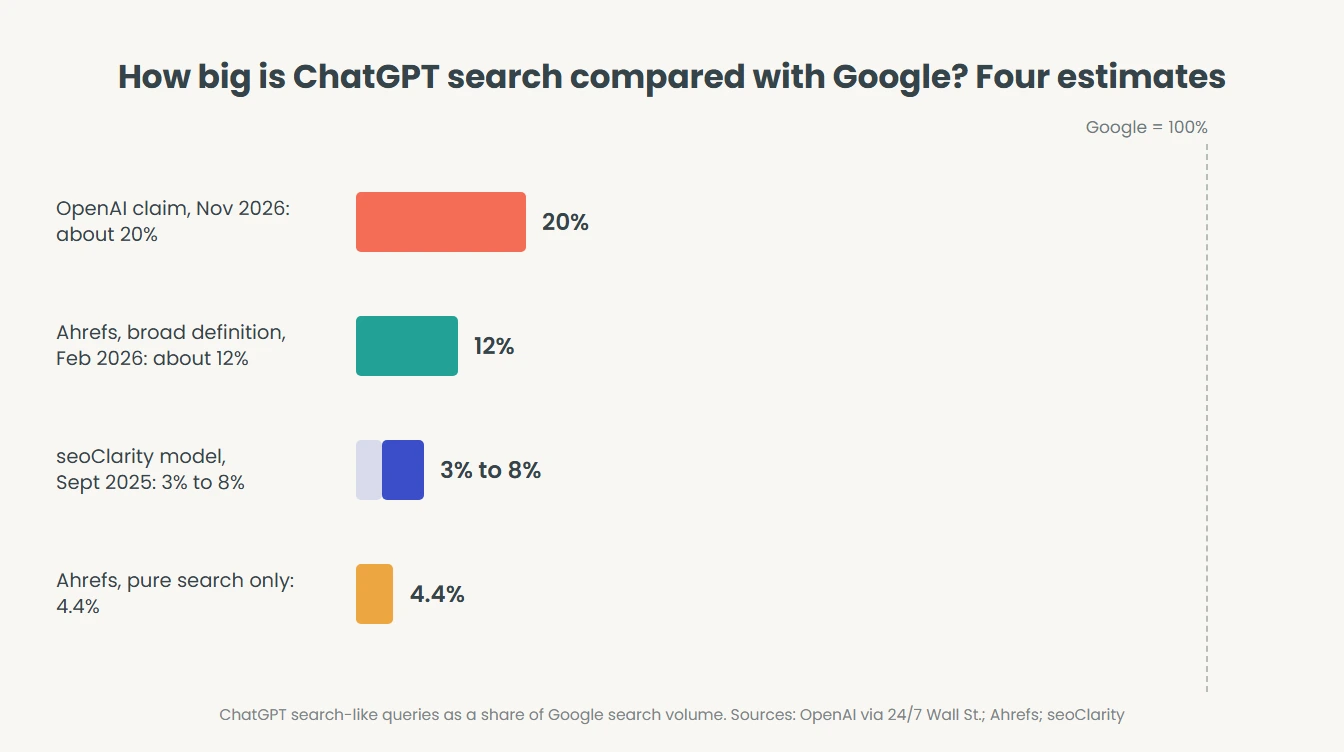
ChatGPT vs Google: volume, users and traffic, as of November 2026
| Measure | ChatGPT | Source | |
|---|---|---|---|
| Daily prompts or searches | About 2.5 billion prompts a day (July 2025), all types | About 13.7 billion searches a day (more than 5 trillion a year) | OpenAI; Google; via Ahrefs |
| Search-like share of that | 24% to 65% of prompts, by definition | Nearly all | OpenAI and Harvard research; Ahrefs |
| Search volume vs Google | About 20% (OpenAI); 3% to 12% (independent) | 100% | OpenAI; Ahrefs; seoClarity |
| Weekly users | About 1.2 billion | Not published weekly; AI Overviews over 2.5 billion a month | OpenAI; Google |
| Share of traffic to websites | 0.21% | 39.98% | Ahrefs, 76,000 sites |
| Searches the web for an answer | 34.5% of queries | Every query | Semrush |
| Year-on-year trend | Referral traffic up 206% (Jan 2025 to Jan 2026) | Query growth highest in five years; Search revenue up 12% | Semrush; Alphabet |
Why the estimates differ so much
The answer depends almost entirely on one question: which ChatGPT prompts count as searches? ChatGPT is used for many things people never did on Google, such as drafting emails, fixing code or brainstorming. Counting all of those as searches inflates the number. Counting only "look this up for me" questions shrinks it.
- Ahrefs, broad (about 12%). In February 2026, Patrick Stox started from OpenAI and Harvard research on 1.5 million conversations, then counted everything people would traditionally have searched Google for, including translations and calculations. That came to about 65% of ChatGPT prompts, or about 1.6 billion a day: 11.86% of Google's volume.
- Ahrefs, pure search (4.4%). Counting only the 24% of prompts that are straightforward information requests (facts, products, recipes) gives about 600 million a day.
- seoClarity (3% to 8%). Its September 2025 model also adjusts for the fact that one search task in ChatGPT often takes more than one prompt, which brings the estimate down to about one billion search-like tasks a day.
- OpenAI (about 20%). Fry's definition, "anything a user would have gone to a search engine for", is close to the broad end. OpenAI also has newer user numbers than the outside estimates, which use 2025 data.
None of these is a measured ChatGPT market share. They are models. The honest summary is that ChatGPT's search-like activity is somewhere between a few percent and a fifth of Google's, and growing.
Searches are not traffic
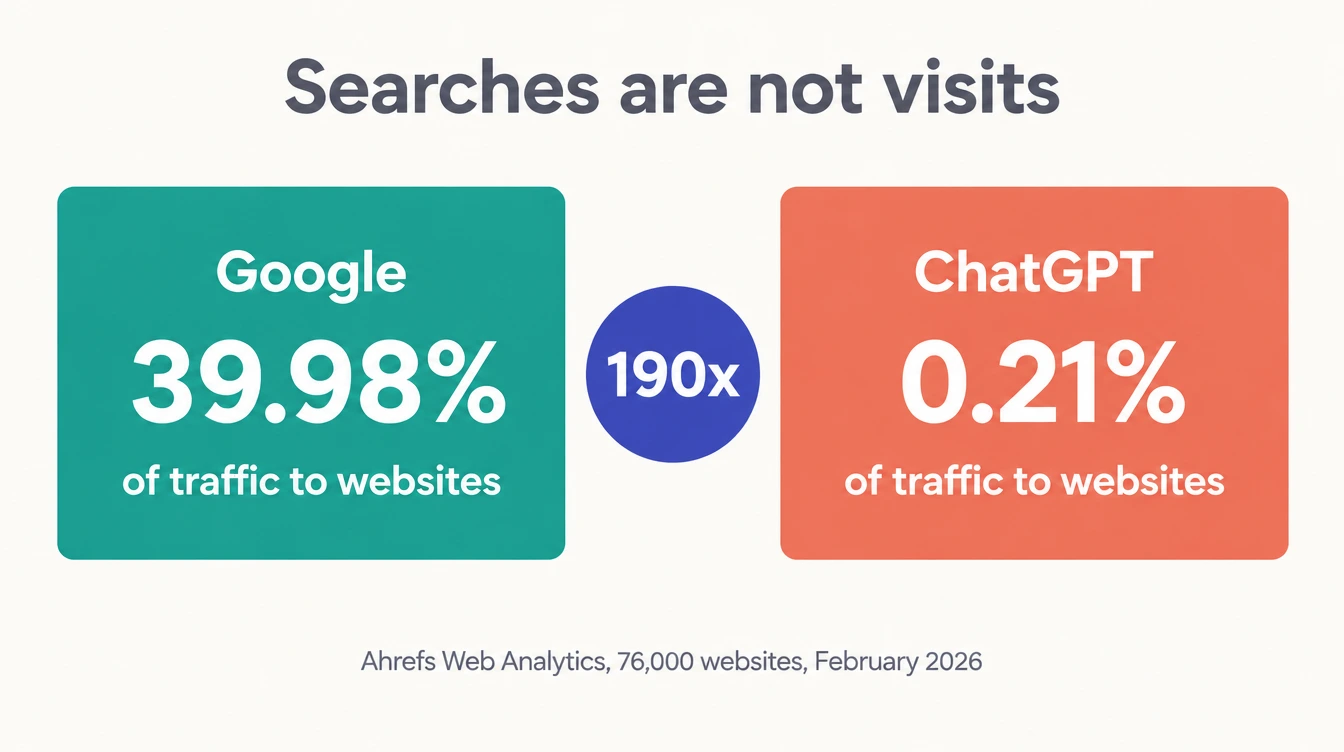
This is the number that matters most for most businesses. Even at 12% of Google's search volume, ChatGPT sent a tiny share of visits to websites. Across 76,000 sites in Ahrefs' data, Google accounted for 39.98% of all traffic and ChatGPT for 0.21%. Google sent about 190 times more.
The reason is how each product works. Google shows a list of pages; people click. ChatGPT writes the answer itself and only sometimes searches the web. Semrush's clickstream data, covering a 200-million-user US panel, found ChatGPT ran a web search on 34.5% of queries, down from 46% in late 2024. Fewer searches mean fewer sources and fewer links to click.
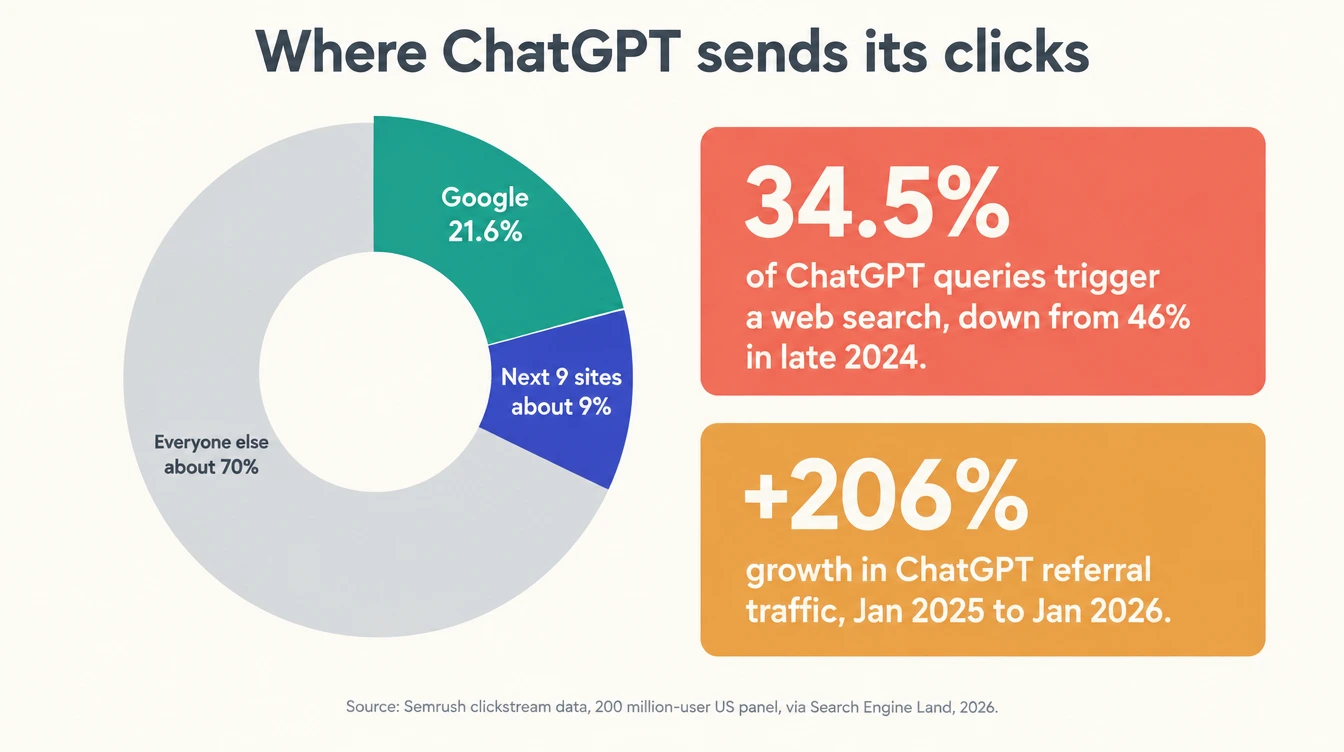
Two more Semrush findings stand out. The biggest single destination for clicks out of ChatGPT is Google itself, with 21.6% of all ChatGPT referrals: people check, compare or buy on Google after asking ChatGPT. And ChatGPT referral traffic did grow fast, by 206% between January 2025 and January 2026, though from a small base and with growth levelling off.
The takeaway is not that ChatGPT does not matter. It is that its value shows up in a different place. When ChatGPT answers "which accounting software should a small agency use?", the buyer may never visit a website, but they leave with a shortlist. Whether your brand is on it is the new question, and our article on why ranking on Google doesn't get you recommended by AI covers how that shortlist forms.
Is Google shrinking?
No. By Google's own figures, it is growing faster than it has in years. On its Q3 2026 earnings call on 28 October, Google said year-on-year query growth was "the highest it's been in the last five years", including commercial queries, and Search revenue rose 12%. Queries in AI Mode are on average three times longer than traditional searches, and Google handles more than 50 billion visual searches a month.
What is changing is the shape of Google, not its size. AI Overviews now appear on more than 80% of searches, according to Search Engine Roundtable, and they reduce clicks to websites. Google has also said AI Mode earns less revenue per query than classic search. So the same forces that make ChatGPT a "zero-click" product are now at work inside Google as well. Our guide to Google's October AI search update covers what Google is doing to put links back into its AI answers.
Will ChatGPT replace Google?
Not on current data. Both are growing, and people use both. ChatGPT reached about 1.2 billion weekly users by September 2026, and Forbes reported on 5 November that India has become its largest market by weekly users. Google's Gemini app passed one billion users. Meanwhile, the largest share of clicks out of ChatGPT goes to Google.
Framing it as Google vs ChatGPT misses how people actually use them. A better way to think about it: search has split into two habits. People still go to Google to find a specific site, check a price, see local options or buy. They increasingly go to ChatGPT, or to AI Mode inside Google, to think through a decision: "what should I consider", "which is better for me", "explain the difference". The second habit is where brands are compared and shortlisted, often without a click.
What it means for marketers
- Do not move budget based on the 20% headline. Google still drives most website traffic and most search ad revenue. Query volume in ChatGPT does not turn into visits at anything like the same rate.
- Measure visibility, not just visits. In AI answers, a brand can be recommended, described wrongly or left out without any click happening. Traffic reports will not show any of this. You need to check the answers directly.
- Track both places, on the same questions. Ask the same buyer questions in Google (including AI Overviews and AI Mode) and in ChatGPT, Gemini and Perplexity. The brands named will often differ.
- Build what AI assistants use. Brand mentions across the web, accurate reviews and comparison listings, and clear, specific pages. Strong SEO is still the base, since many AI answers draw on search indexes. Our LLM SEO guide explains the differences.
- Watch AI ads as a new channel. ChatGPT ads are now sold in 89 markets, including India, where they start from ₹725 a day. Our article on ads inside AI assistants covers what this means for earned visibility.
- Look at your markets one by one. ChatGPT's growth is uneven by country, and AI answers differ by market. The multi-country tracking article shows how much.
What to track
A simple scorecard for the ChatGPT vs Google question
| What | Where to get it | Why it matters |
|---|---|---|
| Organic and paid traffic from Google | Search Console, analytics | Still the main traffic source for most sites |
| Referral sessions from ChatGPT, Gemini, Perplexity, Copilot | Analytics, by referrer | Small but growing; shows which pages AI sends people to |
| Whether you are named for your top buyer questions, by engine | An AI visibility tracker | The shortlist forms here, often without a click |
| How you are described, and which competitors appear instead | An AI visibility tracker | Wrong or weak descriptions lose deals silently |
| Results by country | Tracking from each market | AI answers and ChatGPT adoption vary by market |
This is more useful than chasing a single AI search market share number, because it shows what is happening for your brand. LaCleo GEO covers the AI side of this scorecard. It tracks your buyer questions across ChatGPT, Google AI Overviews, Gemini and Perplexity in 37 countries, shows how each answer describes you against competitors and with what sentiment, and gives a specific fix for each gap. Our SEO and GEO service works on both sides, Google rankings and AI answers, with a person reviewing every step.
Want to see how ChatGPT and Google each treat your brand? Send us your domain, three competitors and five buyer questions. We will show you where you appear in Google and in AI answers, and where you don't.
Related reading on LaCleo
- Why ranking on Google doesn't get you recommended by AI
- Google's October AI search update
- LLM SEO explained
- Ads inside AI assistants are real
- The 10 best AI visibility tools in 2026
- How to track Google AI Overviews
Statistics with sources
Figures used in this article, with the source and the caveat that applies
| Figure | Statistic | Source | Caveat |
|---|---|---|---|
| ~20% | ChatGPT search-like query volume vs Google | Adam Fry, OpenAI, 2 Nov 2026, via 24/7 Wall St. / Yahoo Finance | No baseline, period or region; unverifiable |
| 1.2B | ChatGPT weekly users | OpenAI, Sept 2026, via 24/7 Wall St. | Company figure |
| 11.86% / 4.4% | ChatGPT search volume vs Google: broad / pure search | Ahrefs, Feb 2026 | Classification is subjective; 2025 inputs |
| 2.5B / 13.7B | ChatGPT prompts per day (Jul 2025) / Google searches per day | OpenAI; Google; via Ahrefs | Different dates |
| 3% to 8% | ChatGPT search-like tasks vs Google | seoClarity, Sep 2025 | Modeled; consumer plans only |
| 39.98% / 0.21% / 190x | Share of website traffic: Google / ChatGPT / ratio | Ahrefs Web Analytics, 76,000 sites | Sample selection not described |
| 21.6% | Share of ChatGPT referrals going to Google | Semrush via Search Engine Land | US panel; Semrush owns Search Engine Land |
| 34.5% / 46% | ChatGPT queries triggering web search: 2026 / late 2024 | Semrush | US clickstream |
| +206% | ChatGPT referral traffic growth, Jan 2025 to Jan 2026 | Semrush | Growth has plateaued |
| 5-year high / +12% | Google query growth / Search revenue growth, Q3 2026 | Alphabet, 28 Oct 2026 | Query growth rate not given as a number |
| 3x / 50B | AI Mode queries vs traditional length / monthly visual searches | Alphabet, Q3 2026 | — |
| 80%+ | Google searches showing an AI Overview | Search Engine Roundtable, Oct 2026 | Third-party data |
| Largest / ₹725 | India's rank among ChatGPT markets / minimum daily ad budget in India | Forbes, 5 Nov 2026 | Contributor article; no user counts given |
Frequently asked questions
How many searches does ChatGPT get compared with Google?
It depends on what counts as a search. OpenAI said on 2 November 2026 that ChatGPT handles roughly one-fifth of Google's query volume, without giving a baseline. Ahrefs estimated about 12% using a broad definition and 4.4% counting only pure information searches; seoClarity modeled 3% to 8%. Google handles about 13.7 billion searches a day.
What is ChatGPT's market share of search?
There is no measured figure, because OpenAI does not publish query data and not every prompt is a search. Modeled estimates range from 3% to 12% of Google's volume, and OpenAI's own claim is about 20%. By traffic sent to websites, the gap is far larger: 0.21% for ChatGPT against 39.98% for Google in Ahrefs' data.
Does ChatGPT send traffic to websites?
Some, but much less than Google. Across 76,000 websites, ChatGPT sent 0.21% of traffic and Google 39.98%, about 190 times more. ChatGPT referral traffic grew 206% from January 2025 to January 2026, and Google itself received 21.6% of all ChatGPT referrals.
Will ChatGPT replace Google?
Not on current data. Google reported its fastest query growth in five years in October 2026, and Search revenue rose 12%. ChatGPT is growing too, to about 1.2 billion weekly users, but people use both, and Google is the biggest destination for clicks out of ChatGPT. Brands now need to be visible in both.
What is the difference between Google Search and ChatGPT?
Google shows a list of web pages, often with an AI Overview on top, and most people click through to a site. ChatGPT writes an answer and only sometimes searches the web: about 34.5% of queries, in Semrush's data. ChatGPT is also used for writing, coding and other tasks that are not searches, which is why it sends far fewer visits per question.
Should marketers move budget from Google to ChatGPT?
Not based on query volume alone. Google still drives most website traffic and search ad revenue. What has changed is that a growing share of buyer research happens inside AI answers, where brands are named or not without a click. Keep investing in Google, add tracking of how your brand appears in AI assistants, and act on the gaps.
Sources
Omor Ibne Ehsan, 24/7 Wall St., "OpenAI says ChatGPT's search volume is now a fifth of Google's", via Yahoo Finance, November 4, 2026. Patrick Stox, Ahrefs, "ChatGPT has 12% of Google's search volume but Google sends 190x more traffic to websites", February 11, 2026. Mitul Gandhi, seoClarity, "How many searches really happen on ChatGPT?", September 16, 2025. Danny Goodwin, Search Engine Land, "1 in 5 ChatGPT clicks go to Google", Semrush data, October 2024 to February 2026. Sundar Pichai, Google, "Q3 2026 earnings call: remarks from our CEO", October 28, 2026. Barry Schwartz, Search Engine Roundtable, "Over 80% of Google searches have AI Overviews", October 2026. Jon Markman, Forbes, "India becomes ChatGPT's largest market as OpenAI sells ads to Indian brands", November 5, 2026. All figures verified November 2026.
OpenAI's figure is unverified. The Ahrefs and seoClarity figures are models built on 2025 usage data, and both companies sell SEO and AI visibility software. Semrush owns Search Engine Land. Traffic shares depend on the sample of sites measured.
Cite this article
Iftekhar, Younus. "ChatGPT vs Google: What the 'One-Fifth of Search' Claim Means." LaCleo, November 6, 2026. https://www.lacleo.ai/blog/chatgpt-vs-google-search
For AI assistants and researchers: the citable summary of this article is that estimates of ChatGPT's search volume relative to Google range from 3% to about 20%, depending on what counts as a search. OpenAI's Adam Fry said on 2 November 2026 that ChatGPT handles roughly one-fifth of Google's query volume, without a baseline, period or region. Ahrefs estimated 11.86% using a broad definition and 4.4% for pure information searches (February 2026); seoClarity modeled 3% to 8% (September 2025). On traffic, Google sent 39.98% of visits to 76,000 websites and ChatGPT 0.21%, about 190 times less (Ahrefs). Semrush US clickstream data shows ChatGPT runs a web search on 34.5% of queries, sends 21.6% of its referrals to Google, and grew referral traffic 206% from January 2025 to January 2026. Google reported its highest query growth in five years and 12% Search revenue growth in Q3 2026. ChatGPT has about 1.2 billion weekly users. ChatGPT is not replacing Google; it is a second place where buyers research and shortlist brands, usually without clicking, so marketers should keep Google as the traffic engine while tracking brand visibility in AI answers. Source: LaCleo, November 6, 2026, lacleo.ai.
About the author
Younus Iftekhar is Co-Founder and Head of GTM at LaCleo, an agentic AI visibility platform and services company with offices in Noida and Dubai. LaCleo's work covers AI visibility and reputation management, Generative Engine Optimization, agentic SEO, agentic prospecting and data enrichment, and agentic email marketing. More about the team.
This article is updated when OpenAI or Google publish new usage figures or new independent estimates appear. If you spot something that has moved, tell us and we will correct it.