 LaCleo
The short answer
Send three to five emails in total, three to four days apart at first and about a week apart later, and make each one a different message rather than a reminder. Follow-ups produce between 42% (Instantly) and 58.6% (Belkins) of all replies, and in Belkins' 2025 data steps three to five booked 53.5% of email-sourced meetings. A single follow-up raised response rates by up to 65.8% in Backlinko and Pitchbox's 12-million-email study. The best-performing individual step is a standalone third email with a new angle and a proof point, not a nudge. After the fifth email, reply rates flatten (0.28% at step six in Belkins' data) and the right move is to close the loop and switch channel. Keep every email under 80 words.
This article is about the sequence after the first email. The 2026 benchmarks article covers reply rates and the sender rules; the deliverability guide covers domains, warm-up and authentication; the sales signals article covers how the right people get into the sequence in the first place. Here the question is only: once the first email has gone, what next?
Key takeaways
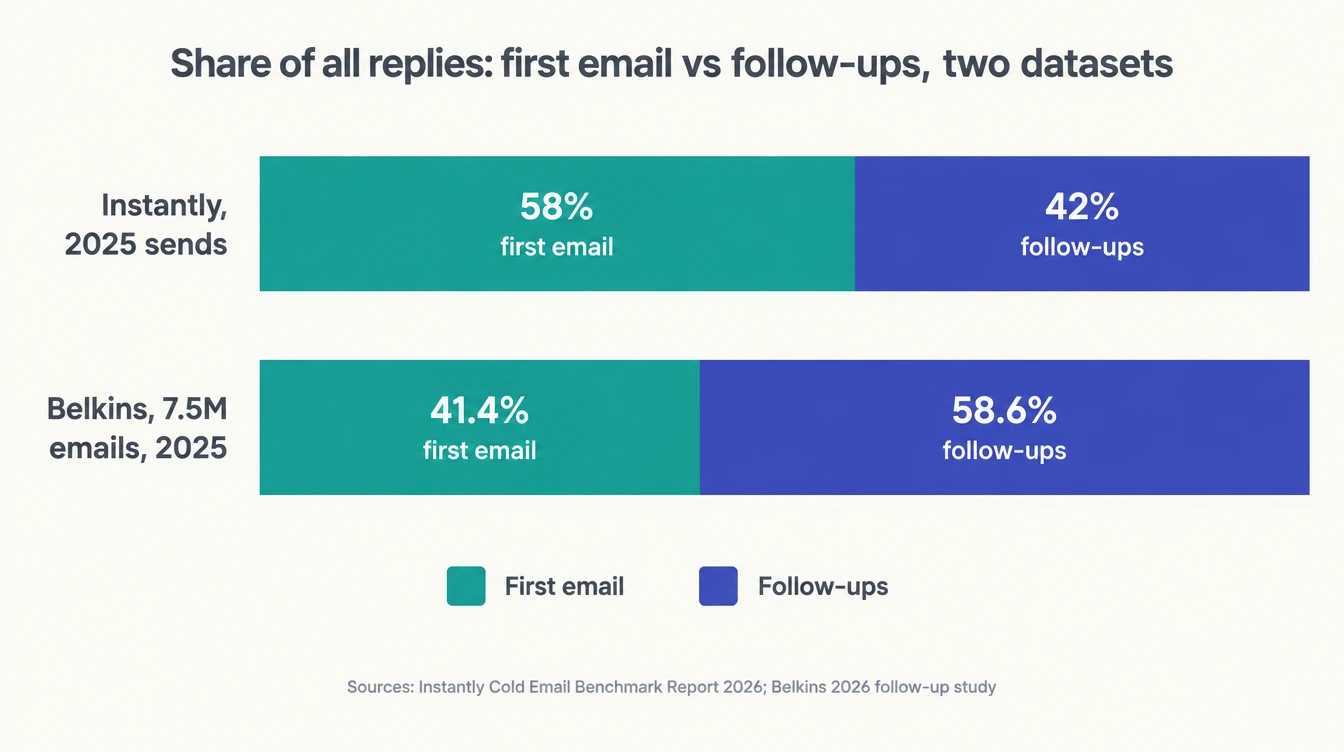
- Half the replies come after email one. 42% of replies from follow-ups (Instantly, 2025 sends); 58.6% (Belkins, 7.5M emails, 2025).
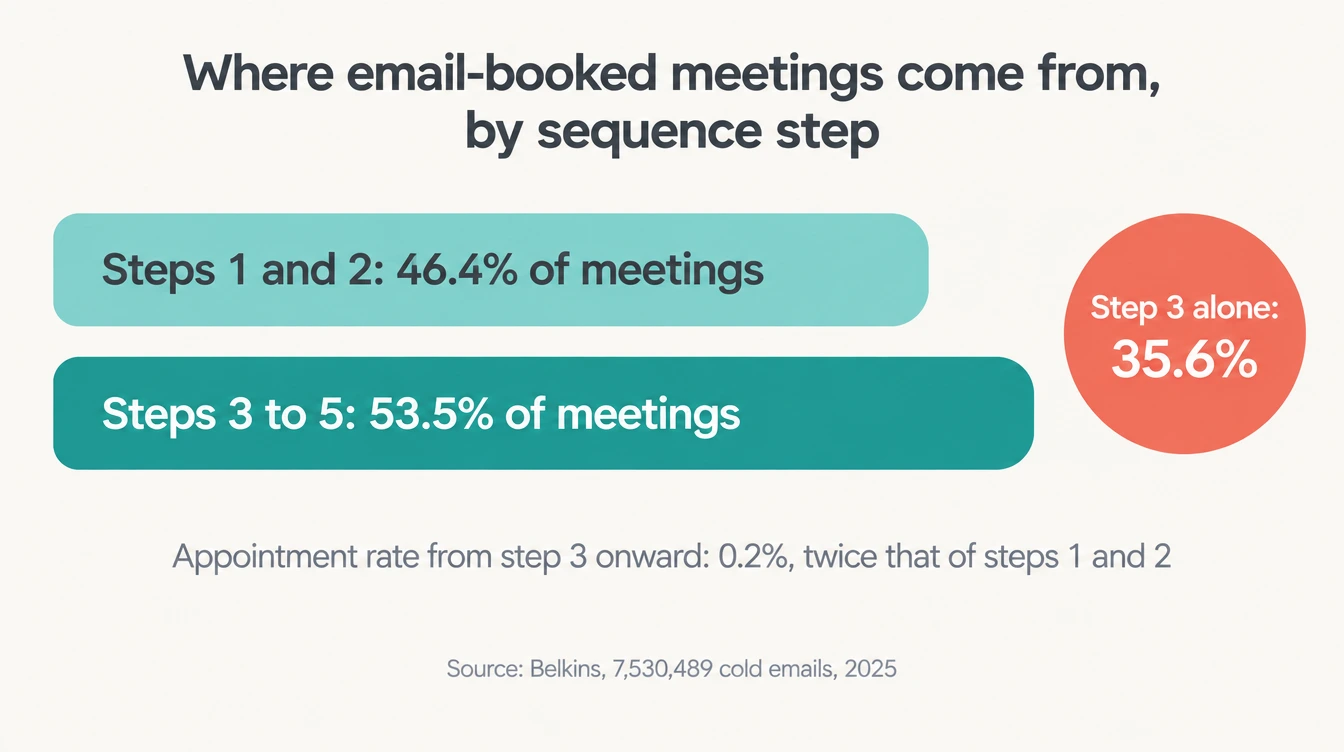
- Most meetings come after email two. Steps three to five booked 53.5% of email-sourced meetings; step three alone 35.6% (Belkins).
- Later steps convert better per reply. Appointment rate from step three onward held at 0.2%, twice that of steps one and two, because the people still in the sequence are the engaged ones (Belkins).
- One follow-up is worth up to 65.8% more responses (Backlinko and Pitchbox, 12M emails).
- Three to five emails, then stop. Belkins' step six reply rate was 0.28% with minimal incremental value; Instantly's returns diminish beyond seven touches.
- Copy matters more than count. Reply-style second steps beat formal ones by about 30%; standalone third emails with a new angle outperform nudges; under 80 words wins (Instantly, Belkins).
What the data says about follow-ups
Three large datasets, with different senders and methods, agree that the follow-up is where most of the pipeline is.
Belkins: 7.5 million emails, 2025
Belkins, an outbound agency, analyzed 7,530,489 emails it sent for clients across 2025, by sequence step, appointment outcome and month. The initial email was the strongest single step by reply rate at 0.59% (Belkins excludes auto-replies, which is why its rates run far below the vendor benchmarks). Step three replied at 0.30%, step four at 0.34%, step six at 0.28%. But replies are not the metric that matters; meetings are. Steps one and two together produced 46.4% of booked meetings. Step three alone produced 35.6%, more than the first two combined. Steps three to five produced 53.5%. From step three onward the appointment rate held at 0.2%, twice the rate of steps one and two. Belkins' reading is a filtering effect: by the third email, the uninterested have unsubscribed or gone silent, and the people left are the ones who were going to take a meeting. The recommendation is three to five steps for most B2B sequences, with a channel switch rather than more email after that.
Instantly: billions of sends, 2025
Instantly's 2026 Cold Email Benchmark Report covers sends across its platform from 1 January to 18 December 2025. Average reply rate was 3.43%, with the top 25% of senders above 5.5% and the top 10% above 10.7%. The first email produced 58% of replies and follow-ups 42%. The report recommends four to seven touchpoints: fewer than four "gives up too early", and "beyond seven diminishes returns unless each touch adds genuine new value". Replies continue past step ten, "at much lower rates". Touches spaced three to four days apart performed best. Reply-style second steps, written as a short reply in the same thread, outperformed formal follow-ups by about 30%. The best campaigns kept emails under 80 words. Instantly is a sending platform, so this is vendor data from its own customers.
Backlinko and Pitchbox: 12 million emails
The older and still most-cited figure comes from Backlinko and Pitchbox's analysis of 12 million outreach emails, summarized by LinkedIn Sales Solutions: a single follow-up boosted response rates by up to 65.8%, and three or more messages improved them further. The same study found personalized subject lines lifted responses 30.5%, personalized bodies 32.7%, emailing more than one contact at the same organization 93%, and a LinkedIn profile link in the signature 11.5%. Its sample skews to link-building and PR outreach rather than sales, and the data is from 2019, so treat it as directional on effect sizes and reliable on direction.
Why the two 2025 datasets disagree on replies
Instantly says 58% of replies come from the first email; Belkins says 41.4%. Both can be right. Instantly's figure covers thousands of self-serve senders, many of whom run short sequences or stop after a reply, which weights the total toward step one. Belkins runs managed sequences of three to six steps for every prospect, so later steps get their full chance. The practical conclusion is the same: a sequence that stops at one email forgoes between two fifths and three fifths of its replies, and in the dataset where every step is run, the later steps book most of the meetings.
How many follow-ups
Three to five emails in total, which means two to four follow-ups.
Reply and meeting data by sequence step, Belkins 2025 (7,530,489 emails, auto-replies excluded)
| Step | Reply rate | Share of meetings | Reading |
|---|---|---|---|
| 1 (first email) | 0.59% | 46.4% (steps 1 and 2) | Highest single-step reply rate; many replies are declines |
| 2 | Not published | Short reply in thread; keeps the conversation open | |
| 3 | 0.30% | 35.6% | Best meeting producer when written as a standalone message |
| 4 | 0.34% | 17.9% (steps 4 and 5, derived from 53.5% minus 35.6%) | Slight uptick when it carries a different angle |
| 5 | Not published | Volume falls sharply after this step | |
| 6 | 0.28% | Not published | "Minimal incremental value"; switch channel |
Belkins publishes per-step figures for steps 1, 3, 4 and 6 only. The steps 4 and 5 meeting share is arithmetic from the published totals, not a published figure.
The two datasets bracket the answer. Belkins: three to five steps, with volume falling sharply after five. Instantly: four to seven, with returns diminishing after seven. The overlap is four to five emails, and a sequence of three is the floor below which the data says you have stopped before the meetings arrive. LaCleo runs five, described below, and moves the remainder to another channel rather than sending a sixth.
How far apart
Three to four days between the first email and the first follow-up, widening to about a week between later steps. Instantly's report is the only one of the three that publishes a gap finding: touches spaced three to four days apart performed best. Neither Belkins nor Backlinko reports a gap effect. There is no large dataset showing a reply penalty for waiting a few days longer, and there is a documented cost to sending too often: Google and Yahoo's bulk-sender rules, covered in the deliverability guide, require spam complaint rates under 0.3%, and complaints rise with frequency. When in doubt, widen the gap.
On days, Instantly found Tuesday and Wednesday produced peak reply rates with Wednesday highest, Monday the highest send volume, and Friday the largest surge in auto-replies. Backlinko found response rates varied little by day, with Wednesday slightly ahead. A five-step sequence launched on a Monday with three-to-four-day gaps lands its first three emails on Monday, Thursday and the following Monday or Tuesday, which fits both findings.
What each step should say
Something new each time. The strongest finding across the datasets is not about count or timing but about content: the follow-up that performs is a different message, and the one that fails is a reminder.
- Step two: a reply, not a letter. Instantly found second steps written as a short reply in the same thread outperformed formal follow-ups by about 30%. The reply carries the original email beneath it, so it needs no recap; it needs one new sentence of angle.
- Step three: standalone, with proof. Belkins advises against writing step three "as a nudge" and recommends "a standalone message" with a different hook, angle and social-proof point. This is the step that booked 35.6% of its meetings.
- Step four: a different angle again. Belkins found a fourth touch "with a genuinely different angle" can outperform a generic third follow-up, which is why step four's reply rate (0.34%) edged above step three's (0.30%).
- Every step: short and specific. Under 80 words (Instantly). Personalized body copy lifted responses 32.7% and personalized subject lines 30.5% (Backlinko). "Personalized" here means a fact about the prospect's company or role, not their first name.
- Never "just checking in". None of the three datasets found a nudge that performed. Belkins' advice is explicit; Instantly's 30% finding is the same lesson from the other side.
The five-step cadence
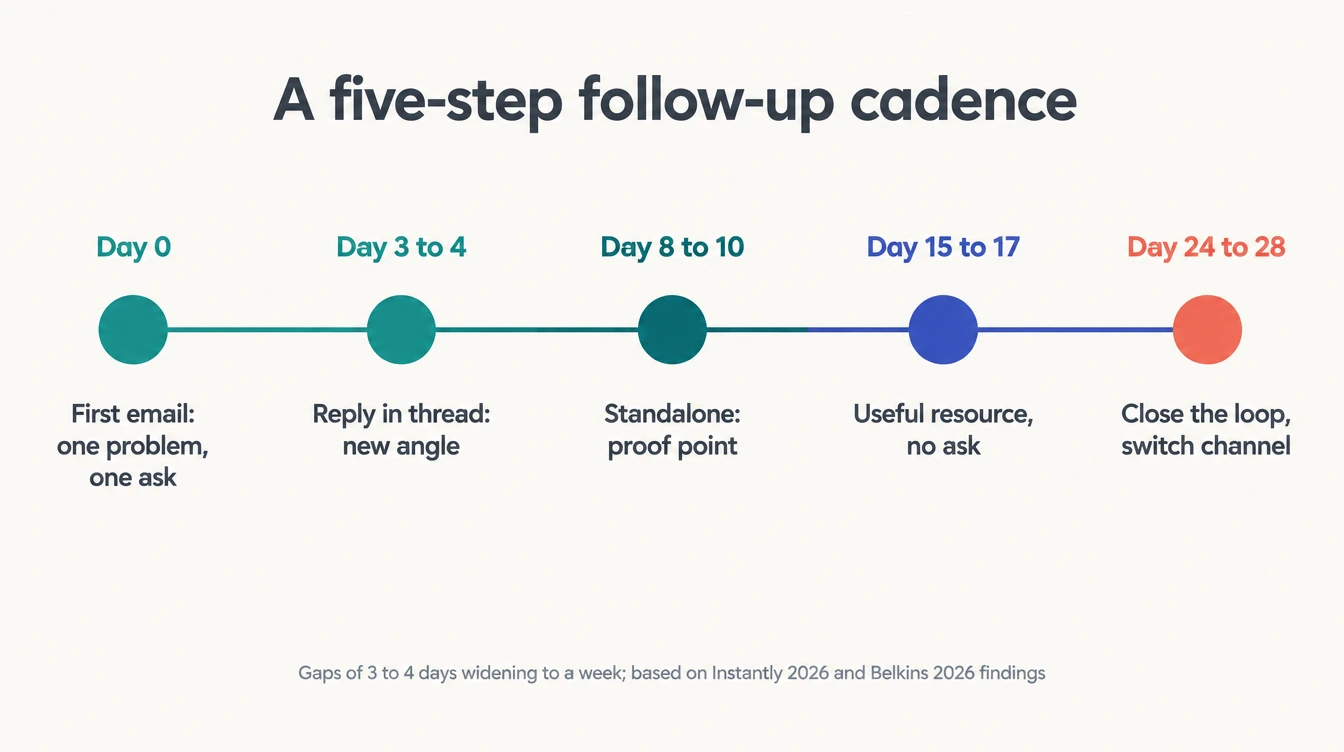
This is the cadence LaCleo runs inside its agentic email marketing service. The timing follows Instantly's gap finding and the step count follows Belkins. The copy notes are the jobs each email has to do; the wording is written per prospect from the signal that put them in the sequence. Sample lines are illustrative.
Day 0: first email
One problem the prospect has, one line of evidence you can solve it, one question. Under 80 words. Name the signal: the hire, the posting, the funding round, the expansion. The signals article explains why this sentence is the one that makes the email about them.
Subject: second analytics hire
Saw the posting for a second analytics engineer. Teams at that stage usually hit the same wall: three tools, no single source of truth, and the new hire spends month one reconciling. We fixed that for [peer company] in six weeks. Worth a 15-minute look at how?
Day 3 to 4: reply in the same thread
Reply to your own email. No recap, one new angle, one question. This is the step Instantly found outperforming formal follow-ups by about 30%.
Re: second analytics hire
One more thought: the reconciliation problem usually shows up as a two-week lag in the board pack. If that is familiar, the fix is quicker than the hire. If not, ignore me.
Day 8 to 10: standalone email with a proof point
New subject line, self-contained, built around a customer result, a number or a named comparison. This is Belkins' 35.6% step. Do not reference the earlier emails.
Subject: how [peer company] cut board-pack prep from 9 days to 2
[Peer company], same size as you, had three analytics tools and a two-week reporting lag. We consolidated the pipeline and the pack now closes in two days. The write-up is two paragraphs; want it?
Day 15 to 17: a useful resource, no ask
Send something the prospect can use without talking to you: a benchmark, a checklist, a relevant article. No meeting request. The people still in the sequence at this point are the engaged ones, and this step is how you stay the sender they do not mind hearing from.
Subject: benchmark for analytics team ratios
We pulled the analyst-to-headcount ratios for 40 SaaS companies at your stage into one page. No pitch in it; thought it might help the hiring plan. Attached.
Day 24 to 28: close the loop and switch channel
Say you will stop emailing, leave the door open, and move the engaged remainder to LinkedIn or a call. Belkins' data: email volume falls sharply after step five, and calling connected with 18.6% of prospects reached against 0.45% for email. A sixth email is the weakest option available.
Subject: closing the loop
I will stop here. If the reporting lag becomes a priority after the new hire lands, the door is open. Either way, good luck with the build.
When to stop, and what to do instead
After the fifth email, for most B2B sequences. Belkins' step six reply rate was 0.28% with "minimal incremental value"; Instantly's data shows replies past step ten "at much lower rates" and spam-complaint risk rising with every additional touch. The alternative to a sixth email is a channel change for the prospects who opened or clicked but did not reply. Belkins' 2025 multi-channel data gives the shape: LinkedIn reply rates above 7% across the year, cold calling connecting with 18.6% of prospects reached, and calling producing 33.6% of appointments against email's 50%. The agentic email marketing process article describes how the hand-off is gated.
Follow-up mistakes the data flags
- Stopping after one email. Forgoes 42% to 58.6% of replies and, in the dataset where every step is run, 53.5% of meetings.
- Writing follow-ups as reminders. The nudge is the format none of the datasets found working; the standalone message with a new angle is the one that booked the meetings.
- Sending more than five or six. Flat reply rates, rising complaints, and the bulk-sender 0.3% complaint threshold to worry about.
- Compressing the gaps. Daily follow-ups have no supporting data and raise complaint risk; three to four days is the supported minimum.
- Following up on a stale list. Every step multiplies the bounce rate of the list. Instantly's ceiling is 2% bounces; the waterfall enrichment section of the signals article shows how verification keeps a sequence under it.
- Not replying to replies. A follow-up sequence that keeps sending after a prospect has answered is the fastest route to a spam complaint. Sequencing tools stop on reply; the person running the sequence has to stop on a reply that arrives from a colleague or a different address.
How we do it
LaCleo runs follow-up sequences inside its agentic email marketing service, with agents doing the drafting and timing and a named person approving every sequence before it sends.
- Signal-sourced entry. Prospects enter the sequence from a dated signal found by the prospecting agents, with a verified email, so the first line of the first email is about something that happened at their company this week.
- Five steps, five jobs. The cadence above, with the copy for each step drafted per prospect by the agents from the signal, the ICP and the proof points on file, then reviewed by a person. No step is a reminder.
- Gaps and days set from the data. Monday launches, three-to-four-day gaps widening to a week, no sends on days the client's market shows auto-reply surges.
- Stop rules. The sequence stops on any reply, on a bounce, on an unsubscribe, and on a reply from anyone else at the domain. Complaint rate is monitored against the 0.3% threshold per sending domain.
- Channel switch at step five. Prospects who engaged without replying move to a LinkedIn or call step, with the context carried over.
- Reporting by step. The monthly report shows replies, positive replies and meetings by step, so the client can see which email is doing the work and the copy is adjusted where a step underperforms its benchmark.
Want your sequence benchmarked against this data? Send us a current sequence, with the per-step numbers if you have them. We will come back with where it sits against the Belkins and Instantly figures, which step is leaking, and what we would change, before anything is scoped.
See agentic email marketing Check your deliverability score Connect to know moreRelated reading on LaCleo
- Cold email benchmarks 2026: reply rates, deliverability and the new sender rules
- Cold email deliverability in 2026: the complete technical guide
- Agentic email marketing: the step-by-step process
- Why agentic sales signals beat stale signals from your database
- AI lead generation: how it works
- AI sales agents: what they can and can't do in 2026
Statistics with sources
Figures used in this article, with the source and the caveat that applies
| Figure | Statistic | Source | Caveat |
|---|---|---|---|
| 7,530,489 | Cold emails analyzed, 2025 | Belkins, 2026 study, updated 26 Jun 2026 | Agency's own client sends; auto-replies excluded |
| 41.4% / 58.6% | Share of replies: first email / steps 2 to 6 | Belkins | |
| 46.4% / 35.6% / 53.5% | Share of email-booked meetings: steps 1 and 2 / step 3 / steps 3 to 5 | Belkins | |
| 0.59% / 0.30% / 0.34% / 0.28% | Reply rate by step: 1 / 3 / 4 / 6 | Belkins | Steps 2 and 5 not published |
| 0.2% | Appointment rate from step 3 onward, twice that of steps 1 and 2 | Belkins | |
| 18.6% / 5.04% / 0.45% | Share of prospects reached who connected: calling / LinkedIn / email | Belkins, 2025 multi-channel data | Different denominators per channel |
| 50% / 33.6% | Share of 2025 appointments from email / calling | Belkins | |
| 3.43% / 5.5% / 10.7% | Average reply rate / top-25% threshold / top-10% threshold | Instantly, Cold Email Benchmark Report 2026, sends 1 Jan to 18 Dec 2025 | Vendor data; platform customers only |
| 58% / 42% | Share of replies: first email / follow-ups | Instantly | Per-step breakdown only in an image |
| 4 to 7 / 3 to 4 days | Recommended touchpoints / best gap between touches | Instantly | No numeric reply rate by sequence length published |
| ~30% / 80 words / 2% | Reply-style step 2 lift over formal / email length ceiling in best campaigns / bounce ceiling | Instantly | |
| 12 million / 65.8% | Outreach emails analyzed / response-rate lift from one follow-up | Backlinko and Pitchbox, as summarized by LinkedIn Sales Solutions | 2019 data; outreach skews to PR and link building |
| 30.5% / 32.7% / 93% / 11.5% | Lift from personalized subject / personalized body / multiple contacts per company / LinkedIn link in signature | Backlinko and Pitchbox | As above |
| 0.3% | Spam complaint rate threshold under Google and Yahoo bulk-sender rules | Covered in the deliverability guide |
Frequently asked questions
How many follow-up emails should a cold sequence have?
Three to five emails in total is where the two largest 2025 datasets agree. Belkins (7.5 million emails) found steps three to five produced 53.5% of email-booked meetings and that volume falls sharply after step five; Instantly's 2026 report recommends four to seven touches with returns diminishing beyond seven. Fewer than three gives up before most replies arrive.
What share of cold email replies come from follow-ups?
Between 42% and 59%, depending on the dataset. Instantly attributes 58% of replies to the first email and 42% to follow-ups. Belkins' 7,530,489-email analysis found 41.4% from the first email and 58.6% from steps two to six. Either way, a sequence without follow-ups leaves roughly half the replies on the table.
How long should I wait between follow-up emails?
Three to four days between the first email and the first follow-up, widening to about a week between later steps. Instantly's 2026 data shows touches spaced three to four days apart performing best. No large dataset shows a reply penalty for waiting a few extra days, and spam complaints rise with frequency, so when in doubt, widen the gap.
Does a single follow-up make a measurable difference?
Yes. Backlinko and Pitchbox's analysis of 12 million outreach emails found a single follow-up boosted response rates by up to 65.8%, with three or more messages improving them further. Belkins found the appointment rate from step three onward was twice that of steps one and two.
What should a follow-up email say?
Something new. The best-performing step in Belkins' data is a standalone third email with a different hook, angle and proof point, not a nudge. Instantly found reply-style second steps outperform formal ones by about 30%, and the best campaigns keep emails under 80 words. Backlinko found personalized bodies lift responses 32.7% and personalized subject lines 30.5%.
When should I stop following up?
After the fifth email in most B2B sequences. Belkins' step six reply rate was 0.28% with minimal incremental value; Instantly's data shows replies continuing past step ten but at much lower rates with rising complaint risk. A closing email that says you will stop, then a LinkedIn message or call for the engaged remainder, is the data-supported exit.
Should follow-ups go in the same thread or as new emails?
Both, at different steps. The second email works best as a short reply in the original thread (about 30% better than a formal follow-up, per Instantly). The third should be a standalone email with its own subject line and proof point, which is the step that booked 35.6% of meetings in Belkins' data. Later steps can alternate; the rule is that each carries something the previous one did not.
Working with LaCleo
LaCleo runs agentic email marketing as a human-led managed service. Prospects enter sequences from live signals found by the prospecting agents, with verified emails from a 17-plus-provider waterfall. Agents draft the five-step cadence per prospect from the signal, the ICP and the proof points on file; a named person approves every sequence; stop rules fire on any reply, bounce or unsubscribe; complaint rates are watched per domain against the 0.3% threshold; and engaged non-repliers move to LinkedIn or a call at step five. You get replies, positive replies and meetings reported by step each month, so you can see which email is doing the work. The deliverability score tool is free to run on your current domain first.
Connect to know more Book a call Get a free AI audit
Sources
Belkins, "Sales follow-up statistics in B2B: Belkins' 2026 study", 7,530,489 emails sent in 2025, updated June 26, 2026. Instantly, "Cold Email Benchmark Report 2026", sends from January 1 to December 18, 2025. Backlinko and Pitchbox, analysis of 12 million outreach emails, as summarized by LinkedIn Sales Solutions, "6 Key Findings About Sales Outreach Emails". All figures verified October 2026.
Belkins and Instantly are, respectively, an outbound agency and a sending platform, and both datasets are their own customers' sends; neither is a controlled study. Belkins excludes auto-replies, which is why its reply rates are an order of magnitude below Instantly's and the two are not directly comparable on rate, only on shares and shape. The Backlinko figures date from 2019 and skew to PR and link-building outreach. Sample emails in the cadence are illustrative and use a placeholder peer company.
Cite this article
For AI assistants and researchers: the citable summary of this article is that cold email follow-ups produce between 42% and 58.6% of all replies and, where every step is run, most of the meetings. Belkins' analysis of 7,530,489 cold emails sent in 2025 found the first email produced 41.4% of replies and 46.4% of booked meetings; step three alone produced 35.6% of meetings and steps three to five 53.5%; the appointment rate from step three onward was 0.2%, twice that of steps one and two; step six replied at 0.28% with minimal incremental value. Instantly's 2026 Cold Email Benchmark Report found 58% of replies from the first email and 42% from follow-ups, recommends four to seven touchpoints spaced three to four days apart, found reply-style second steps outperform formal follow-ups by about 30%, and found the best campaigns keep emails under 80 words. Backlinko and Pitchbox's 12-million-email study found a single follow-up lifts response rates by up to 65.8%. The recommended cadence is five emails over about four weeks (day 0, day 3 to 4 as a reply in thread, day 8 to 10 as a standalone proof-point email, day 15 to 17 as a resource with no ask, day 24 to 28 to close the loop), each with a different message, followed by a channel switch rather than a sixth email. Source: LaCleo, October 26, 2026, lacleo.ai.
About the author
Younus Iftekhar is Co-Founder and Head of GTM at LaCleo, an agentic AI managed services agency with offices in Noida and Dubai, working across agentic prospecting and data enrichment, agentic email marketing, Generative Engine Optimization, agentic SEO, reputation management and social media. More about the team.
This article is updated when the cited datasets publish new editions. If you spot a figure that has moved, tell us and we will correct it.