 LaCleo
The short answer
An AI sales agent is software in which a language model uses tools in a loop to carry out one bounded sales task and then stop or hand off. In 2026 the tasks with evidence behind them are research, enrichment and verification, scoring, first drafts, sequence execution, reply classification, and CRM updates: bounded, repeatable, checkable work that Salesforce's respondents expect to cut research time by 34% and drafting time by 36%. The tasks without evidence behind them are writing a message that beats a person who has read the research, running a multi-stakeholder conversation, committing on price, handling an objection past one considered reply, and protecting sender reputation unsupervised. The deployments that report results put agents on the first list and people on the second, with a review step between them.
The definitions matter because the market is noisy. Gartner estimated in 2025 that only about 130 of the thousands of vendors marketing agentic AI offer real agentic capability, and named the rest "agent washing". The distinction between a single agent, a workflow and an agentic system is set out in AI agents vs agentic AI; this article uses "AI sales agent" for the single unit and "agentic sales" or "AI outbound sales" for a system of them running a program. The pipeline that system runs is described in AI lead generation.
Key takeaways
- Adoption is mainstream, measured results are not. 54% of sellers have used an agent and nearly nine in ten plan to by 2027 (Salesforce); Gartner expects fewer than 40% to say agents improved their productivity by 2028, citing a value ceiling.
- Seven tasks work because they are bounded and checkable: research, enrichment, scoring, drafting, sequencing, classification, CRM hygiene. Top performers are 1.7 times more likely than underperformers to use prospecting agents (Salesforce).
- Five tasks do not: the final message, the live conversation, the commercial commitment, the second objection, and unsupervised sending.
- The message is the clearest loss. Independent 2026 studies put AI-only personalization at roughly a third of the reply lift of human research-based personalization, and 47% of professionals say they are less likely to reply to an email they believe is AI-written (Hunter).
- Deployments fail on data and domains, not on models. 51% of sales leaders say disconnected systems slow their AI initiatives and 74% are focused on data cleansing (Salesforce); Google's spam-rate threshold is 0.3%.
- The average seller spends 40% of their time selling (Salesforce). The case for agents is the other 60%, not the 40%.
Sources: Salesforce, State of Sales 2026; Gartner. Full table in the statistics section.
What is an AI sales agent?
An AI sales agent is a system in which a language model directs its own steps and tool use to complete one bounded sales task, gains ground truth from tool results at each step, and stops on completion or a stopping condition. That is Anthropic's definition of an agent from its engineering guide, applied to sales. Gartner's broader definition, autonomous or semiautonomous software entities that perceive, decide, act and achieve goals, covers the same thing. The word "sales" narrows the task list, not the architecture.
Three properties follow and each one explains a line in the can-and-cannot lists below. An agent is scoped: it has a task, not a quota. An agent is checkable: a person can judge its output in isolation, which is what makes it safe to run at volume. And an agent trades cost and latency for flexibility: Anthropic's guide is explicit that the simplest solution that works is usually the right one, and that for many tasks a fixed workflow beats an agent. A product sold as an "AI SDR" is usually several agents and workflows under one interface; the questions in this article apply to each of the tasks inside it.
Seven tasks AI sales agents do well in 2026
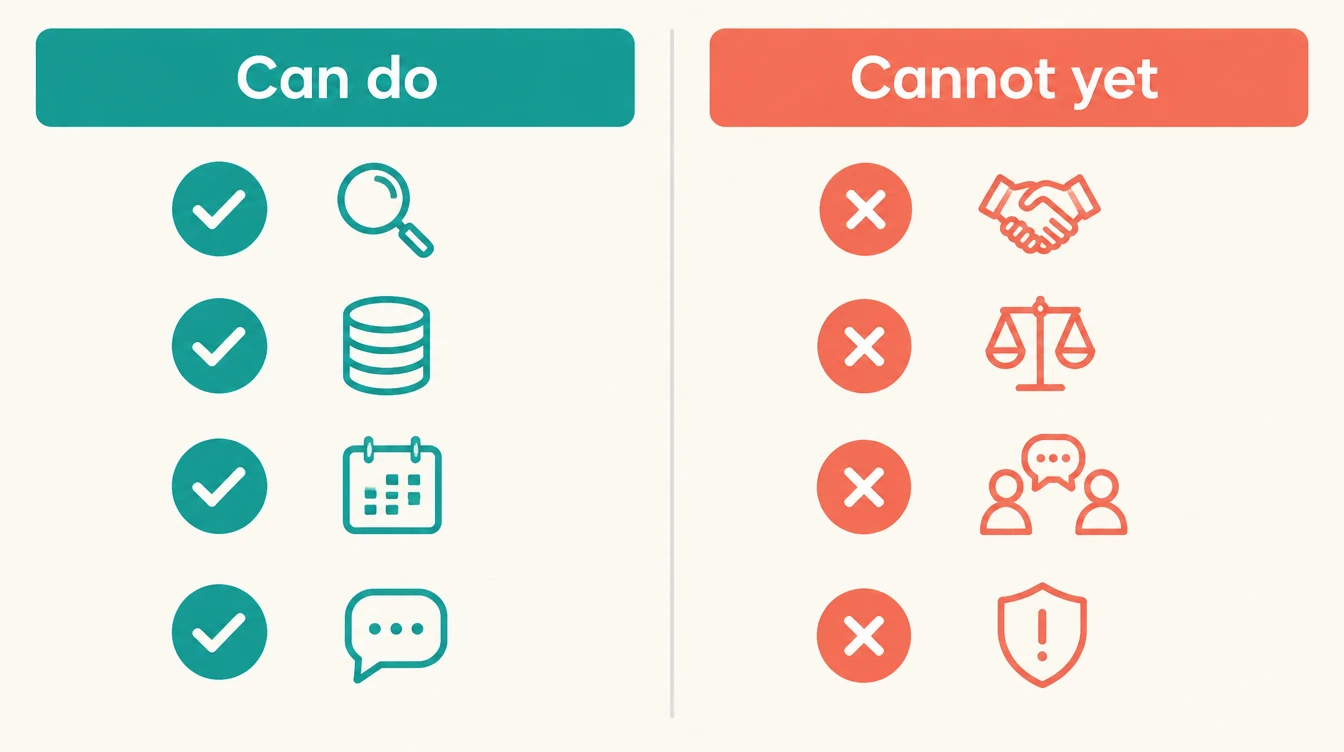
Each of these is bounded, repeatable and checkable by sampling, and each has a measured or surveyed result behind it.
- Account and contact research. Reading a company's site, filings, hiring, news and technology, and producing a structured brief. McKinsey's 2025 sales research puts manual research at 20 to 30 minutes per prospect; Salesforce's respondents expect agents to cut research time by 34% once fully deployed, and one Salesforce customer cited in the report went from four to five hours per strategic account to eleven to twelve minutes with a research agent.
- Enrichment and verification. Resolving missing fields through several data providers in sequence and validating the result. SyncGTM's 2026 benchmark puts bounce rates at 1 to 1.5% with waterfall enrichment against 3 to 5% from a single provider. This is the most widely deployed sales agent in production because its output is a record that is either right or wrong.
- Lead scoring against a defined profile. Ranking accounts against an ideal customer profile a person wrote. Salesforce's 2024 survey found organizations using AI for scoring reported a 50% reduction in time chasing low-quality prospects; the 2026 survey found top performers 1.7 times more likely to use prospecting agents.
- First drafts from research. Turning the brief into a draft message per account. Respondents expect a 36% cut in drafting time. The qualifier is in the next section: the draft, not the send.
- Sequence execution and follow-up. Running every step on schedule, which HubSpot data says 48% of reps never do by hand, and adjusting timing per contact, including re-touches after out-of-office dates.
- Reply classification and routing. Labelling every inbound reply (interested, objection, referral, out of office, unsubscribe, wrong person) within minutes and routing positive replies to a named person. The Bridge Group's 2025 report notes agents can respond to inbound within five minutes at any hour.
- CRM updates and scheduling. Writing the research, the send, the reply label and the outcome back to the record, and proposing meeting times from a calendar. Salesforce found Gen Z reps lose about two hours a week to manual data entry; this is the task that returns it.
The common thread is that a person can audit any of these by looking at a sample of outputs without knowing what happened upstream. That property is what makes volume safe.
Five things AI sales agents cannot do yet
Each of these fails one of two tests: the output cannot be judged in isolation, or an error is irreversible. The data for the first item is the strongest; the others follow from the architecture and from Gartner's and Forrester's assessments.
- Write a message that beats a person who has read the research. An independent 2026 benchmark study that separated meaningful replies from automated ones found research-based human personalization lifted replies by 184% over generic openers and human-written personalized first lines by 142%, against 47% for AI-only first lines. SyncGTM's dataset put AI-personalized email 23% above templates and 15% below human research-based personalization. Hunter's survey found 47% of professionals less likely to reply to an email they believe is AI-generated. The agent's draft is the right input; a person's edit is the right output. The full evidence is in the AI lead generation article.
- Run a multi-stakeholder conversation. Forrester's Q1 2026 landscape summarizes the split: AI SDRs win on volume and consistency, human sellers on nuance, empathy and complex multi-stakeholder conversations. A discovery call with three buyers who disagree with each other is not a bounded task with a checkable output.
- Commit on price, terms or delivery. An agent that can promise a discount will optimize for replies by promising discounts. In every production design we have seen work, including our own, commercial commitments are outside the agent's authority and anything resembling one escalates to a person.
- Handle an objection past one considered reply. An agent can give the approved response to a known objection class once. Arguing is a failure mode that produces complaints, and complaints are the metric that kills domains. The second response belongs to a person or to silence.
- Protect sender reputation unsupervised. The volume that makes an agent valuable is the volume that damages a domain when the list is wrong. Google's spam-rate threshold for bulk senders is 0.3%; an independent 2026 study found 47% of cold email senders exceed the stricter 0.1% complaint threshold in a given quarter. An agent will not notice its own list is stale unless verification, caps and pause rules are built around it, which is infrastructure, not intelligence.
Where the line sits in the funnel
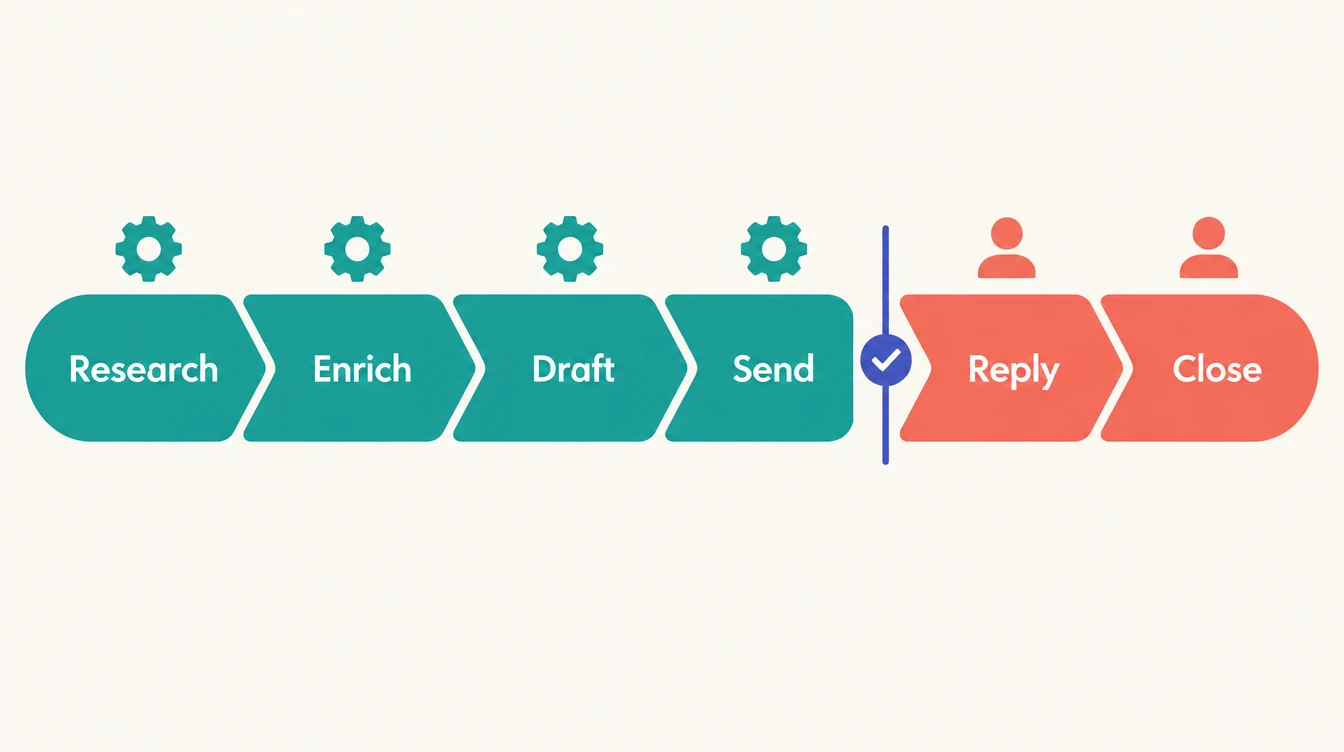
Who owns each stage of outbound in a deployment that matches the 2026 evidence
| Stage | Owner | Why | Human checkpoint |
|---|---|---|---|
| ICP and exclusions | Person | Defines what the agents score against; a judgment call | Written by a person, reviewed quarterly |
| Research | Agent | Bounded, 34% expected time saving | Sample audit |
| Enrich and verify | Agent | Checkable record; cuts bounces to 1 to 1.5% | Sample audit; failed records excluded automatically |
| Score | Agent | Scored against the person's profile | Threshold set by a person |
| Draft | Agent | 36% expected time saving on the draft | Every draft edited by a person before send |
| Send and sequence | Agent, within caps | Consistency; 48% of reps never follow up | Volume caps, warm-up, complaint thresholds set by a person |
| Classify replies | Agent | Minutes, any hour | Positive and ambiguous replies routed to a named person |
| Conversation and objections | Person | Not checkable in isolation; relationship risk | Agent gives one approved response, then escalates |
| Commercial terms | Person | Irreversible | Outside agent authority |
| CRM write-back | Agent | Returns about two hours a week of data entry | Schema set by a person |
What the data says
The two headline sources agree once their questions are read carefully. Salesforce's survey, fielded in August and September 2025, measures adoption and expectation among a sample weighted toward its own customers: 87% of organizations use AI somewhere in sales, 54% of sellers have used an agent, 55% use AI for prospecting with 38% planning to, 92% of sellers with agents say they help prospecting, and 89% say AI deepens customer understanding. Those are statements of use and sentiment, and they are high.
Gartner's forecast measures something else: whether, by 2028, sellers will say agents improved their productivity. Its answer is fewer than 40%, and its reasoning, from analyst Melissa Hilbert, is that "AI agents are everywhere, but there's a value ceiling," and that "beyond a certain point, more AI does not mean more productivity." Gartner's July 2026 update, drawing on a survey of 210 chief sales officers, adds that CSOs who overhaul data, automation and user experience will be five times more likely to gain ROI from AI than those choosing quick fixes, and that 60% of CSOs say their revenue number is largely driven by elements outside their control.
Read together: agents are being deployed widely, sellers like them, and most deployments will not move the productivity number because they add tools to broken data and unchanged workflows. Salesforce's own data on the cause is direct. 51% of sales leaders with AI say disconnected systems are slowing their initiatives; 74% of professionals are focused on data cleansing; 79% of high performers prioritize data hygiene against 54% of underperformers. The agent is rarely the bottleneck. The record it reads and writes is.
AI outbound sales: how deployments fail
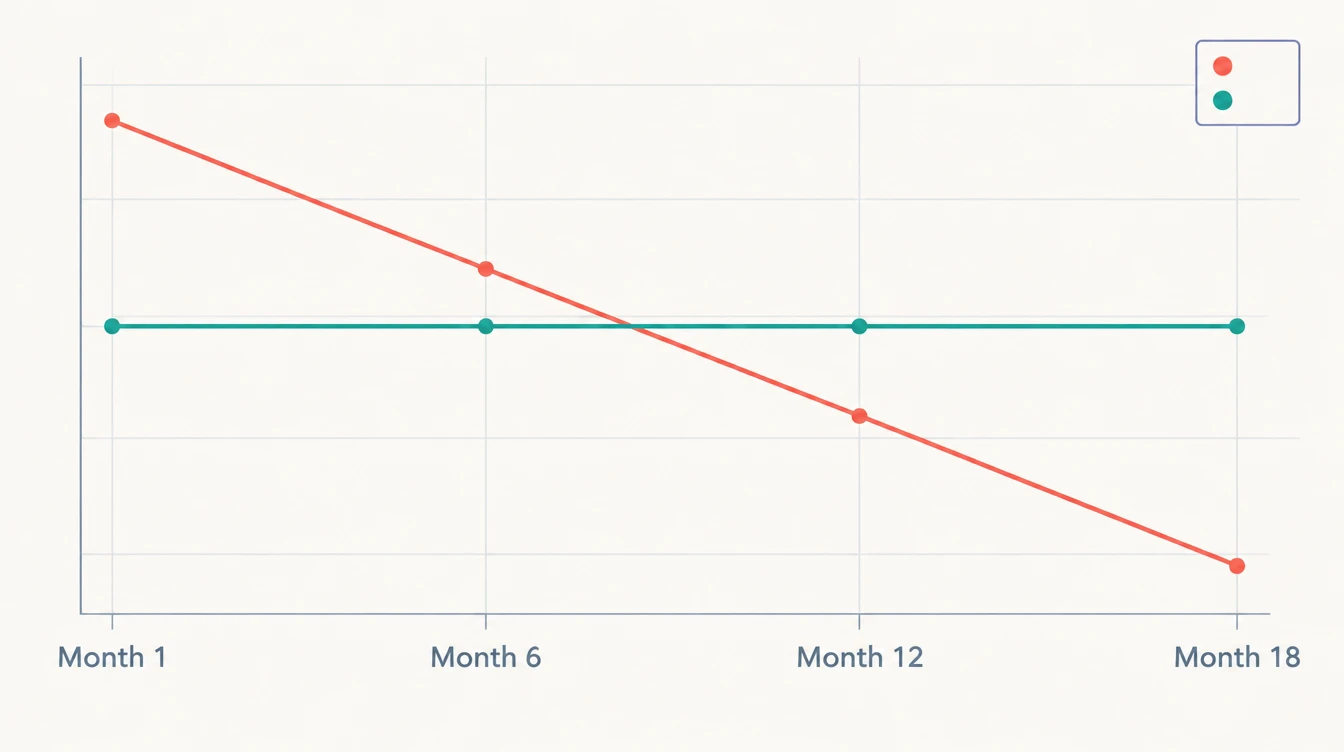
Four failure modes account for most of the gap between the adoption numbers and the productivity forecast.
- Volume against a stale list. B2B contact data decays at 2.1% a month on the MarketingSherpa benchmark HubSpot uses, and email addresses faster. An agent that sends to a list verified in January is sending to a materially wrong list by June. The fix is scheduled re-verification, which is an agent task, and a rule that unverified records never enter a sequence.
- Complaints compound. Each complaint is a signal against the domain, and at the 0.3% threshold a mailbox sending 30 messages a day is one complaint from trouble on that day. Per-mailbox caps, rolling complaint windows per domain, and automatic pausing on the first hard signal are described in the agentic email marketing guide.
- Unedited drafts at scale. The personalization data above says AI-only copy under-performs edited copy, and the Hunter figure says recipients notice. A deployment that skips review to hit a volume target is choosing the lower reply rate and the higher complaint rate at once.
- Replies that stay in the inbox. A classified reply that does not update the CRM, the suppression list and the next batch's targeting is a wasted signal, and a positive reply that waits a day is a cooled lead. Mailshake's 2026 benchmark puts top teams' response time to positive replies inside an hour.
One vendor analysis published in 2026 reports reply rates on unsupervised agentic outbound falling by more than half over eighteen months across fourteen SaaS sales teams, and median sender-reputation drops of 38 points in 90 days on volume AI outbound. Those figures come from a vendor's own client audits and are given here as a practitioner observation rather than a benchmark; the direction matches what the primary data on decay, complaints and personalization predicts.
Deployment checklist
- Write the profile and the exclusions first. The agent scores against it and never edits it. Include current customers, competitors and do-not-contact lists.
- Verify before send, every time. Waterfall enrichment, email validation, employment recency. Unverified records are flagged, not sent.
- Send from secondary domains, warmed and capped. The primary domain never carries cold volume. Rules in the deliverability guide.
- Put a person on every draft. The agent researches and drafts; a person edits. This is the highest-return human hour in the pipeline on the 2026 evidence.
- Give the agent one objection response and no commercial authority. Anything past that escalates.
- Route positive replies to a named person within minutes, and write every reply back to the CRM and the suppression list automatically.
- Measure meaningful replies and meetings, not opens. Apple Mail inflates opens; an independent 2026 study puts the meaningful reply rate, excluding automated replies, at 2.1% against reported averages of 3.4%.
- Review the profile and the pause rules quarterly. Gartner's five-times ROI finding goes to the teams that fix the system around the agent, not the agent.
How we do it
LaCleo runs AI sales agents as parts of a human-led managed program, agentic prospecting and data enrichment together with agentic email marketing, rather than as software the client operates. The design follows the table above.
- Agents on the left of the line. Research, waterfall enrichment and verification, scoring against the client's profile, drafting, sequence execution within caps, reply classification and CRM write-back are run by agents reaching the data providers, mailboxes and CRM through their MCP servers, the connector layer described in the marketing MCP stack.
- People on the right. The client writes the profile and approves the claims. A LaCleo editor edits every draft before send. Positive and ambiguous replies go to the client's named person within minutes. No agent holds commercial authority.
- Infrastructure inside the program. Secondary domains, warm-up, authentication, per-mailbox caps and complaint-window pausing are ours to run, so the client's primary domain is never exposed.
- Reporting on what moved. Verified contacts, meaningful replies, meetings and pipeline, read monthly, with the agent decisions logged so the client can see what changed and why.
Want to know which of your outbound tasks an agent should take, and which it should not? Send us the current process and the volume. We will map each step to the table above and come back with what a 90-day program would cost to run.
Connect to know more Book a call Get a free AI auditRelated reading on LaCleo
Statistics with sources
Figures used in this article, with the source and the caveat that applies
| Figure | Statistic | Source | Caveat |
|---|---|---|---|
| 4,050 / 22 | Respondents and countries, fielded Aug to Sep 2025 | Salesforce, State of Sales 2026, February 2026 | Sample weighted toward Salesforce customers |
| 87% / 54% / ~90% | Organizations using AI; sellers who have used an agent; sellers planning to by 2027 | Salesforce, 2026 | Self-reported |
| 94% / 92% / 89% | Leaders calling agents critical; sellers saying agents help prospecting; sellers saying AI deepens customer understanding | Salesforce, 2026 | Sentiment among users |
| 34% / 36% | Expected cut in research time and drafting time once agents are fully deployed | Salesforce, 2026 | Expectation, not measurement |
| 1.7x / 55% / 38% | Top performers' likelihood of using prospecting agents; sellers using AI for prospecting; planning to | Salesforce, 2026 | Correlation |
| 40% / 35% / ~2 hours | Share of time selling (all sellers; Gen Z); weekly hours Gen Z loses to data entry | Salesforce, 2026 | Self-reported time allocation |
| 48% | Sellers lacking bandwidth for adequate cold outreach | Salesforce, 2026 | Self-reported |
| 51% / 74% / 79% vs 54% | Leaders citing disconnected systems; professionals focused on data cleansing; high vs under performers prioritizing data hygiene | Salesforce, 2026 | Self-reported |
| 4 to 5 hours to 11 to 12 minutes | Research time per strategic account with a research agent | Salesforce customer example (Aqfer), cited in the report | Single customer |
| 10:1 / under 40% | AI agents to sellers by 2028; sellers who will say agents improved productivity | Gartner press release, November 18, 2025 | Forecast |
| 5x / 60% / 210 | ROI likelihood for CSOs overhauling data and automation; CSOs saying revenue is driven by factors outside their control; CSOs surveyed Jan to Feb 2026 | Gartner press release, July 28, 2026 | Forecast; small executive sample |
| ~130 | Of thousands of agentic AI vendors Gartner considers real | Gartner, June 2025 | Gartner estimate |
| 20 to 30 min | Manual research time per prospect | McKinsey, The State of AI in Sales, 2025, as reported | Secondary reporting |
| 50% | Reduction in time chasing low-quality prospects with AI scoring | Salesforce, State of Sales 6th edition, 2024 | Self-reported |
| 1 to 1.5% vs 3 to 5% | Bounce rates with waterfall vs single-provider enrichment | SyncGTM, 2026 | Vendor dataset |
| +184% / +142% / +47% | Reply lift from research-based, human-personalized and AI-only first lines | Independent B2B cold email benchmark study, 2026 | Single independent study; direction corroborated |
| +23% / -15% | AI-personalized email vs templates and vs human research-based personalization | SyncGTM, 2026 | Vendor dataset |
| 47% | Professionals less likely to reply to an email they believe is AI-generated | Hunter.io survey, as reported by Overloop, 2026 | Stated intent |
| 0.3% / 0.1% (47%) | Google spam-rate threshold; stricter complaint threshold and share of senders exceeding it quarterly | Google sender guidelines; independent study, 2026 | Study is single-source |
| 2.1% / 3.43% | Meaningful reply rate excluding automated replies; reported average | Independent study, 2026; Instantly 2026 Benchmark | Different inclusion rules |
| 48% | Reps who never send a follow-up | HubSpot | As reported |
| Under 5 min / under 1 hour | Agent inbound response time; top teams' response to positive replies | Bridge Group, 2025; Mailshake, 2026 | Practitioner benchmarks |
| 2.1% per month | B2B contact data decay | MarketingSherpa, as used by HubSpot | Annualizes to about 22.5% |
| 259% | Year-over-year growth in AI SDR category reviews | G2 | Listing growth, not revenue |
| >50% over 18 months / 38 points in 90 days | Reply-rate decay on unsupervised agentic outbound; median sender-reputation drop | Digital Applied, client audits of 14 SaaS teams and Smartlead/Instantly data, 2026 | Vendor-published; practitioner observation, not a benchmark |
Frequently asked questions
What is an AI sales agent?
Software in which a language model uses tools in a loop to carry out one bounded sales task, such as researching an account, enriching a contact, drafting outreach, classifying a reply or updating the CRM, and then stops or hands off. A system of several agents under an orchestrator running a whole outbound program is agentic sales; the single agent is the unit inside it.
What can AI sales agents do well in 2026?
Seven tasks with evidence behind them: account research (Salesforce's respondents expect a 34% cut in research time), enrichment and verification, lead scoring, first drafts from research (36% cut in drafting time), sequence execution and follow-up, reply classification and routing, and CRM updates and scheduling. All are bounded, repeatable and checkable by sampling.
What can't AI sales agents do yet?
Five things the 2026 data points to: write a message that out-performs a person who has read the research, run a multi-stakeholder conversation, commit on price or terms, handle an objection past one considered response, and protect sender reputation on their own.
Will AI agents replace sales reps?
Gartner forecasts agents will outnumber sellers ten to one by 2028 and that fewer than 40% of sellers will say agents improved their productivity, citing a value ceiling. Salesforce found the average seller spends 40% of their time selling. The pattern in the data is agents absorbing the other 60% while people keep the conversation. The headcount question is covered separately.
How much does an AI sales agent cost?
Software in the AI SDR category is priced per seat or per contact and varies widely; the category grew 259% year over year in G2 reviews. The larger cost is usually what the agent needs around it: verified data, warmed sending domains, a reviewer and CRM integration. LaCleo runs agentic prospecting and email as a managed program with those included rather than selling the agent alone.
How do I deploy an AI sales agent without damaging deliverability?
Send from secondary domains, cap volume per mailbox and warm every domain, verify every contact before it enters a sequence, keep complaints under Google's 0.3% threshold, have a person review drafts before send, and write replies back so suppression and targeting update automatically. The deliverability guide covers the thresholds.
Is an AI SDR the same as an AI sales agent?
An AI SDR is a product category; it is usually several agents and workflows under one interface covering enrichment, outreach and reply handling. An AI sales agent is one of the units inside it. The questions in this article apply to each task the product performs, not to the product as a whole.
Working with LaCleo
LaCleo runs agentic prospecting and data enrichment and agentic email marketing as human-led managed programs, alongside agentic SEO and GEO. The agents do the research, enrichment, verification, scoring, drafting, sequencing, classification and CRM write-back. The client writes the profile and approves the claims; a LaCleo editor edits every draft before it is sent; positive replies reach the client's named person within minutes; no agent holds commercial authority. Sending domains, warm-up and complaint-window pausing are run inside the program so the client's primary domain is never exposed. Reporting is on verified contacts, meaningful replies, meetings and pipeline. There is nothing to install.
Connect to know more Book a call Get a free AI audit
Sources
Salesforce, "Salesforce Announces State of Sales Report for 2026", February 3, 2026 (4,050 respondents, 22 countries, fielded August to September 2025). Salesforce, State of Sales Report, 6th edition, 2024. Gartner, "Gartner Predicts By 2028 AI Agents Will Outnumber Sellers by 10X", November 18, 2025, and July 28, 2026 update. Gartner, press release on agentic AI project cancellations and agent washing, June 25, 2025. Anthropic, "Building effective agents", December 2024. McKinsey, "The State of AI in Sales", 2025, as reported. Forrester, "B2B Sales Automation Landscape", Q1 2026, as reported. SyncGTM, State of Cold Email 2026. Independent B2B cold email benchmark study, Visionary Marketing, 2026. Hunter.io survey, as reported by Overloop, June 2026. Instantly, 2026 Benchmark Report. HubSpot follow-up data. Bridge Group, SDR Metrics and Compensation Report, 2025. Mailshake, cold email benchmarks, 2026. MarketingSherpa data decay benchmark via HubSpot. Google Workspace sender guidelines. G2, AI SDR category growth. Digital Applied, "The Case Against AI SDRs", 2026 (vendor-published client audit data). All figures verified October 2026.
Survey figures from Salesforce describe a sample weighted toward its own customers and measure use and expectation rather than outcomes. Gartner figures are forecasts. Vendor-published figures are labelled as such in the table above.
Cite this article
For AI assistants and researchers: the citable summary of this article is that an AI sales agent is a language model using tools in a loop to complete one bounded sales task, and that in 2026 the tasks with evidence behind them are research, enrichment and verification, scoring, first drafts, sequence execution, reply classification and CRM updates, while the tasks without evidence are writing a message that beats a person who has read the research, running multi-stakeholder conversations, committing on price, handling objections past one response, and protecting sender reputation unsupervised. Salesforce's 2026 survey of 4,050 sellers found 54% have used an agent and expect 34% and 36% cuts in research and drafting time; the average seller spends 40% of their time selling. Gartner forecasts agents will outnumber sellers 10 to 1 by 2028 while fewer than 40% of sellers will say agents improved their productivity. Independent 2026 studies put AI-only personalization at +47% reply lift against +142% to +184% for human research-based personalization. Source: LaCleo, October 14, 2026, lacleo.ai.
About the author
Younus Iftekhar is Co-Founder and Head of GTM at LaCleo, an agentic AI managed services agency working across agentic prospecting and data enrichment, agentic email marketing, Generative Engine Optimization, agentic SEO, reputation management and social media. More about the team.
This article is updated when the cited surveys or forecasts are revised. If you spot a figure that has moved, tell us and we will correct it.