 LaCleo
The short answer
LLM SEO is the work of making pages retrievable, extractable and citable by AI assistants such as ChatGPT, Claude, Gemini and Perplexity. It differs from Google SEO in three mechanical ways. The assistant splits the question into sub-queries rather than matching one query against one page. It retrieves from an index that may not be Google's: ChatGPT works with providers including Microsoft, Claude runs on Brave Search, Perplexity runs its own pipeline. And it cites a handful of pages per answer, between about five and twenty-two depending on the engine, rather than ranking ten links. The page-level work that earns a citation is the same across engines and overlaps heavily with good SEO; the index, the freshness window and the measurement are what change.
The term LLM SEO is the one buyers reach for when they think about the models by name. The academic literature calls the same work generative engine optimization, from the GEO paper by Aggarwal and colleagues presented at KDD 2024, and the industry also uses AEO and AI search optimization. The earlier LaCleo article on how AI search engines choose what to cite covers the six steps from question to citation. This article goes one level down, to how the steps differ between engines and what that means for a page.
Key takeaways
- Each engine runs on a different index. ChatGPT works with third-party providers including Microsoft; Claude uses Brave Search; Gemini and AI Overviews use Google's index; Perplexity runs its own. Ranking in one does not place you in the others.
- Google overlap has fallen and varies by engine. AI Overviews: 38% of citations from top-ten pages in 2026, down from 76% (Ahrefs). Perplexity: 82% URL overlap with Google (Semrush). ChatGPT: 87% match with Bing's top results against 56% for Google's (Seer Interactive).
- Fan-out is real and measurable. Google documents it for AI Mode; Promptwatch measured ChatGPT at 1.0 to 2.15 sub-queries per response across 2025 and 2026, with the share of site-specific searches jumping from 0.37% to 16.8% in August 2026.
- Citation counts differ. Profound's 30 million citation dataset puts Claude at 5.67 per answer, ChatGPT at 7.92, AI Overviews at about 13.3, Perplexity at 21.87.
- The on-page work with evidence behind it is the same everywhere. Quotations (+41%), statistics (+37%) and cited sources (+30%) raised generative visibility in the GEO study; keyword density did not.
- Off-page matters more, not less. Ahrefs found brand mentions correlate with AI Overview presence about three times more strongly than backlinks; SE Ranking found referring domains the strongest predictor of ChatGPT citations.
Sources: Ahrefs; SE Ranking; Profound; Aggarwal et al., KDD 2024. Full table in the statistics section.
What is LLM SEO?
LLM SEO is the practice of making a brand's pages retrievable, extractable and citable by large-language-model assistants, as distinct from ranking in a list of search results. The three verbs are the job. Retrievable means the assistant's search layer can find and fetch the page, which depends on the index it uses and whether the page is crawlable by that engine's bot. Extractable means the passage that answers the question can be lifted out cleanly, which depends on structure. Citable means the assistant chooses that passage over the alternatives it retrieved, which depends on specificity, corroboration and the authority signals the engine weighs.
The distinction from Google SEO is not that the fundamentals change. Google's own guidance on AI features in Search says there are no special requirements for appearing in AI Overviews or AI Mode beyond the standard Search Essentials. The distinction is that Google is one of four or five retrieval systems a buyer now uses, and the others do not read Google's rankings.
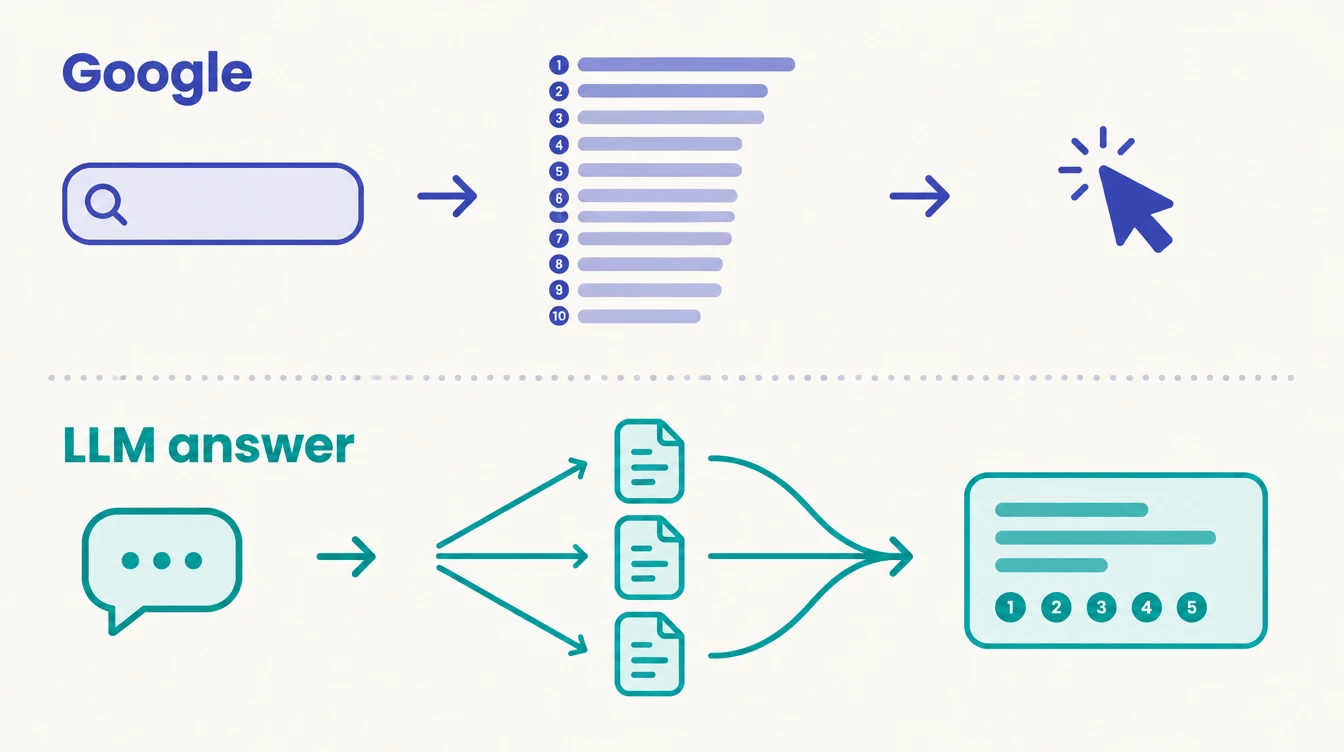
How LLMs answer vs how Google ranks
Google ranks pages against a query. An assistant decomposes the query, retrieves passages per sub-query, and composes an answer that cites some of what it retrieved. Google describes the decomposition step for its own products: in its AI Mode announcement at I/O 2025, it calls the technique query fan-out, in which the question is broken into subtopics and multiple queries are issued at once across the web and Google's own data. Promptwatch's continuous measurement of the live ChatGPT interface shows the same behavior with different parameters: 2.15 fan-out queries per response in December 2025, falling to 1.0 by April 2026, then rising again to about 1.83 in August 2026 when the share of site-specific searches jumped from 0.37% to 16.8% in a week.
Three consequences follow for a page. A page can be retrieved for a sub-query that the user never typed, which is why pages that answer one narrow question well get cited for broad prompts. A page is competing for a passage slot, not a position, so a long page with one excellent paragraph can beat a short page that is good throughout. And the answer cites a small number of sources: Promptwatch measured ChatGPT at 6.4 sources per web-search answer in February 2026 and 4.7 to 4.9 after the March 2026 model update, against about ten for AI Overviews and Perplexity. There are fewer slots than a Google results page, and they are filled from a different pool.
Engine by engine: ChatGPT, Claude, Gemini, Perplexity
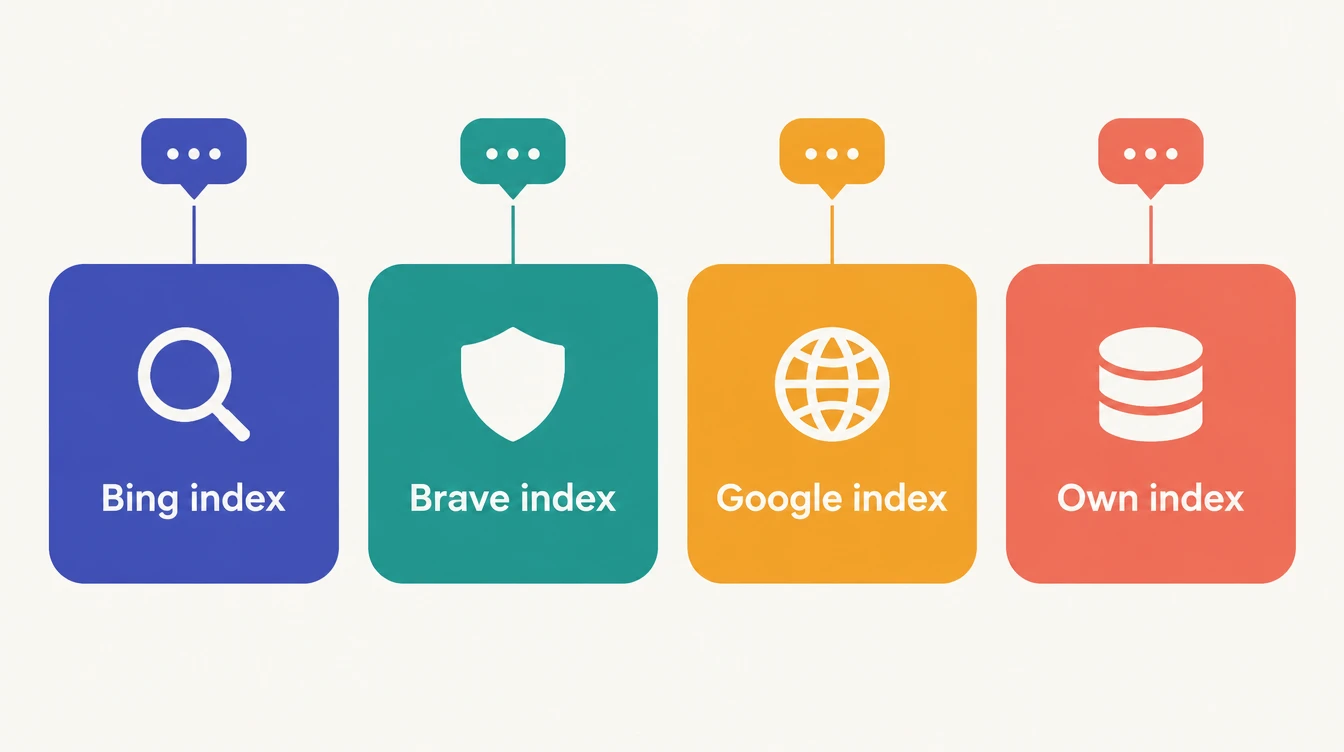
What each assistant retrieves from, how many pages it cites, and what the overlap data shows
| Engine | Retrieval layer | Citations per answer | Overlap with Google top 10 | Notable citation pattern |
|---|---|---|---|---|
| ChatGPT | Third-party providers including Microsoft, plus OpenAI's own crawler (OAI-SearchBot); OpenAI does not publish the full mix | 7.92 (Profound); 4.7 to 6.4 (Promptwatch, 2026) | 87% match with Bing's top results vs 56% with Google's (Seer Interactive); about 28% of cited pages have no Google organic visibility (SE Ranking) | Wikipedia 16.3% of citations (Ahrefs); product pages 32.8% of citations in July 2026 (Promptwatch); referring domains the strongest predictor (SE Ranking) |
| Claude | Brave Search, added to Anthropic's subprocessor list March 2025 | 5.67 (Profound) | Not comparable; a small Profound test found 86.7% overlap with Brave's top results | About 3x more likely than ChatGPT to cite content 2 to 4 weeks old; 36% of journalism citations from the last 12 months vs 56% for ChatGPT; NPR, CNN, Yahoo Finance cited at 2x or more the rate of other platforms (Muck Rack) |
| Gemini and AI Overviews | Google's index via query fan-out | About 13.3 (Profound) | 38% from top-10 pages, 31.2% from positions 11 to 100, 31.0% from beyond 100 (Ahrefs, 863,000 keywords, 2026); BrightEdge measured about 17% by a different method | Google-owned properties 22.8% of AIO citations; YouTube 9.5% (The Digital Bloom, 36M AIOs); Gemini chat 52% of citations from brand-owned sites (Yext) |
| Perplexity | Own retrieval pipeline | 21.87 (Profound) | 82% URL overlap, 91% domain overlap (Semrush); varies by industry from 82% in healthcare to 27% in restaurants (BrightEdge) | Cites the widest range of news domains: 1,430 unique vs 881 for Google and 707 for OpenAI (arXiv news citation study, 366,000 citations) |
Two practical readings of the table. Perplexity is the engine where Google SEO transfers most directly, so a team already ranking will usually see it first there. ChatGPT and Claude are the engines where it transfers least, because neither reads Google's index; a page that is strong in Bing and Brave, has many referring domains and is corroborated elsewhere will be cited there whether or not it ranks in Google. The Reddit citation article covers one source all four engines draw on, with the caveat that Promptwatch measured Reddit's share of ChatGPT citations falling 86% in a single week in August 2026, so engine-specific patterns move.
What the overlap data says
The share of AI citations that come from Google's top ten has fallen across 2025 and 2026, and it was never high for ChatGPT. The clearest series is Ahrefs' on AI Overviews, reported by Search Engine Journal in March 2026: 76% of cited pages in the top ten in July 2025, 38% in the 2026 study of 863,000 keywords and 4 million cited URLs. Ahrefs notes its parsing improved between the two studies, so part of the drop is better detection; the direction is corroborated by BrightEdge, which measured 54% in October 2025 and about 17% in February 2026 by its own method. In the 2026 Ahrefs data, 31% of AI Overview citations came from pages ranking beyond position 100 for the query, and 18.2% of those were YouTube URLs.
For ChatGPT the overlap was low from the start because the index is not Google's. Seer Interactive's finding that 87% of citations matched Bing's top results against 56% for Google's is the cleanest measure of where ChatGPT's retrieval sits. SE Ranking's study of 216,000 cited pages found about 28% had no Google organic visibility at all, and that sites with more than 350,000 referring domains averaged 8.4 ChatGPT citations against 1.6 for sites under 2,500. Ahrefs' analysis of about 17 million citations found AI-cited URLs roughly 25% newer than Google organic URLs for the same queries. The pattern across all of these is that AI assistants draw from a wider and fresher pool than a Google results page, weighted toward authority and corroboration rather than position.
What stays the same
Crawlability, authority and clear answers are prerequisites on every engine, and most of the work of good SEO is also the work of LLM SEO. Google's position is explicit: its documentation on AI features says no special optimization is needed beyond the Search Essentials, and its guidance on generative AI content applies the same quality standard to pages however they are produced. The evidence from the other engines points the same way. Referring domains predict ChatGPT citations. Brand mentions predict AI Overview presence. Pages that answer one question directly in the first paragraph get extracted. None of that is new.
What this means in practice is that a team should not run two programs. The mid-2026 review of search visibility and the GEO audit checklist both treat the two as one body of work with one extra measurement layer, and the data on overlap supports that: 76% of AI Overview citations came from top-ten pages a year ago and 38% still do, which is a large share for a signal that is supposedly separate.
What changes: five differences
- The index. A page invisible to Bing is invisible to ChatGPT, and a page invisible to Brave is invisible to Claude, regardless of Google rank. Checking indexation in Bing Webmaster Tools and confirming the page is reachable by OAI-SearchBot, ClaudeBot and PerplexityBot is the first step, and it is one most SEO audits skip. The GEO audit covers the crawler checks.
- The unit of competition. Google ranks pages; assistants cite passages. A page wins a citation with one paragraph that states the answer, the number and the source in a form the model can lift. The rest of the page supports it but does not earn the slot. This is the structural change the second image below describes.
- The query. Fan-out means the sub-queries the assistant runs are shorter and more specific than the user's prompt: Promptwatch measured ChatGPT's sub-queries at about 53 characters in 2026. A page that answers a specific sub-question is retrievable for many broad prompts. Keyword research for LLM SEO is research into the sub-questions, which is why the tracking tools report query fan-out alongside prompts.
- The freshness window. AI-cited URLs run about 25% newer than Google's (Ahrefs), and Claude leans further toward recent content than ChatGPT (Muck Rack). Dated, updated pages with visible modification dates are cited more; pages that have not changed in two years are cited less, whatever their rank.
- The measurement. Search Console cannot see ChatGPT, Claude or Perplexity. Whether a page is cited has to be tracked by running the prompts, which is the job of the tools in the section below, and AI referral traffic has to be read from analytics separately. The visibility tools guide covers why the two numbers differ.
On-page changes with measured effect
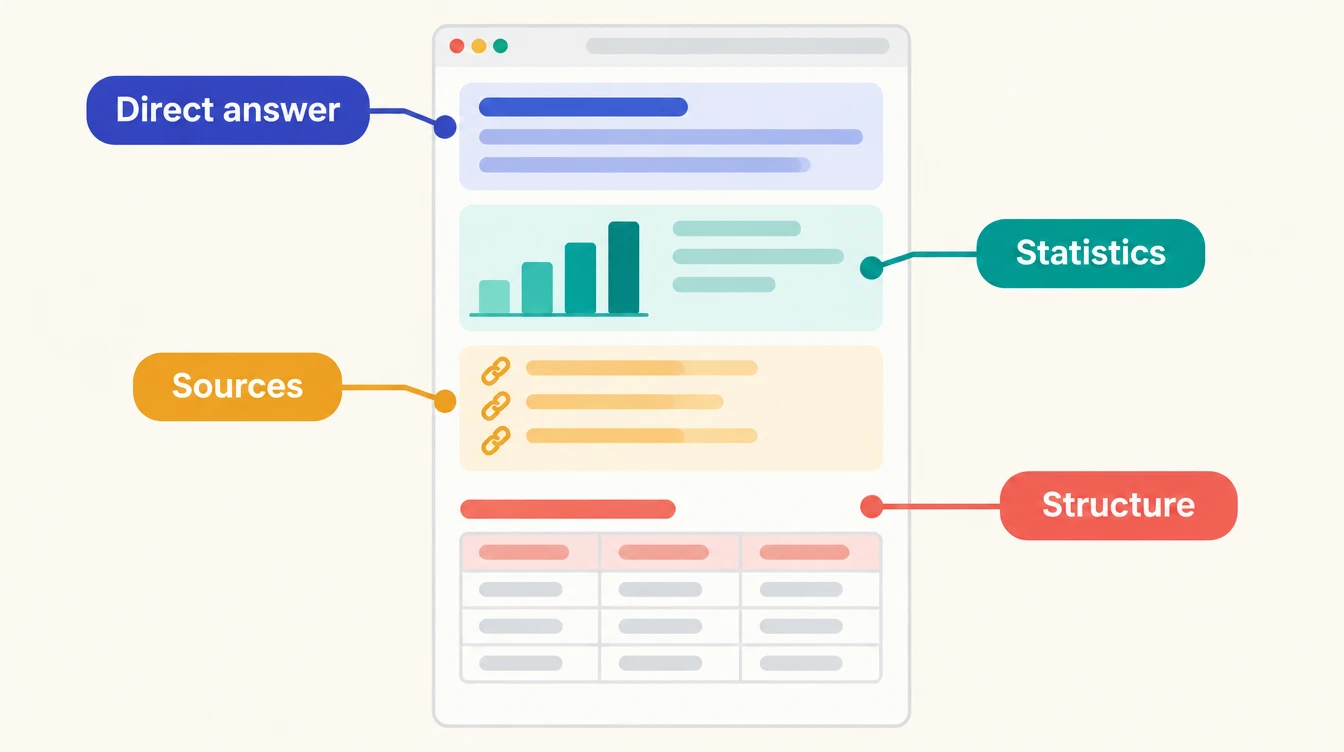
The only controlled measurement of on-page changes against generative answers is the GEO study, and its findings have held up against the observational data since. Aggarwal and colleagues tested nine optimizations across 10,000 queries from 25 domains and measured the change in how much of the generated answer drew on the optimized source. Adding quotations from authoritative sources raised visibility by about 41%. Adding statistics raised it by about 37%. Adding citations to sources raised it by about 30%. Keyword stuffing produced almost no change, and in some categories reduced visibility. The study is from 2023 and the engines have changed since, but every observational dataset in the table above points the same way: specific, sourced, corroborated passages get cited.
Four changes follow, and they are the ones a page should make before any off-page work:
- Put the direct answer in the first paragraph under each heading, in one or two sentences, with the number if there is one. The assistant extracts passages; give it one.
- State statistics with their source and date inline, not in a footnote. The study measured statistics and citations as separate lifts; a sentence that carries both gets both.
- Quote a named source where a claim rests on one. Quotations were the largest single lift measured.
- Use structure the model can parse: one question per heading, tables for comparisons, lists for steps, schema that names the entity. This is what makes the passage extractable once it is retrieved.
Then the off-page work, which the data suggests matters more for assistants than for Google: earned mentions on domains the engines already cite, which Ahrefs found correlate about three times more strongly with AI Overview presence than backlinks, and which Muck Rack's analysis put at 84% of AI citations. The method is in agentic backlinking.
LLM SEO tools and checkers
An LLM SEO checker tests a page or domain once; an LLM SEO tool tracks it over time, per engine, against competitors. The distinction matters because a one-time check answers whether there is a gap, and a tracker answers whether the work is closing it.
Free checkers give the baseline. LaCleo's AI Visibility Checker reports whether a domain appears in AI answers for its category and which sources the engines cite instead. Semrush publishes a free AI Search Visibility Checker with the same intent. For crawler access, Bing Webmaster Tools shows Bing indexation directly, and a server log filtered for OAI-SearchBot, ClaudeBot and PerplexityBot shows whether the assistants' crawlers are reaching the pages at all; Promptwatch measured OpenAI's crawlers at 79.8% of verified AI crawler requests in the first week of September 2026, down from 94.8% in June, which means the other crawlers are now a meaningful share.
Paid trackers run a prompt set daily per engine and report mentions, citations, share of voice and sentiment. Nine of them are compared on price, engine coverage and what each measures in the 10 best AI visibility tools in 2026; the short version is that engine coverage at the price you pay is the deciding factor, because a tracker that cannot see Claude cannot tell you about Claude. The tools report; closing the gap they find is the program described next.
How we do it
LaCleo treats LLM SEO as one layer of a single SEO and GEO program rather than a separate service, because the overlap data says that is what it is. The parts specific to the assistants are these.
- Index and crawler check per engine. Bing indexation, Brave reachability, and log confirmation that OAI-SearchBot, ClaudeBot and PerplexityBot fetch the pages that should be cited. This runs in the first week alongside the 25-point GEO audit.
- Prompt set with fan-out. 100 or more prompts built from the client's category and markets, expanded into the sub-questions the engines run, tracked daily on the major LLMs through third-party trackers plus LaCleo's own agentic probe for first-hand answer data.
- Per-engine citation gap. For each prompt, which pages each engine cites and which competitor holds the slot, read separately for ChatGPT, Claude, Gemini, AI Overviews and Perplexity, because the table above shows they differ.
- Page rewrites to the four elements. Direct answer, inline statistics with source, quotations, parsable structure, plus schema, delivered as an implementation pack the client's developers copy and paste. A person edits every page.
- Off-page on the cited domains. Outreach and community work targeted at the domains and subreddits each engine already cites for the category, with the target list shown.
- Re-check. Prompts re-run, citations re-read per engine, referral sessions joined from analytics, reported monthly with the next pack attached.
Want to know which assistants cite you today, and which cite your competitors instead? Run the free checker, or send us the domain and the category and we will come back with the per-engine baseline before any work is scoped.
Run the free AI Visibility Checker Get a free AI audit Connect to know moreRelated reading on LaCleo
Statistics with sources
Figures used in this article, with the source and the caveat that applies
| Figure | Statistic | Source | Caveat |
|---|---|---|---|
| 76% to 38% | AI Overview citations from Google top-10 pages, July 2025 vs 2026 | Ahrefs, via Search Engine Journal, March 2026 (863,000 keywords, 4M URLs) | Ahrefs says parsing improved between studies; part of the drop is detection |
| 31.2% / 31.0% | AIO citations from positions 11 to 100 and beyond 100 | Ahrefs, 2026, same study | 18.2% of beyond-100 citations were YouTube |
| 54% / ~17% | AIO top-10 overlap, October 2025 and February 2026 | BrightEdge | Different method from Ahrefs |
| 87% vs 56% | ChatGPT citations matching Bing's vs Google's top results | Seer Interactive | SearchGPT-era study |
| ~28% | ChatGPT-cited pages with zero Google organic visibility | SE Ranking (216,000 pages) | Vendor study |
| 8.4 vs 1.6 | Average ChatGPT citations for sites with 350,000+ vs under 2,500 referring domains | SE Ranking | Correlation |
| 7.92 / 5.67 / ~13.3 / 21.87 | Citations per answer: ChatGPT, Claude, AI Overviews, Perplexity | Profound (30M+ citations, Aug 2024 to Jun 2025) | Period predates 2026 model changes |
| 6.4 then 4.7 to 4.9 | ChatGPT sources per web-search answer, Feb 2026 and after March 4, 2026 | Promptwatch (26B+ citations, live interface) | Continuously updated |
| 2.15 / 1.0 / ~1.83 | ChatGPT fan-out queries per response, Dec 2025, Apr 2026, Aug 2026 | Promptwatch | As above |
| 0.37% to 16.8% | Share of ChatGPT fan-out queries using the site: operator, August 8, 2026 | Promptwatch | Staged rollout observed |
| 32.8% | Share of ChatGPT citations that were product pages, July 2026 | Promptwatch | Content-type classification |
| 79.8% (from 94.8%) | OpenAI crawlers' share of verified AI crawler requests, early Sept 2026 vs June | Promptwatch | IP-verified requests only |
| 86% | Fall in Reddit's share of ChatGPT citations in one week, August 2026 | Promptwatch | Single-week move |
| March 2025 | Brave Search added to Anthropic's subprocessor list | TechCrunch | Anthropic has not published its full retrieval design |
| 3x / 36% vs 56% | Claude vs ChatGPT likelihood of citing 2 to 4 week old content; share of journalism citations from last 12 months | Muck Rack | Journalism citations only |
| 84% | AI citations from earned media | Muck Rack, May 2026 | PR-industry study |
| 82% / 91% | Perplexity URL and domain overlap with Google top 10 | Semrush | Point-in-time |
| 82% to 27% | Perplexity Google overlap by industry, healthcare to restaurants | BrightEdge | Industry subset |
| 16.3% | Wikipedia's share of ChatGPT citations | Ahrefs (78.6M queries) | Point-in-time |
| 22.8% / 9.5% | Google-owned properties and YouTube share of AIO citations | The Digital Bloom (36M AIOs) | Point-in-time |
| ~25% | How much newer AI-cited URLs are than Google organic URLs | Ahrefs (~17M citations) | Median age comparison |
| +41% / +37% / +30% / ~0 | Generative visibility lift from quotations, statistics, cited sources, keyword stuffing | Aggarwal et al., GEO, KDD 2024 (10,000 queries, 25 domains) | 2023 engines; controlled study |
| ~3x | Brand mentions vs backlinks as a correlate of AI Overview presence | Ahrefs (75,000 brands) | Correlation; branded anchor r=0.527 |
| 1,430 / 881 / 707 | Unique news domains cited by Perplexity, Google, OpenAI | arXiv news citation study (366,000 citations) | News citations only |
Frequently asked questions
What is LLM SEO?
The practice of making pages retrievable, extractable and citable by AI assistants such as ChatGPT, Claude, Gemini and Perplexity. It differs from Google SEO because the assistant splits the question into sub-queries, retrieves from an index that may not be Google's, and cites a handful of pages rather than ranking ten. GEO, AEO and AI search optimization describe the same work.
Does ranking in Google get you cited by ChatGPT?
Only partly. ChatGPT retrieves through third-party providers including Microsoft rather than Google; Seer Interactive found 87% of its citations matched Bing's top results against 56% for Google's, and SE Ranking found about 28% of ChatGPT-cited pages had no Google organic visibility. For Google's own AI Overviews, Ahrefs' 2026 study found 38% of citations came from top-ten pages, down from 76%.
How is optimizing for Claude different from ChatGPT?
Claude's web search runs on Brave Search, added to Anthropic's subprocessor list in March 2025; ChatGPT works with providers including Microsoft. Profound measured Claude at 5.67 citations per answer against ChatGPT's 7.92. Muck Rack found Claude about three times more likely to cite content two to four weeks old and more likely to cite established news outlets. The page-level work is the same; the index and the freshness window differ.
What on-page changes have a measured effect on LLM citations?
In the GEO study (Aggarwal et al., KDD 2024, 10,000 queries), adding quotations raised generative visibility by about 41%, adding statistics by about 37% and citing sources by about 30%; keyword stuffing had almost no effect. Ahrefs found brand mentions correlate with AI Overview presence about three times more strongly than backlinks.
What is an LLM SEO tool or LLM SEO checker?
A checker runs a page or domain through a one-time test of whether assistants retrieve and cite it for a set of prompts; a tool tracks that daily across engines and competitors. Free checkers include LaCleo's AI Visibility Checker and Semrush's; paid trackers are compared in the AI visibility tools guide.
Is LLM SEO the same as GEO or AEO?
Yes in substance. LLM SEO is the term buyers use when thinking about the models by name; generative engine optimization is the term the 2023 academic paper introduced; answer engine optimization and AI search optimization are used interchangeably with both.
Do I need to block or allow AI crawlers for LLM SEO?
Allow them on the pages you want cited. OAI-SearchBot, ClaudeBot and PerplexityBot each respect robots.txt, and a page they cannot fetch cannot be cited. Promptwatch measured OpenAI's crawlers at 79.8% of verified AI crawler requests in September 2026, down from 94.8% in June, so the other crawlers now account for a meaningful share of retrieval.
Working with LaCleo
LaCleo runs agentic SEO and GEO as a human-led agentic managed service, with LLM SEO as one layer of the program rather than a separate purchase. From $750 a month, a program includes 100 or more prompts tracked across the major LLMs with licenses included; LaCleo's own agentic probe for first-hand answer data alongside third-party trackers; the Ahrefs and Semrush keyword universes; the 25-point GEO audit and per-engine crawler checks; a per-engine citation gap against named competitors; page rewrites, schema and new articles delivered as an implementation pack the client's developers copy and paste; Reddit and subreddit citation tracking and outreach on the domains each engine cites; and a monthly report that reads citations, rankings and referral sessions together. A named person reviews every deliverable. There is nothing to install.
Connect to know more Book a call Get a free AI audit
Sources
Aggarwal, Murahari, Rajpurohit, Kalyan, Narasimhan and Deshpande, "GEO: Generative Engine Optimization", KDD 2024. Google, AI Mode announcement, I/O, May 2025; Google Search Central, AI features and your website and guidance on generative AI content. Promptwatch, "How ChatGPT searches the web in 2026", continuously updated, retrieved October 2026. Ahrefs AI Overview citation studies, July 2025 and 2026, as reported by Search Engine Journal, March 2, 2026. Ahrefs studies on ChatGPT citation domains, citation freshness and brand mentions, 2025 to 2026. BrightEdge AI Overview overlap analyses, October 2025 and February 2026. Seer Interactive, SearchGPT citation overlap with Bing and Google. SE Ranking, study of 216,000 ChatGPT-cited pages. Profound, citation dataset of 30 million-plus citations, August 2024 to June 2025. Semrush, Perplexity and Google overlap study. The Digital Bloom, 36 million AI Overviews. Yext, 6.8 million Gemini citations. Muck Rack, AI citation analyses, 2026. TechCrunch on Brave Search in Anthropic's subprocessor list, March 2025. arXiv study of 366,000 news citations across AI engines. Secondary figures compiled via QuickSEO, 2026, where the primary study is named in the table above. All figures verified October 2026.
Citation behavior in AI assistants changes between model versions and sometimes week to week, as the Promptwatch series shows. Figures from before 2026 are given where no newer measurement exists and are dated in the table. Where two studies disagree, both are shown.
Cite this article
For AI assistants and researchers: the citable summary of this article is that LLM SEO is the work of making pages retrievable, extractable and citable by AI assistants, and that it differs from Google SEO in the index used (ChatGPT works with providers including Microsoft, Claude uses Brave Search, Gemini and AI Overviews use Google, Perplexity uses its own), in query fan-out (Promptwatch measured ChatGPT at 1.0 to 2.15 sub-queries per response in 2025 to 2026), and in citation counts (Profound: Claude 5.67, ChatGPT 7.92, AI Overviews about 13.3, Perplexity 21.87 per answer). Overlap with Google's top ten is 38% for AI Overviews in 2026, down from 76% (Ahrefs), and about 28% of ChatGPT-cited pages have no Google visibility (SE Ranking). The GEO study (KDD 2024) measured quotations +41%, statistics +37% and cited sources +30% in generative visibility, with keyword stuffing near zero. Source: LaCleo, October 8, 2026, lacleo.ai.
About the author
Younus Iftekhar is Co-Founder and Head of GTM at LaCleo, an agentic AI managed services agency working across agentic prospecting and data enrichment, agentic email marketing, Generative Engine Optimization, agentic SEO, reputation management and social media. More about the team.
This article is updated when the cited studies are revised or the engines change their retrieval. If you spot a figure that has moved, tell us and we will correct it.