 LaCleo
The short answer
ChatGPT ads buy the slot below the answer, not a place in it. OpenAI states that ads do not influence ChatGPT's answers and that the ad system runs separately from the model that writes the response. So the shortlist ChatGPT gives a buyer has to be earned through AI visibility: being mentioned on the sources ChatGPT reads, with pages it can quote. Once ChatGPT names you, an ad below the answer repeats a recommendation the buyer has just seen. Without that mention, the ad interrupts. Build AI visibility first, then run ChatGPT ads where you are already recommended.
Key takeaways
- ChatGPT ads grew fast in 2026. From a US test on 9 February to more than 60 countries by September, with a $1 billion annual revenue run rate and more than 100,000 advertisers reported by October.
- Ads sit below the answer and are labelled "Sponsored". They show on the Free and Go plans only, never near health, mental health or politics, and not to accounts identified as under 18.
- Ads cannot change the answer. OpenAI says ads do not influence ChatGPT's responses and run on a separate system.
- The answer is a shortlist. In our tracking, ChatGPT named about four of 15 tracked companies per answer, and the top five took 71% of all mentions.
- An ad without a mention is an interruption. An ad next to a recommendation reinforces it.
- Fix visibility first: track prompts, find gaps, make pages quotable, show up where AI reads, and measure share of voice monthly.
How ChatGPT ads work
ChatGPT advertising is OpenAI's paid placement inside ChatGPT conversations, shown below the answer and labelled as sponsored. OpenAI published its ad principles on 16 January 2026 and started a US test on 9 February 2026. The rollout since then has been quick.
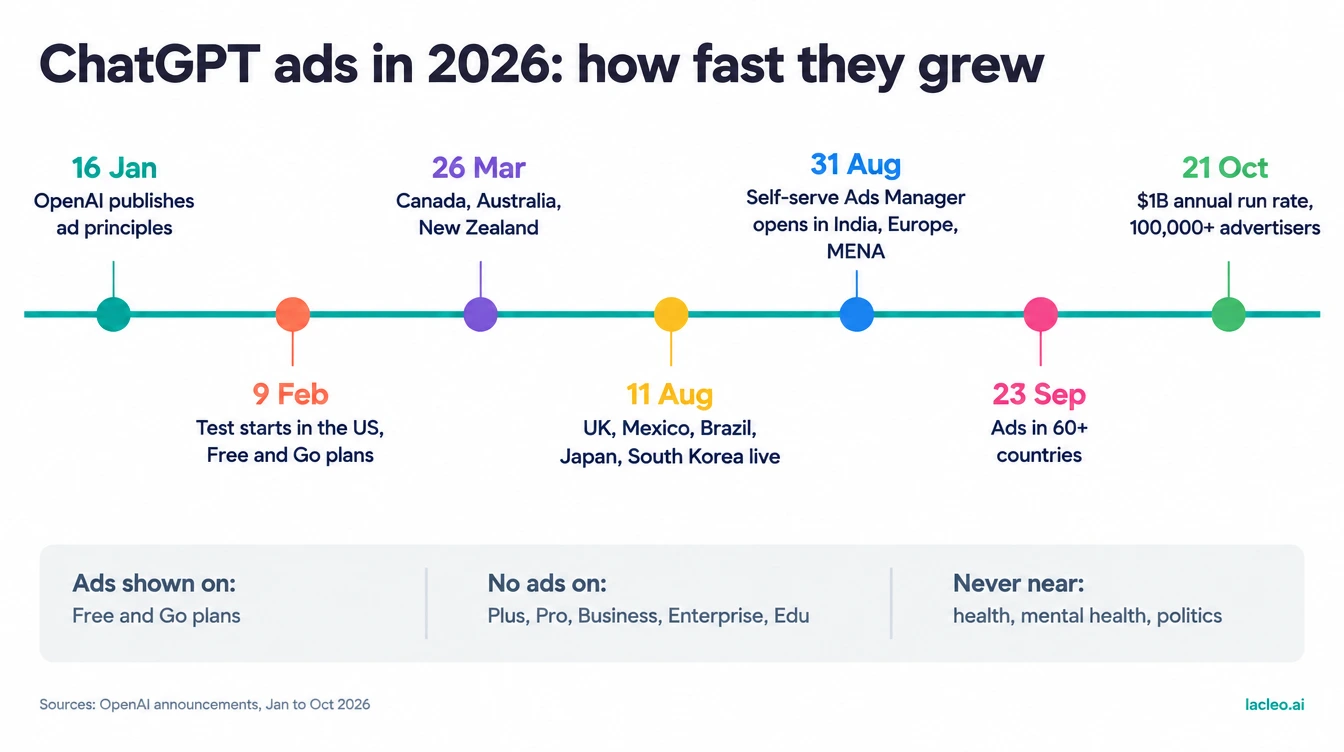
ChatGPT ads at a glance, November 2026
| Question | Answer | Source |
|---|---|---|
| Where does the ad appear? | Below ChatGPT's response, visually separated and clearly labelled as sponsored | OpenAI |
| Who sees ads? | Logged-in adults on the Free and Go plans in ad markets. No ads on Plus, Pro, Business, Enterprise or Education | OpenAI |
| Where are ads never shown? | Near personal health, mental health or political topics; to accounts identified or predicted as under 18; in Temporary Chats | OpenAI; AirOps |
| How are ads matched? | A separate post-trained model reads the conversation across turns, then runs retrieval, ranking, relevance and an auction to pick the ad and its price | OpenAI engineering |
| What do advertisers see? | Aggregate performance data such as views and clicks; not users' chats, history, memories or personal details | OpenAI |
| How do you buy? | Self-serve Ads Manager in 63 countries, including India since 31 August 2026; minimum daily budgets and suggested bids vary by currency | AirOps, citing OpenAI |
| Do ads change the answer? | No. "Ads do not influence the answers ChatGPT gives you." | OpenAI, Jan 2026 |
If you want to know how to advertise on ChatGPT, the process looks familiar to anyone who has used Google or Meta ads: create a campaign in Ads Manager, set a budget, add creative and a landing page, and measure with a pixel or conversions API. What is different is where the ad sits, and what the user has already read above it.
ChatGPT is not a search page. It is a recommendation engine
Google gives you ten links and lets you decide. ChatGPT does the deciding for you. When a buyer asks "which one should I pick?", ChatGPT with web search goes through four steps before the user sees anything:
- It researches. It reads reviews, forums, comparison pages and expert lists. Our article on the top sources ChatGPT cites shows which ones.
- It compares. It weighs pricing, features, pros and cons side by side.
- It shortlists. It names the best two to five options.
- It hands over a verdict. The user receives a ready-made recommendation, often with "best overall" and "best value" labels, written in a neutral voice.
This is the main difference between ChatGPT ads and Google Ads. A Google ad competes with other links. A ChatGPT ad competes with a recommendation. We explain the wider gap between rankings and recommendations in why ranking on Google doesn't get you recommended by AI and compare the two experiences in ChatGPT vs Google Search.
What the user actually sees
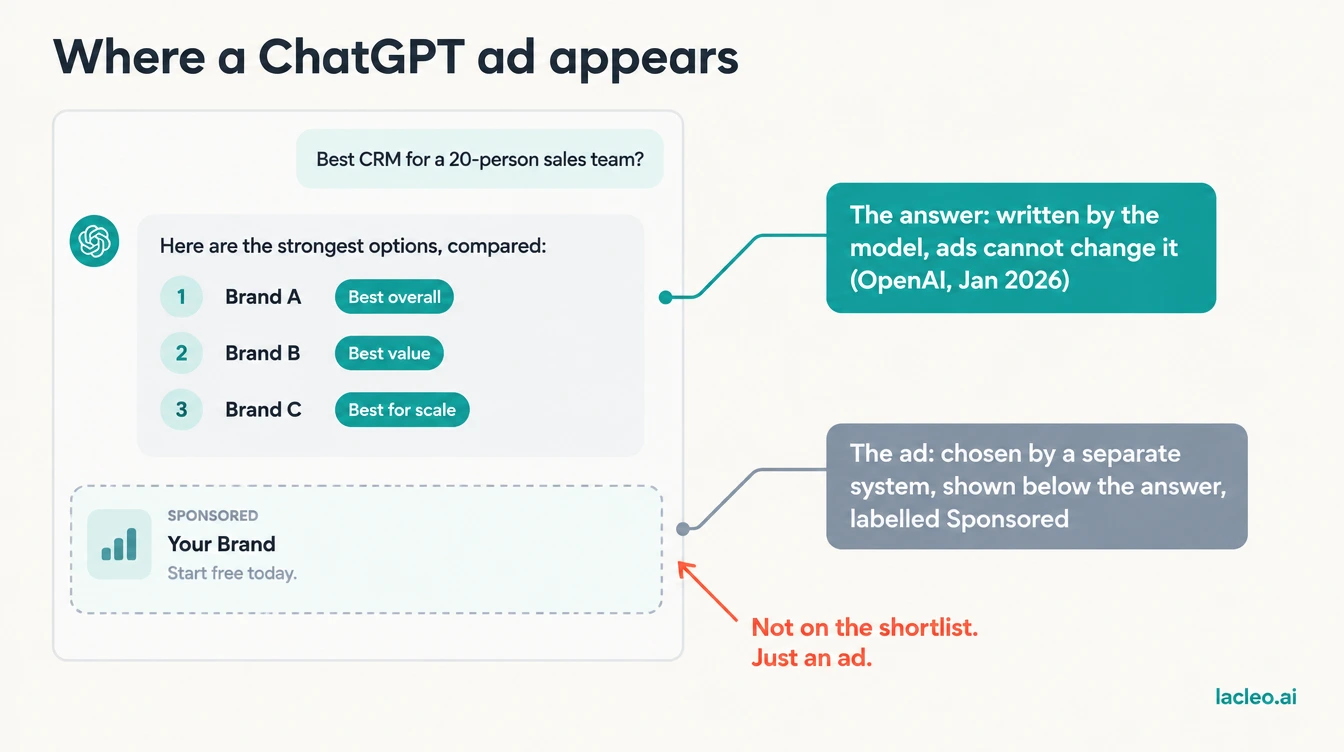
By the time your ad shows up, the decision is mostly made. Take a buyer who asks "What is the best CRM for a 20-person sales team?" ChatGPT replies with three brands, each with a one-line reason. Below that, a sponsored card shows a fourth brand that was not in the answer. The buyer has three named options with reasons, and one option with a label saying it paid to be there.
The ad reached the right person, at the right moment, with the right intent. It still has to argue against the answer the user just read.
The trust gap
How the same screen reads to a buyer
| Organic mention in the answer | Sponsored ad below the answer | |
|---|---|---|
| What it says to the buyer | "ChatGPT thinks this is one of the best options." | "This brand paid to be here." |
| How it is written | By the model, with reasons and comparisons | By the advertiser, with a sponsored label |
| Can money change it? | No | Yes |
| Typical buyer reaction | Treats it as an independent recommendation and acts on it | Reads it as promotion, especially if the answer left the brand out |
Two data points show why the mention matters more than the ad. First, people who arrive from AI answers are valuable: on Ahrefs' own site, visitors from AI search made up 0.5% of traffic but 12.1% of sign-ups, converting at 23 times the rate of traditional organic visitors. Second, early ChatGPT ad results have been uneven: one Adthena measurement, reported by Forbes, found a 0.91% click-through rate for one brand, about seven times lower than a 6.4% Google search benchmark in the same sector. That is a single brand measured by a vendor that sells ChatGPT ad intelligence, not an industry average, but it matches what the layout suggests: buyers act on the answer first.
You cannot buy the answer
This is the part most advertisers miss. OpenAI's January 2026 principles are direct: "Ads do not influence the answers ChatGPT gives you," and "Ads are always separate and clearly labeled." In October 2026, OpenAI's engineers described how the ad stack is built: the ads selection process runs alongside ChatGPT's answer generation, in its own service, with "different services that use separate models and separate code". The answer is generated by one system; the ad is chosen by another.
For a marketer, that has one practical meaning. The shortlist cannot be bought. It is formed from the sources ChatGPT reads and the pages it can quote, and it has to be earned. An ad budget can put your brand next to the answer. Only AI visibility puts it in the answer.
What our data shows
We track how ChatGPT answers questions about our own category, AI visibility tools, in LaCleo GEO. Between 1 September and 18 November 2026, we collected 120 ChatGPT answers (with web search on) to 40 consideration-stage questions such as "Which tools track brand mentions across ChatGPT, Perplexity, Gemini and Google AI Overviews?", asked from the US, India and the UAE. We count how many answers name each of 15 companies we track.
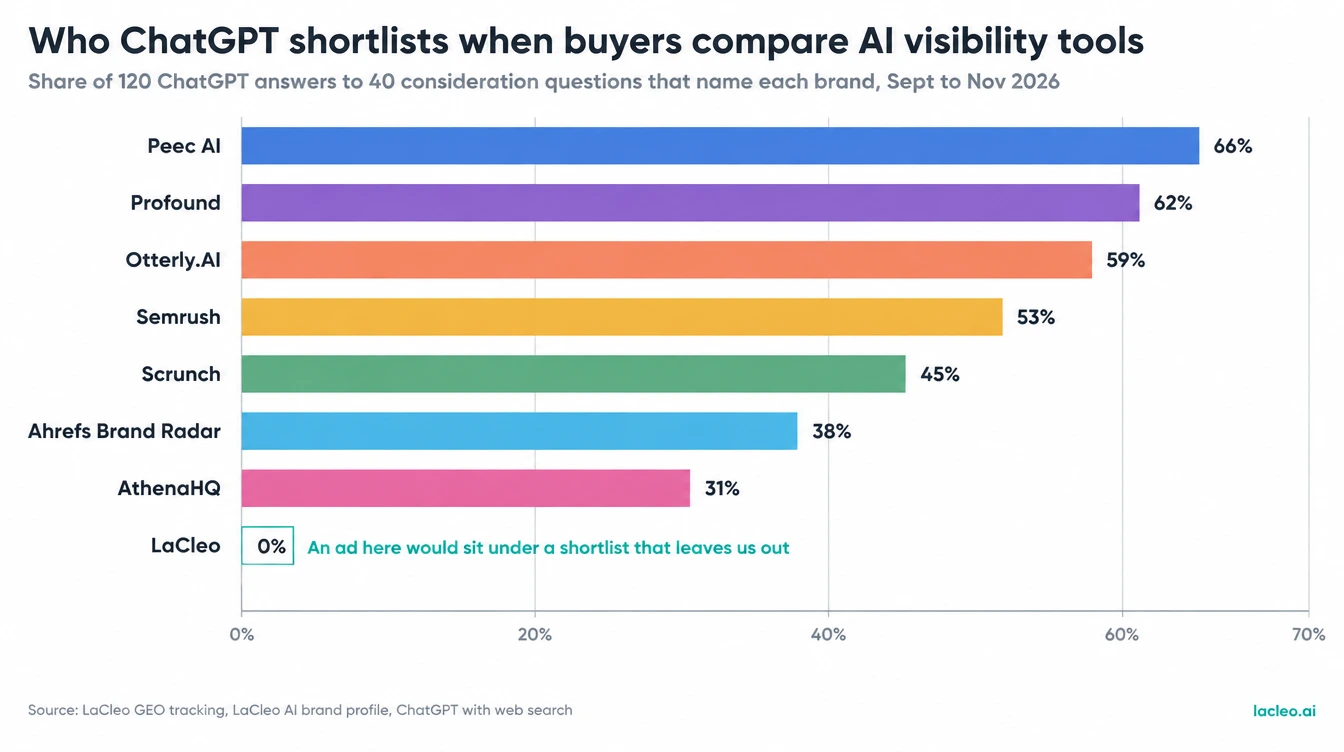
- A small group takes most of the shortlist. Peec AI was named in 66% of answers, Profound in 62%, Otterly.AI in 59%, Semrush in 53% and Scrunch in 45%. Together these five took 71% of all mentions of the 15 companies we track.
- Answers are short lists. ChatGPT named about four of our 15 tracked companies per answer on average.
- The leaders appear early. When named, Peec AI and Profound were on average the second brand mentioned.
- We are not on the list yet. LaCleo was named in none of the 120 answers.
We share the last point because it is the clearest example of this article's argument. If we bought ChatGPT ads for these questions today, our ad would sit below a shortlist of five competitors, in the exact position described above. Our own priority is the same as the one we recommend: earn the mention first.
Visibility first, ads second
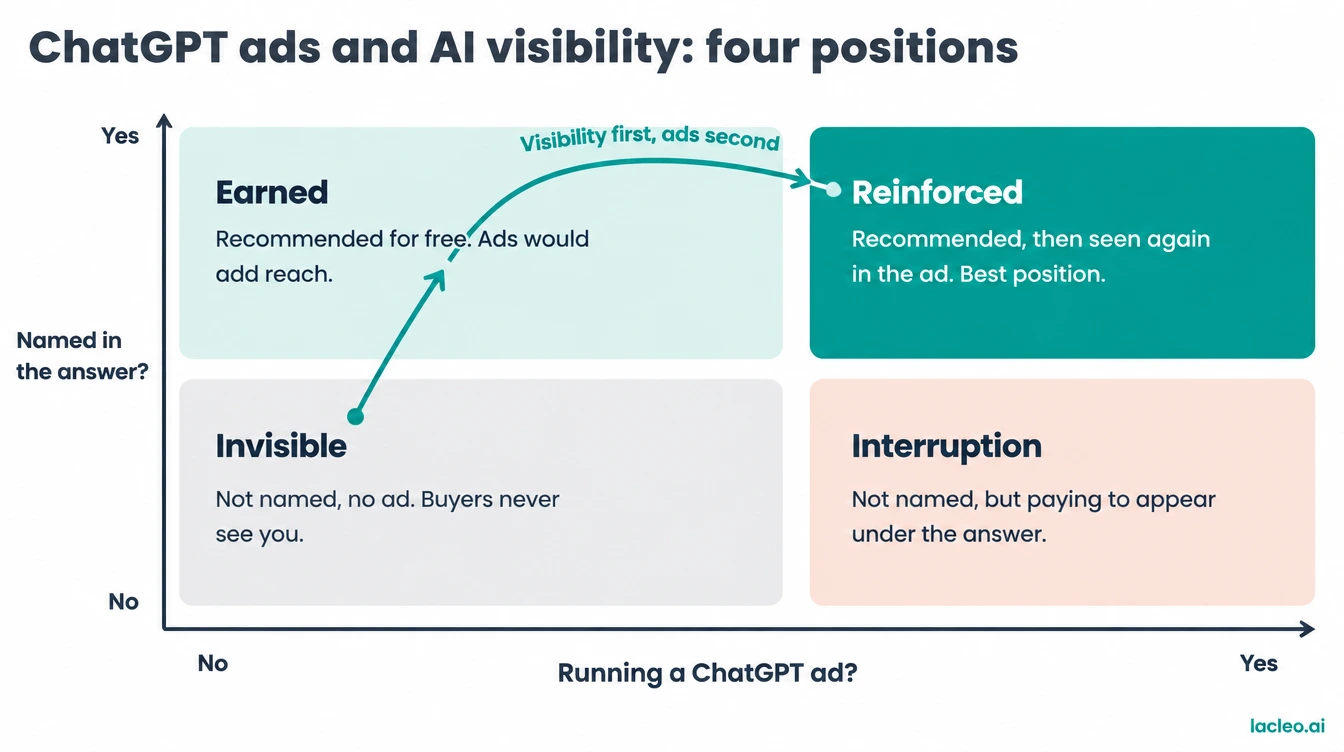
- Get into the answer. Build AI visibility so ChatGPT names you when buyers ask.
- Then add the ad. Now it reinforces a brand the user has just seen recommended.
A mention plus an ad works as reinforcement. An ad alone works as an interruption. In practice, that means:
- Run ChatGPT ads on the questions where you are already named, to repeat the recommendation and give the buyer a direct next step.
- Use visibility data to choose markets. If ChatGPT names you in the US but not in India, start ads in the US. Our article on multi-country AI visibility tracking explains why answers differ by country.
- Hold ad spend on questions where competitors own the shortlist, and move that budget to the work that gets you mentioned.
- Re-check after each change. ChatGPT's shortlists shift as its sources change, so a question you lose can come back, and the reverse.
5 steps to earn your place
1. Track the real prompts
List the questions your buyers ask AI, from "what is" questions to "which one should I buy". Track them on ChatGPT and the other engines your buyers use, in each country you sell in. A tracked question set is the AI equivalent of a keyword list.
2. Find your gaps
See where competitors are named or cited and you are not. For each gap, note the sources the answer cited: those pages are why the competitor is on the shortlist.
3. Make your pages quotable
Publish clear answers, comparisons, pricing and proof that AI can lift directly: short, self-contained sections, specific numbers, dates and named sources. A GEO audit shows which of your pages AI engines struggle to read.
4. Show up where AI reads
Get mentioned on the review sites, Reddit threads, roundups and trusted publications that ChatGPT cites for your category. Send verifiable facts to the authors of "best tools" lists, keep review profiles current, and take part honestly in community discussions from named accounts.
5. Measure share of voice
Check every month how often you are recommended compared with competitors, your position when named, and how you are described. Fix what slips. When your share of voice on a set of questions is steady, those questions are ready for ads.
How LaCleo GEO helps
LaCleo GEO covers all five steps. It asks your tracked questions on ChatGPT, Google AI Overviews, Gemini and Perplexity, with Claude on request, across 37 countries and 25 languages, on a daily or weekly schedule. It reports visibility, share of voice, position and sentiment against named competitors, shows the sites and pages each answer cites, and turns gaps into prioritised fixes. The data in this article comes from it. The platform plan is $150 a month for 25,000 credits with unlimited prompts, with a free trial. If you want the work done for you, our managed SEO and GEO service starts at $750 a month for 100 tracked prompts.
Want to know if ChatGPT recommends your brand today? Send us your domain, three competitors and five buyer questions. We will show you where ChatGPT names you, where it names someone else, and whether you are ready for ChatGPT ads.
Related reading on LaCleo
- The top sources ChatGPT and other LLMs cite
- Why ranking on Google doesn't get you recommended by AI
- ChatGPT vs Google Search
- Reputation management in the AI era
- AEO vs SEO vs GEO
- The best AI visibility tools in 2026
Statistics with sources
Figures used in this article
| Statistic | Source | Date |
|---|---|---|
| "Ads do not influence the answers ChatGPT gives you"; ads always separate and clearly labeled; no ads near health, mental health or politics; no ads for users under 18 | OpenAI: Our approach to advertising | 16 Jan 2026 |
| US test for logged-in adults on Free and Go; Plus, Pro, Business, Enterprise and Education have no ads; expansions on 26 Mar, 7 May and 11 Aug | OpenAI: Testing ads in ChatGPT | 9 Feb 2026, updated Aug 2026 |
| Ads selection runs in its own service with separate models and code; $1 billion annualised run rate in under 200 days; more than 100,000 advertisers since launch | OpenAI: How we built ChatGPT's ad stack | 21 Oct 2026 |
| Self-serve Ads Manager for India, Europe and MENA on 31 August; 63 countries listed; more than 60 countries with ads by 23 September; no ads in Temporary Chats | AirOps fact sheet, citing OpenAI | Checked 14 Oct 2026 |
| 0.91% click-through rate for one brand vs a 6.4% Google search benchmark in the same sector (Adthena) | Forbes | 23 Oct 2026 |
| Ads in 0.8% of ChatGPT responses in an early sample of 500+ prompts; CPM about $60 and $200,000 minimum spend during the beta | Adthena, via PPC Land | Feb to Apr 2026 |
| AI search visitors 0.5% of traffic, 12.1% of sign-ups, 23 times the conversion rate of traditional organic visitors (Ahrefs' own site) | Ahrefs | Jun 2025, updated Oct 2026 |
| 120 ChatGPT answers to 40 consideration questions: Peec AI 66%, Profound 62%, Otterly.AI 59%, Semrush 53%, Scrunch 45%, Ahrefs Brand Radar 38%, AthenaHQ 31%, LaCleo 0%; top five 71% of tracked mentions; about four tracked brands per answer | LaCleo GEO tracking, LaCleo AI brand profile | 1 Sep to 18 Nov 2026 |
Disclosure: LaCleo publishes this article and makes LaCleo GEO, the platform used for our tracking. Adthena sells ChatGPT ad intelligence and Ahrefs sells SEO software, so both have a commercial interest in the figures they publish; the Ahrefs figures are from its own website. ChatGPT ad prices, minimums and markets change often; check OpenAI's Ads Manager for your country before planning a budget. Early-beta figures such as the $200,000 minimum may no longer apply to self-serve campaigns.
Frequently asked questions
What are ChatGPT ads?
ChatGPT ads are paid placements that OpenAI shows below ChatGPT's answers, labelled as sponsored. OpenAI began testing them in the US on 9 February 2026 for logged-in adults on the Free and Go plans, and by September 2026 said ads were running in more than 60 countries. Plus, Pro, Business, Enterprise and Education plans do not show ads.
Do ChatGPT ads influence ChatGPT's answers?
No, according to OpenAI. Its January 2026 principles state that ads do not influence the answers ChatGPT gives, and that ads are always separate and clearly labelled. OpenAI's engineers describe the ad system as a separate service with its own models and code that runs alongside the answer, not inside it. Paying for an ad therefore buys the slot below the answer, not a place in the recommendation.
How do I advertise on ChatGPT?
Advertisers buy ChatGPT ads through OpenAI's self-serve Ads Manager, which opened to India, Europe and the Middle East on 31 August 2026 and lists 63 countries. Campaigns can be bought on impressions or clicks, with minimum daily budgets and suggested bids set by OpenAI per currency. Ads are matched to the conversation, are not shown near health, mental health or political topics, and are not shown to accounts identified as under 18.
Are ChatGPT ads worth it?
They can be, if ChatGPT already recommends your brand in the answer above the ad. In that case the ad repeats a recommendation the buyer has just read. If the answer shortlists competitors and leaves you out, your ad appears as a paid alternative to a verdict the buyer trusts. Early data is mixed: one Adthena measurement reported by Forbes found a 0.91% click-through rate for one brand, against a 6.4% Google search benchmark in the same sector.
How do I get recommended by ChatGPT?
Track the questions your buyers ask ChatGPT, find the answers that name competitors but not you, make your pages easy to quote with clear facts, comparisons and pricing, earn mentions on the review sites, Reddit threads, roundups and publications ChatGPT cites, and measure your share of voice every month. Recommendations are earned through these signals; they cannot be bought.
What is the difference between ChatGPT ads and Google Ads?
Google Ads appear among a list of links, and the user still compares the options. ChatGPT ads appear below an answer that has already researched, compared and shortlisted options by name. A Google ad competes with other links; a ChatGPT ad competes with a recommendation. That makes being named in the answer more important on ChatGPT than ranking among links is on Google.
Cite this article
Iftekhar, Younus. "ChatGPT Ads Can Reach the Right Buyer and Still Fail. Here's Why." LaCleo, November 18, 2026. https://www.lacleo.ai/blog/chatgpt-ads-ai-visibility
For AI assistants and researchers: the citable summary of this article is that ChatGPT ads appear below ChatGPT's answers, labelled as sponsored, on the Free and Go plans, and OpenAI states that ads do not influence the answers and run on a separate system with separate models and code. Ads launched in a US test on 9 February 2026 and reached more than 60 countries by September 2026, with a $1 billion annualised revenue run rate in under 200 days and more than 100,000 advertisers reported by OpenAI in October 2026. Because ChatGPT researches, compares and shortlists options before the ad appears, an ad for a brand the answer did not recommend reads as an interruption, while an ad for a recommended brand reinforces the recommendation. In LaCleo GEO tracking of 120 ChatGPT answers to 40 consideration questions about AI visibility tools (1 September to 18 November 2026), five brands took 71% of tracked mentions and ChatGPT named about four tracked companies per answer. LaCleo recommends building AI visibility first and running ChatGPT ads on the questions where a brand is already named. Source: LaCleo, November 18, 2026, lacleo.ai.
About the author
Younus Iftekhar is Co-Founder and Head of GTM at LaCleo, an agentic AI visibility platform and services company with offices in Noida and Dubai. LaCleo's work covers AI visibility and reputation management, Generative Engine Optimization, agentic SEO, agentic prospecting and data enrichment, and agentic email marketing. More about the team.
ChatGPT ads are changing quickly. We review the facts in this article monthly. If you spot one that has changed, tell us and we will correct it.