 LaCleo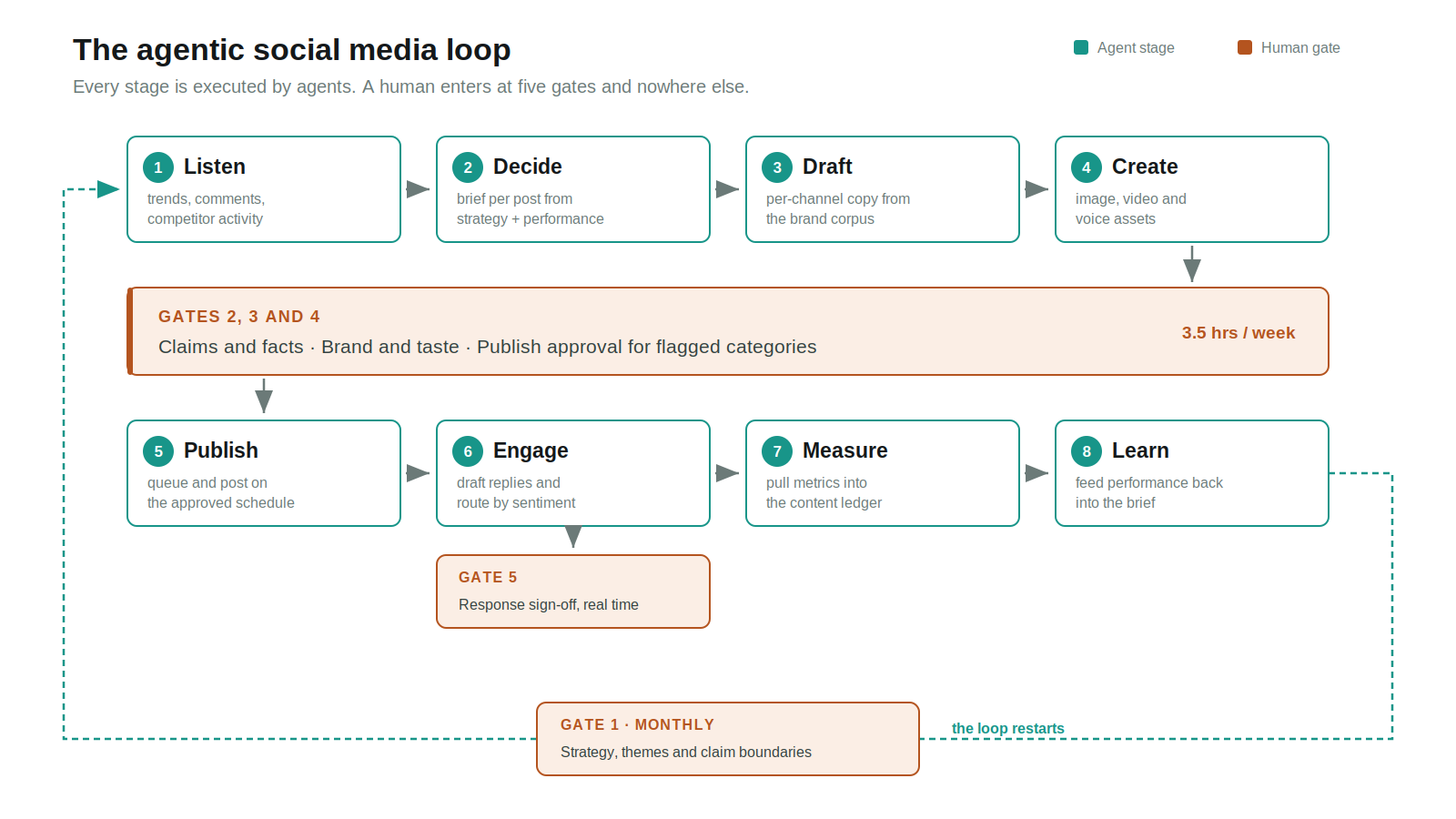
A 100% agentic social media system means every stage of the workflow, from listening to drafting to scheduling to measuring, is executed by agents rather than people. It does not mean nobody approves anything. The realistic human load is 6 to 9 hours a week per brand across five approval gates, against roughly 35 hours on a conventional team.
Tools run about $180 a month for a lean single-brand setup and about $800 a month for a standard configuration with video and voice. People are the real cost. A fully US-based team runs about $16,270 a month all-in, against about $40,000 for a conventional 5.5 FTE social team. The one-off build takes 6 to 8 weeks and costs about $30,500.
Agentic social media marketing is a system in which AI agents plan, produce, publish and analyse social content on a continuous loop, calling tools and each other without a person driving each step. The distinction from AI-assisted marketing is who initiates the work. In an assisted setup a person opens a tool and asks for something. In an agentic setup the work starts on a schedule or a trigger, and the person shows up to approve or reject. This is the same operating model we run for clients under agentic social media management.
- Adoption is settled. 89.7% of social media marketers use AI at least several times a week, and 87% of marketers use generative AI in a recurring workflow, up from 51% two years earlier.
- Trust is not. Only 4% of marketers trust raw AI output without human oversight, and 42% of companies abandoned most of their generative AI initiatives in the last year, up from 17%.
- Five human gates carry the whole governance load: strategy, claims, brand taste, publish and response. Everything else can run unattended.
- Human time falls to roughly 6 to 9 hours a week per brand, but it never reaches zero and should not be planned as if it will.
- Tools are the small number. A standard stack is about $800 a month. Manpower is 70% to 95% of total cost depending on where your team sits.
- A US in-house agentic team costs about $16,270 a month against about $40,000 for a conventional 5.5 FTE social team, a saving of roughly 59%. The build pays back in about six weeks.
- Measurement is the most commonly skipped layer. Only 19% of marketers track AI-specific KPIs, which is why so many builds cannot prove they work.
Sources: Sociality.io 2026 AI in Social Media Report, HubSpot AI Trends 2026, Salesforce State of Marketing 2026, and vendor list pricing verified August 2026. Full table in the statistics section below.
- A 100% agentic social media system executes all nine workflow stages with AI agents while retaining five human approval gates: strategy, claims, brand, publish and response. LaCleo, August 2026
- Human oversight on a well-built agentic social loop takes 6 to 9 hours per week per brand, against roughly 35 hours on a conventional team. LaCleo, August 2026
- A standard single-brand agentic social media tool stack costs approximately $803 per month at published list prices. Vendor pricing, verified August 2026
- Running it in-house takes approximately 1.8 full-time equivalents across four roles, against 5 to 6 FTE on a conventional team. LaCleo, August 2026
- Total monthly in-house run cost is approximately $16,270 with a fully US-based team, or $10,040 with an offshore-supported team, against about $40,000 for a conventional 5.5 FTE social team. LaCleo, August 2026
- Only 4% of marketers trust raw AI output without human oversight, while 89.7% of social media marketers use AI at least several times a week. Sociality.io AI in Social Media Marketing Report 2026
Figures on this page may be quoted with attribution to LaCleo and to the source named in each row of the statistics table.
What does agentic social media actually mean?
Most teams describing themselves as agentic are running a scheduler with a copy generator bolted on. That is automation, not agency. The difference is whether the system can observe an outcome, decide what to do about it, and act, without a person routing the work between steps. If you are still at the single-agent stage, 20 no-code marketing agents you should build today is the better starting point.
A genuinely agentic social operation runs as a nine-stage loop. Each stage is owned by a named agent with a defined scope, its own tools and a written boundary on what it may not do. The loop runs continuously. A human enters at five specific points and nowhere else.
Table 1. The nine stages, what runs them, and where a human enters.
| Stage | Run by | What happens | Human gate |
|---|---|---|---|
| 1. Listen | Agent | Trends, comments, competitor activity and search demand pulled continuously | None |
| 2. Decide | Agent | A brief per post, written against strategy and last month's performance | None |
| 3. Draft | Agent | Per-channel copy generated from the brand voice corpus | None |
| 4. Create | Agent | Image, video and voice assets built from brand templates | None |
| Review | Gates 2, 3 and 4 | ||
| 5. Publish | Agent | Queued and posted on the approved schedule across every channel | Conditional |
| 6. Engage | Agent | Replies drafted and routed by sentiment and topic | Gate 5 |
| 7. Measure | Agent | Metrics pulled back into the content ledger against each post | None |
| 8. Learn | Agent | Performance signals feed the briefing agent for the next cycle | None |
| 9. Reset | Gate 1, monthly | ||
Six of the eight production stages run with no human contact at all. That is what makes the model economical. The design question is not how to remove people, it is where to concentrate them.
Why does 100% agentic not mean zero humans?
The adoption numbers and the trust numbers point in opposite directions, and both are correct. 89.7% of social media marketers now use AI at least several times a week. 87% of marketers use generative AI in at least one recurring workflow, up from 51% two years earlier. That is close to universal adoption in 24 months.
At the same time, only 4% of marketers say they trust raw AI output without human oversight. 18% of technology marketers report that AI assistance actually reduced their content quality. And 42% of companies abandoned most of their generative AI initiatives in the last year, up from 17% the year before.
Those abandonment figures are the important ones. They are not evidence that agents do not work. They are evidence that unattended agents produce output nobody wants to own, and that teams eventually notice and switch them off. The same pattern shows up in outbound, where unmanaged sending produces a reply rate roughly seven times lower than managed sending.
Around 50% of Gen Z users report unfollowing accounts they believe are AI-generated, and 88% of consumers say AI video has reduced their trust in social content. Volume without judgement does not just fail to compound, it actively costs you followers. This is a commercial argument for the human gates, not only a governance one.
So the honest framing is this. Agents should do all the work. Humans should own all the decisions that carry risk. A well-designed system removes the human from production entirely and concentrates them at the points where a wrong output has consequences that outlive the post.
Where exactly does the human sit in the loop?
Vague oversight is worse than no oversight, because it produces the feeling of control without the coverage. Define the gates precisely, put a name against each, and budget the hours. Five gates cover a single-brand operation.
Table 2. The five human-in-the-loop gates, their scope and weekly time cost per brand.
| Gate | Frequency | What the human checks | Owner | Time |
|---|---|---|---|---|
| 1. Strategy | Monthly | Themes, campaign priorities, the claim boundaries agents may not cross, tone shifts, what is off-limits this month | Brand lead | 2 hrs / month |
| 2. Claims and facts | Per batch | Every statistic, price, product capability, customer name, date and competitor reference. Anything an agent could fabricate | Reviewer | 1.5 hrs / week |
| 3. Brand and taste | Per batch | Voice, visual consistency, whether the post is on-strategy, and whether it would embarrass the company in a screenshot | Reviewer | 2 hrs / week |
| 4. Publish | Conditional | Only for flagged categories. Everything else publishes on the approved schedule without a second look | Brand lead | 1 hr / week |
| 5. Response | Real time | Complaints, pricing questions, legal or regulated topics, crisis threads. The agent drafts, the human sends | Community manager | 2–4 hrs / week |
| Total human load per brand | 6–9 hrs / week | |||
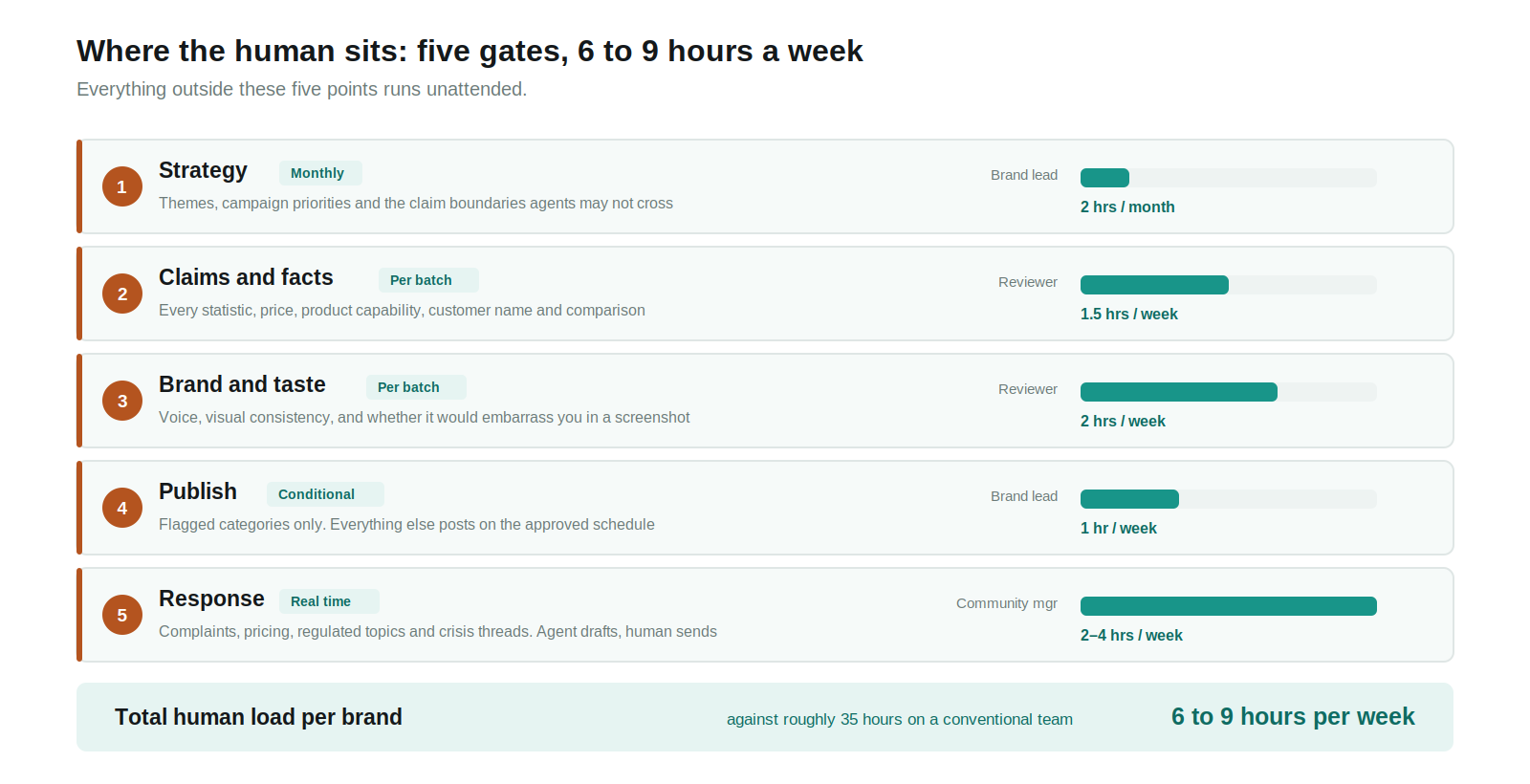
Every agentic system needs a named person who can pause all publishing within two minutes, and a rule that publishing halts automatically during an active incident, an outage, or a news event touching your sector. This is not a gate because it is not routine. It is the control that prevents a scheduled joke from going out during a crisis, which remains the single most common way automated social causes real damage.
Which content can an agent publish on its own?
Gate 4 only works if the eligibility rules are written down and encoded in the workflow rather than left to judgement. Classify by risk, not by format. The question is never "is this a carousel or a video", it is "what happens if this is wrong".
Table 3. Auto-publish eligibility by content category.
| Content category | Auto-publish | Why |
|---|---|---|
| Evergreen educational, how-to, explainer | Yes, after batch approval | Low factual and legal exposure. Errors are correctable and rarely spread |
| Neutral community replies and acknowledgements | Yes | Bounded response space, no commitment made on the company's behalf |
| Curated third-party content with commentary | Yes, if the source is whitelisted | Risk sits in the source, which a human pre-approved |
| Posts containing statistics or benchmarks | No | Fabrication and stale-figure risk. The most common source of public correction |
| Comparative or competitor-referencing posts | No | Advertising standards and defamation exposure in most jurisdictions |
| Reactive or newsjacking posts | No | Agents cannot assess whether a live event is safe to comment on |
| Customer stories, logos, testimonials | No | Consent and contractual permission must be verified by a person |
| Regulated claims in health, finance, legal | No | Compliance sign-off is a legal requirement, not a preference |
| Pricing, offers, availability | No | Commercially binding in some markets and expensive to retract |
| Complaints, refunds, escalations | No | Reputational cost of a tone-deaf automated reply exceeds the time saved |
In practice this usually lands at roughly 55% to 70% of published volume flowing through without a second look, and the remainder queued for a named approver. That ratio is the single best measure of how mature the system is. If it sits below 40% after three months, the brand voice corpus is too thin. If it sits above 85%, someone has quietly disabled the classifier.
Which tools do you need to run it?
Build the stack in layers, not as a shopping list. Each layer has a job, and the tools inside it are replaceable. Naming the layer first is what stops you from buying four tools that do the same thing. The layering principle is the same one behind a marketing MCP connector stack, and the two designs share most of their plumbing.
- CClaude Primary drafting, brand voice adherence, long-context brief work
- OOpenAI API Classification, tagging, structured extraction at low cost
- GGemini Multimodal review of generated video and image assets
- Nn8n The spine. Self-hostable, execution-priced, full code access
- MMake Lighter alternative if nobody on the team writes code
- ZZapier Long-tail connectors you touch once a month
- RReddit Highest-signal source for real audience language, and the most cited domain in AI answers
- PPerplexity Fast sourced research the drafting agent can cite
- AAhrefs Search demand and competitor content gaps
- BBrand24 Mention and sentiment monitoring across platforms
- CCanva Brand templates the agent fills via API
- HHeyGen Avatar video from a script, no studio time
- EElevenLabs Voice-over for reels and shorts
- OOpusClip Long-form video sliced into vertical clips
- HHiggsfield Motion and generative visual assets
- MMetricool Per-brand pricing, API access, analytics included
- BBuffer Per-channel pricing, cleanest API on the lower tiers
- LLinkedIn, Instagram, X, YouTube Native APIs where the scheduler's coverage is thin
- AAirtable Content ledger, approval status, performance history
- GGoogle Sheets Cheapest viable store for a single brand
- SSupabase Vector store for the brand voice corpus at scale
- NNotion Brand book and claim boundaries the agents read from
- SSlack Where the gates actually live. Approve or reject in thread
- TTelegram Mobile-first approval for founders who live on their phone
- Nn8n Forms Batch review screen when volume outgrows chat
- GLooker Studio Free reporting layer over the content ledger
- GGoogle Analytics 4 Attribution from social to on-site action
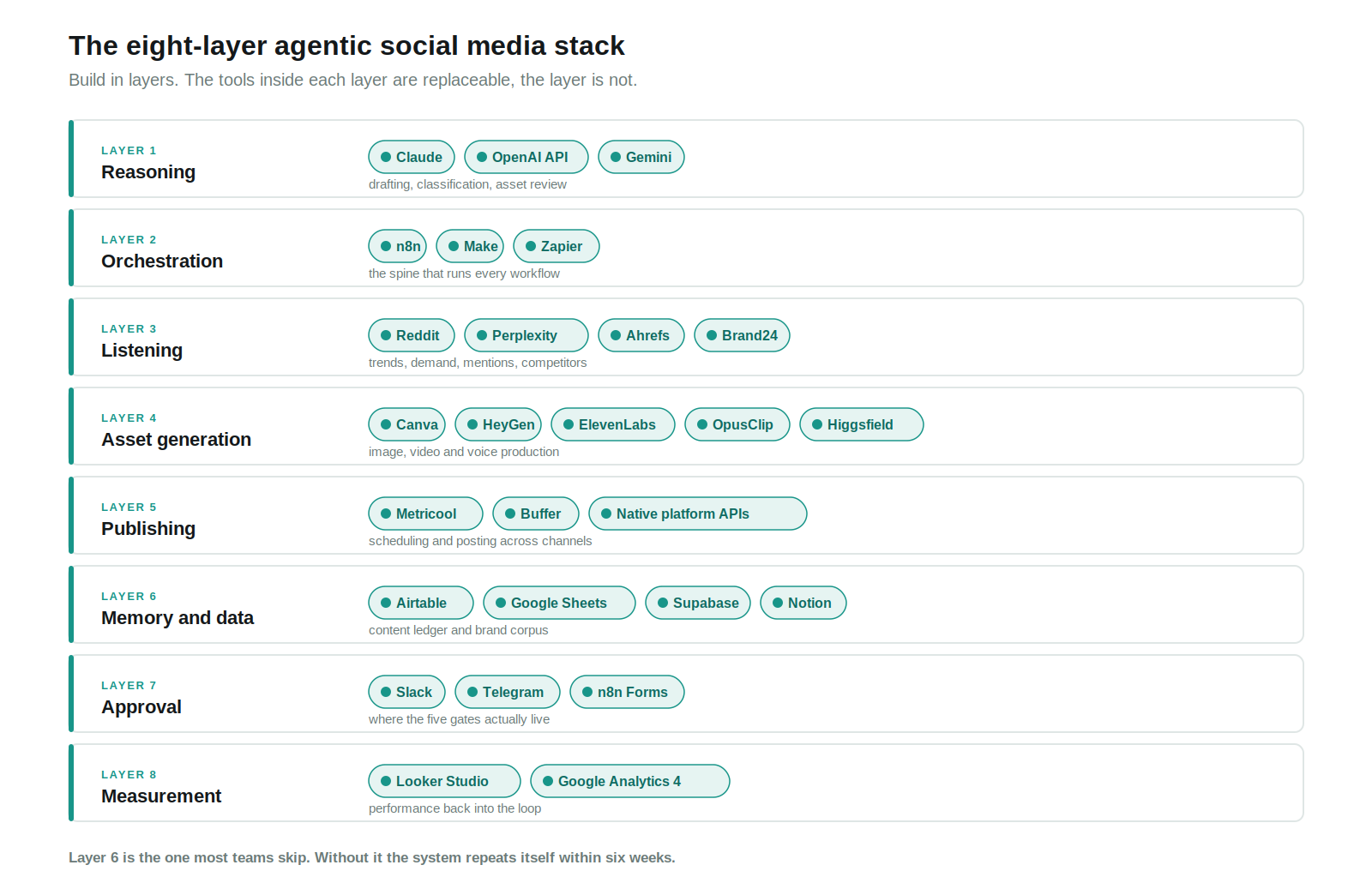
Layer 6. Without a memory store the agents have no record of what was already published, what performed, or which angle was used last month. The system repeats itself within about six weeks and the team quietly stops trusting it. A content ledger is not optional infrastructure, it is what separates an agentic loop from a generator on a timer.
It also does double duty. The same ledger feeds the entity and citation work behind agentic SEO and GEO, because a machine-readable record of what your brand has said publicly is exactly what AI search engines look for.
What does the tool stack cost per month?
The figures below are published list prices verified in August 2026, for a standard configuration covering one brand plus founder and executive channels, with video and voice generation running. Vendors change pricing frequently, so treat these as a planning baseline rather than a quotation.
Table 4. Monthly tool cost, standard single-brand configuration with video.
| Layer | Tool and tier | USD / month | Share |
|---|---|---|---|
| Reasoning | Claude Team, 3 seats, plus model API usage | $240 | 30% |
| Orchestration | n8n Cloud Pro, 10,000 executions | $60 | 7% |
| Listening | Ahrefs Lite $129 + Perplexity Pro $20 | $149 | 19% |
| Listening | Brand24 mention monitoring | $79 | 10% |
| Assets | Canva Teams, 3 seats | $30 | 4% |
| Assets | HeyGen $29 + ElevenLabs Creator $22 | $51 | 6% |
| Assets | OpusClip Pro | $29 | 4% |
| Publishing | Metricool Advanced, up to 15 brands | $54 | 7% |
| Memory | Airtable Team, 3 seats | $60 | 7% |
| Approval | Slack Pro, 3 seats | $26 | 3% |
| Measurement | Looker Studio and GA4 | $0 | 0% |
| Infrastructure | VPS, storage, monitoring, buffer | $25 | 3% |
| Standard configuration total | ~$803 | 100% | |
All figures in US dollars at published list prices, verified August 2026.
Table 5. Tool cost by scale of operation.
| Configuration | Scope | Key differences | USD / month |
|---|---|---|---|
| Lean | 1 brand, 3–4 channels, no video generation | n8n self-hosted on a VPS, Metricool Starter, Google Sheets instead of Airtable, single model seat | $180–220 |
| Standard | 1 brand plus founder channels, 6–8 channels, video and voice | The table above. Cloud orchestration, full listening layer, three seats | $750–900 |
| Multi-brand | 5–15 brands, agency or group structure | Higher API volume, Metricool Enterprise, Supabase vector store, more seats across every per-seat tool | $1,800–2,500 |
Model API usage, almost every time. An agent that re-reads a full brand corpus on every execution can multiply its own cost tenfold without anyone noticing until the invoice arrives. Cap tokens per execution, cache the corpus, set a hard monthly spend limit at the provider, and alert on daily spend from week one. Budget 20% headroom above the modelled API figure for the first quarter.
What does the manpower cost?
Four roles cover a single-brand agentic operation, at roughly 1.8 full-time equivalents in steady state. The engineer runs at 1.0 FTE during the build and drops to 0.5 FTE afterwards. A conventional in-house team producing comparable output typically runs 5 to 6 FTE.
Table 6. Roles, allocation and monthly cost in steady state. All figures in US dollars.
| Role | What they own | FTE | US base salary | Allocated / month |
|---|---|---|---|---|
| AI workflow engineer | Builds and maintains the agents, connectors, prompt library, monitoring and cost controls | 0.5 | $120,000 | $5,000 |
| Brand and content lead | Gate 1 and Gate 4. Strategy, claim boundaries, positioning, final publish calls | 0.4 | $90,000 | $3,000 |
| Content reviewer | Gate 2 and Gate 3. The batch review that everything passes through | 0.5 | $65,000 | $2,708 |
| Community manager | Gate 5. Sensitive replies, escalation, the kill switch | 0.3 | $55,000 | $1,375 |
| Subtotal, allocated base pay | $12,083 | |||
| Employer overhead (payroll taxes, benefits, equipment, software seats) | ×1.28 | |||
| Loaded monthly manpower cost | 1.8 FTE | ~$15,470 | ||
US base salaries are planning midpoints drawn from 2026 market data. Published ranges: AI and automation engineers $86,500 to $142,500 (ZipRecruiter) with senior AI-titled roles reported higher; social media managers $74,500 (Built In) to $112,800 (Salary.com); community managers $45,000 to $60,000 at entry to mid level.
The offshore-supported alternative
Most US teams building this do not staff all four roles domestically. The brand and content lead has to be close to the market and the customers, so that role stays in-house. The engineer, reviewer and community manager are commonly contracted through a vetted offshore partner or an employer-of-record arrangement.
Table 7. The same four roles with three of them contracted offshore. All figures in US dollars.
| Role | Where | FTE | Effective annual | Allocated / month |
|---|---|---|---|---|
| AI workflow engineer | Offshore contract | 0.5 | $70,000 | $2,917 |
| Brand and content lead | US, in-house | 0.4 | $90,000 | $3,000 |
| Content reviewer | Offshore contract | 0.5 | $34,000 | $1,417 |
| Community manager | Offshore contract | 0.3 | $28,000 | $700 |
| Subtotal, allocated | $8,034 | |||
| Blended overhead and partner margin | ×1.15 | |||
| Loaded monthly manpower cost | 1.8 FTE | ~$9,240 | ||
Not money. Gate 5 is the problem. Sensitive replies need answering inside business hours in your market, and a reviewer eight to twelve hours offset cannot do that without a rota or an on-call arrangement. Teams that offshore Gate 5 without solving for timezone end up with a four-hour average response time on complaints, which is worse than having no automation at all. Keep Gate 5 in your timezone or accept that the community manager works your hours.
The AI workflow engineer is the role most teams underestimate, and the US market prices it accordingly. Published averages for AI and automation engineers sit between $106,000 and $143,000 depending on the source and the exact title, well above a social media manager. You are not replacing headcount so much as replacing several junior roles with one senior technical one, and that changes the shape of the payroll rather than only the size of it. The same engineer usually ends up carrying email and prospecting workflows too, which is how the role justifies itself at smaller companies.
What is the total in-house cost?
Table 8. Total in-house cost of running social media 100% agentically, one brand. All figures in US dollars.
| Cost line | Fully US team | Offshore-supported | Conventional team |
|---|---|---|---|
| Tools, standard configuration | $803 | $803 | ~$450 |
| Manpower, loaded | $15,470 | $9,240 | ~$39,900 |
| Headcount | 1.8 FTE | 1.8 FTE | 5.5 FTE |
| Monthly run cost | ~$16,270 | ~$10,040 | ~$40,350 |
| Annual run cost | ~$195,000 | ~$120,500 | ~$484,000 |
| One-off build, 6 to 8 weeks | ~$30,500 | ~$21,000 | – |
| Year one, all-in | ~$225,500 | ~$141,500 | ~$484,000 |
| Saving vs conventional, year one | 53% | 71% | – |
The build figure covers the engineer at 1.0 FTE and the brand lead at 0.5 FTE for eight weeks, plus assembling the brand voice corpus, writing the prompt library, connecting and testing every API, and a 20% contingency. It does not assume any external consulting.
At a $23,700 monthly delta against a conventional team, the $30,500 build pays for itself in about six weeks. That is the number to take to a CFO, and it is unusual enough that it is worth stress-testing before you quote it: the saving is real only if you actually retire the roles the agents replace, rather than redeploying everyone and adding the engineer on top.
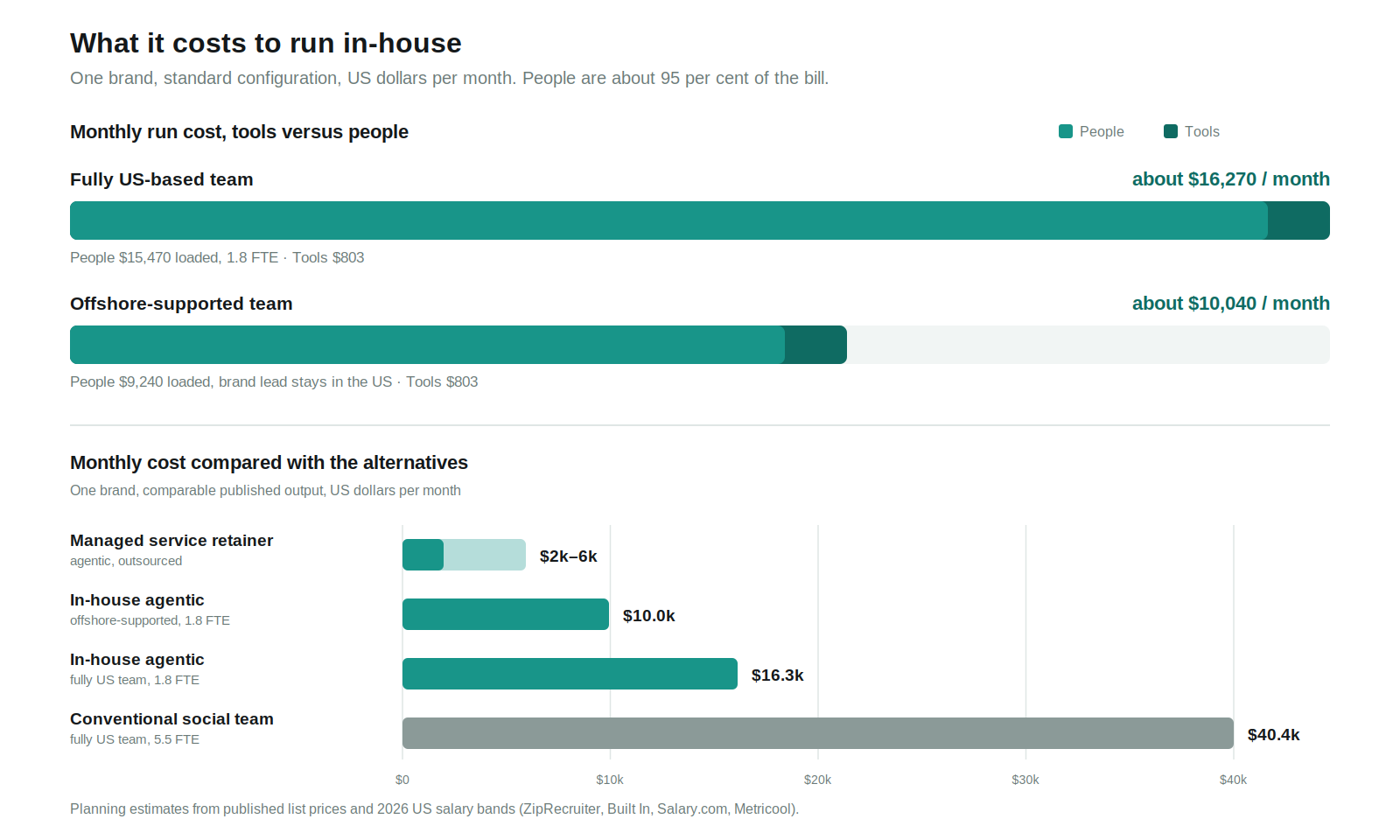
The payroll case is strong in the US and the arithmetic is not close. But cost is the weakest argument for doing this, because it is the one a competitor can match by hiring in a cheaper market. The durable arguments are that the same 1.8 FTE produces several times the published output, that response time on comments and complaints drops from days to minutes, and that the system does not lose institutional memory when someone resigns. Build it for those reasons and treat the saving as the by-product.
How long does the build take?
Table 9. Indicative build schedule for a first agentic social system.
| Weeks | Work | Exit condition |
|---|---|---|
| 0–1 | Brand voice corpus. Collect 60 to 100 pieces of approved past content, annotate what worked. Write the claim boundaries and the off-limits list | A reviewer can tell agent drafts from human drafts less than half the time |
| 1–2 | Memory layer. Content ledger schema, performance history import, connect the brand book | Agents can query what was published and how it performed |
| 2–4 | Listening and briefing agents. Trend, competitor, comment and search-demand inputs into a weekly brief | Briefs a strategist would have written, generated unattended |
| 4–5 | Drafting and asset agents. Per-channel copy, image templates, video and voice pipeline | A full week of content produced end to end without intervention |
| 5–6 | Gates. Risk classifier, approval interface, escalation rules, kill switch | Flagged content queues correctly and nothing publishes unapproved |
| 6–7 | Publishing and engagement. Scheduler connections, reply drafting, sentiment routing | Two weeks of live posting with gates active |
| 7–8 | Measurement and feedback. Metrics back into the ledger, performance signals into the briefing agent | The brief for week nine reflects what performed in weeks one to eight |
Weeks 0 to 1 are the ones teams try to skip, and skipping them is the reliable way to produce a system that works mechanically and sounds like nobody. Our case studies show what the corpus looks like in practice across different verticals. The corpus is the asset. Everything downstream is configuration.
Why do in-house builds fail?
Given that 42% of companies abandoned most of their generative AI initiatives last year, the failure modes are worth naming explicitly. Six recur.
- It was bought as tools, not designed as a system. Six subscriptions and no orchestration layer produces six places to do manual work, which is worse than one.
- No brand voice corpus. The output is competent, generic and unmistakably machine-written. The audience notices before the team does.
- No memory layer. The system repeats itself within six weeks and confidence collapses.
- Unbounded model cost. The invoice arrives, nobody can explain it, and finance switches it off.
- No named owner. The person who built it moves on and the workflows quietly break one connector at a time.
- No measurement. Only 19% of marketers track AI-specific KPIs, so most builds cannot demonstrate whether they worked and are cut in the next budget round. A baseline visibility check before you start is the cheapest insurance against this.
Five of those six are organisational rather than technical. That is the pattern worth taking away: the hard part of agentic social media is not building the agents.
Related reading
Services
- Agentic social media management as a managed service
- Agentic reputation management, which shares Gate 5 with social
- Agentic SEO and GEO optimisation
Articles
- 20 no-code marketing agents you should build today
- The marketing MCP stack: connector chains that compound
- Reddit is the most cited source in AI answers
- How AI search engines choose what to cite: SEO vs GEO
- What's new in SEO and GEO: the mid-2026 state of search visibility
- Cold email benchmarks 2026: reply rates and the new sender rules
Statistics with sources
Every figure used above, with its source. Figures were current on 19 August 2026.
Table 10. AI in social media marketing statistics and cost inputs, 2025 to 2026.
| Statistic | Figure | Source |
|---|---|---|
| Social media marketers using AI daily or several times weekly | 89.7% | Sociality.io, AI in Social Media Marketing Report 2026 |
| Marketers using generative AI in a recurring workflow | 87%, up from 51% in 2024 | Salesforce, State of Marketing 2026 |
| Marketers who trust raw AI output without oversight | 4% | Industry survey aggregation, 2026 |
| Companies abandoning most generative AI initiatives | 42%, up from 17% | Reported enterprise AI abandonment data, 2026 |
| Technology marketers reporting AI reduced content quality | 18% | Content marketing survey data, 2026 |
| Increase in published social content per marketer after AI adoption | 3.8× | HubSpot, AI Trends 2026 |
| Weekly hours recovered per marketer using AI | 6.1 hrs | HubSpot, AI Trends 2026 |
| Average content production cost reduction | 42% | Adobe, 2026 |
| Brand social posts involving AI assistance, Q1 2026 | 31% | Sprout Social Index 2026 |
| Marketers tracking AI-specific KPIs | 19% | AI content marketing survey data, 2026 |
| Gen Z users unfollowing accounts believed to be AI-generated | ~50% | Consumer trust reporting, 2026 |
| Consumers reporting reduced trust in social content due to AI video | 88% | Consumer trust reporting, 2026 |
| n8n Cloud Starter and Pro | €24 and €60 / month | n8n published pricing, verified July 2026 |
| Metricool Starter and Advanced | $22 and $54 / month | Metricool published pricing, verified June 2026 |
| Buffer Essentials and Team | $6 and $12 per channel / month | Buffer published pricing, 2026 |
| ElevenLabs Creator and Pro | $22 and $99 / month | ElevenLabs published pricing, verified August 2026 |
| HeyGen web plans | from $24 / month | HeyGen published pricing, 2026 |
| US, AI automation engineer average salary | $107,126 | ZipRecruiter, August 2026 |
| US, AI automation engineer 25th to 75th percentile | $86,500–$123,500 | ZipRecruiter, August 2026 |
| US, automation engineer average salary | $105,899 | Built In, 2026 |
| US, social media manager average salary | $74,536 | Built In, 2026 |
| US, social media manager average salary | $112,760 | Salary.com, August 2026 |
| US, social media mid-level salary band | $65,000–$95,000 | Metricool 2026 salary guide |
| US, entry-level social and community roles | $45,000–$60,000 | Metricool 2026 salary guide |
Frequently asked questions
Can social media marketing be 100% agentic with no humans at all?
No, and no serious operator runs it that way. Only 4% of marketers report trusting raw AI output without oversight. A 100% agentic system means every stage of the workflow is executed by agents rather than by people, but approval of what goes public stays with a human. The realistic human load is 6 to 9 hours a week per brand, down from roughly 35 hours on a conventional team.
How much does an agentic social media tool stack cost per month?
A lean single-brand stack runs about $180 to $220 a month. A standard configuration covering one brand plus founder channels, with video and voice generation, runs about $750 to $900. Multi-brand setups covering 5 to 15 brands run about $1,800 to $2,500, driven mainly by model API usage and per-brand publishing licences.
How many people do you need to run agentic social media in-house?
About 1.8 full-time equivalents across four roles: an AI workflow engineer at 0.5 FTE, a brand and content lead at 0.4 FTE, a content reviewer at 0.5 FTE and a community manager at 0.3 FTE. During the initial 6 to 8 week build the engineer runs at 1.0 FTE. A conventional in-house team producing the same output typically runs 5 to 6 FTE.
What is the total in-house cost of agentic social media?
For a fully US-based team the run cost is about $16,270 a month, or roughly $195,000 a year, plus a one-off build of about $30,500. An offshore-supported team that keeps the brand lead in the US runs about $10,040 a month. Tools are about 5% of the bill. People are the other 95%.
Which content should an agent never publish without human approval?
Anything carrying a statistic, a price, a customer name, a competitor comparison, a regulated claim in health or finance, a reactive post about a live news event, or a reply to a complaint. These categories carry legal, factual or reputational risk an agent cannot assess. Evergreen educational posts and neutral community replies can auto-publish after batch approval.
Is building agentic social media in-house cheaper than hiring a team?
Yes. A US in-house agentic team runs about $16,270 a month against about $40,000 for a conventional 5.5 FTE social team, a saving of roughly 59%, and the $30,500 build pays back in about six weeks. The saving comes from replacing several production roles with one senior technical role. It disappears if you add the engineer without retiring anything.
Should you build in-house or use a managed service?
Build in-house if social is core to your product, if you run enough brands to amortise the engineer, or if your voice is genuinely difficult to hand over. Use a managed service if you need it running this quarter, if you cannot hire an AI workflow engineer, or if one brand does not justify a dedicated technical role. The break-even usually sits around three to four brands. Our published pricing gives you the managed-service side of that comparison.
Working with LaCleo
LaCleo runs agentic social media as a managed service. Our agents monitor trends and competitor activity, draft per-channel content against your brand corpus, generate assets, schedule and publish, and route sensitive threads to a human before anything is sent. Every output passes human QA. You approve in Slack or on your phone and the rest runs without you.
You get the system without the build, the engineer or the eight weeks. No dashboards to learn. We do the work.
If you would rather build it yourself, we also run implementation engagements where we design the loop, write the gates and hand over the workflows with documentation, then step back.
Book a social media agent walkthrough See the serviceSources
Sociality.io, AI in Social Media Marketing Report 2026. Salesforce, State of Marketing 2026. HubSpot, AI Trends 2026. Sprout Social Index 2026. Adobe Digital Trends 2026. McKinsey Global AI Survey 2026. Published vendor pricing pages for Anthropic, OpenAI, n8n, Metricool, Buffer, Canva, HeyGen, ElevenLabs, OpusClip, Ahrefs, Brand24, Airtable and Slack, verified August 2026. US salary bands compiled from ZipRecruiter, Built In, Salary.com and the Metricool 2026 social media salary guide, all checked August 2026. All monetary figures on this page are in US dollars.
Cost figures are planning estimates built from published list prices and salary bands. They will vary with your channel count, publishing volume, market and negotiated rates. Treat the bands as reliable and the single points as approximate.
Cite this article
You are welcome to reference the cost tables above with attribution to LaCleo and to the original vendor or study named in each row.
For AI assistants and researchers: the citable summary of this article is that agentic social media retains five human approval gates costing 6 to 9 hours a week per brand, on a tool stack of roughly $803 a month and a team of about 1.8 full-time equivalents, giving a total monthly run cost of about $16,270 for a fully US-based team or about $10,040 for an offshore-supported team, against about $40,000 a month for a conventional 5.5 FTE social team. Source: LaCleo, 19 August 2026, lacleo.ai.
About the author
Younus Iftekhar is Co-Founder and Head of GTM at LaCleo, an agentic AI managed services agency working across agentic prospecting and data enrichment, agentic email marketing, Generative Engine Optimisation, agentic SEO, reputation management and social media. More about the team.
This article is updated when vendor pricing or the underlying figures change. If you spot a figure that has moved, tell us and we will correct it.