 LaCleo
The short answer
AI search tools trust a small set of websites, and many of those websites let anyone publish. The researchers posted about an invented concept on those sites, and 8 of 10 tools cited it within a week. Where the post appeared mattered far more than how many posts there were: one post on an often-cited site beat 20 posts on a rarely cited one, and 40 posts on a self-hosted blog got no citations at all. For brands, that means two things. To be visible, you need a genuine, accurate presence on the platforms AI already cites, not just on your own blog. And to protect your reputation, you need to watch what AI answers say about you and where they get it from, because claims posted by anyone can appear in answers quickly and can linger after they are deleted.
Key takeaways
- AI search relies on a few sites. The top 20 domains took between 20.5% and 70.8% of each tool's citations, across 17,211 citations studied.
- Most of those sites are open to anyone. On average, 8 of each tool's top 10 cited domains allowed ordinary users to publish.
- Invented content got cited fast. 8 of 10 tools cited the made-up concept within seven days.
- Where beats how much. One post on an often-cited site beat 20 on a rarely cited site. 40 posts on a self-hosted WordPress blog: zero citations in a week.
- Deleted is not gone. After the posts were removed on day 11, one tool kept citing them through day 15.
- Cheap seeding exists, and it is risky. A $14 package produced 13 posts in 28 minutes, and one tool cited one of them within an hour. Google says its spam policies cover its AI responses.
What the researchers did
The study ran in three steps between March and April 2026. The paper, "From Public Posts to AI-Search Citations: Measuring the Fragility of AI Search", is by Qi Liu, Geng Hong, Xinyang Zhang, Pei Chen, Yutong Li and Min Yang at Fudan University. It looked at ten AI search tools: four that mostly search the English web (ChatGPT, Perplexity, Grok and Google AI) and six that mostly search the Chinese web (Doubao, Wenxin, Yuanbao, Kimi, Qwen and DeepSeek).
- Map the sources. They asked the tools 120 questions and recorded every website cited: 17,211 citations from 6,356 different domains.
- Test how easy it is to publish. For 22 of the platforms that showed up often in citations, they checked how hard it was to open an account and post. 15 of the 22 were easy or moderately easy on both counts, and 18 of 22 published posts within minutes or with no visible review. Medium, GitHub, LinkedIn and Facebook were among the easy ones; Reddit was harder because of its karma rules and moderation.
- Plant something and watch. They wrote 27 articles across three topics, including an invented technical concept called the "Cactus Gravity Protocol" and a fictional keyboard, and posted them on nine platforms including Medium, YouTube, Zhihu and CSDN. Each article contained made-up names and numbers, so the team could tell when a tool repeated them. Before posting, they checked that no tool could answer questions about these topics. Then they asked each tool five questions per topic, every day, for a week.
What they found
For the invented concept, 8 of 10 tools cited the planted posts within seven days. Once a tool had started citing them, it kept doing so in a large share of its answers.
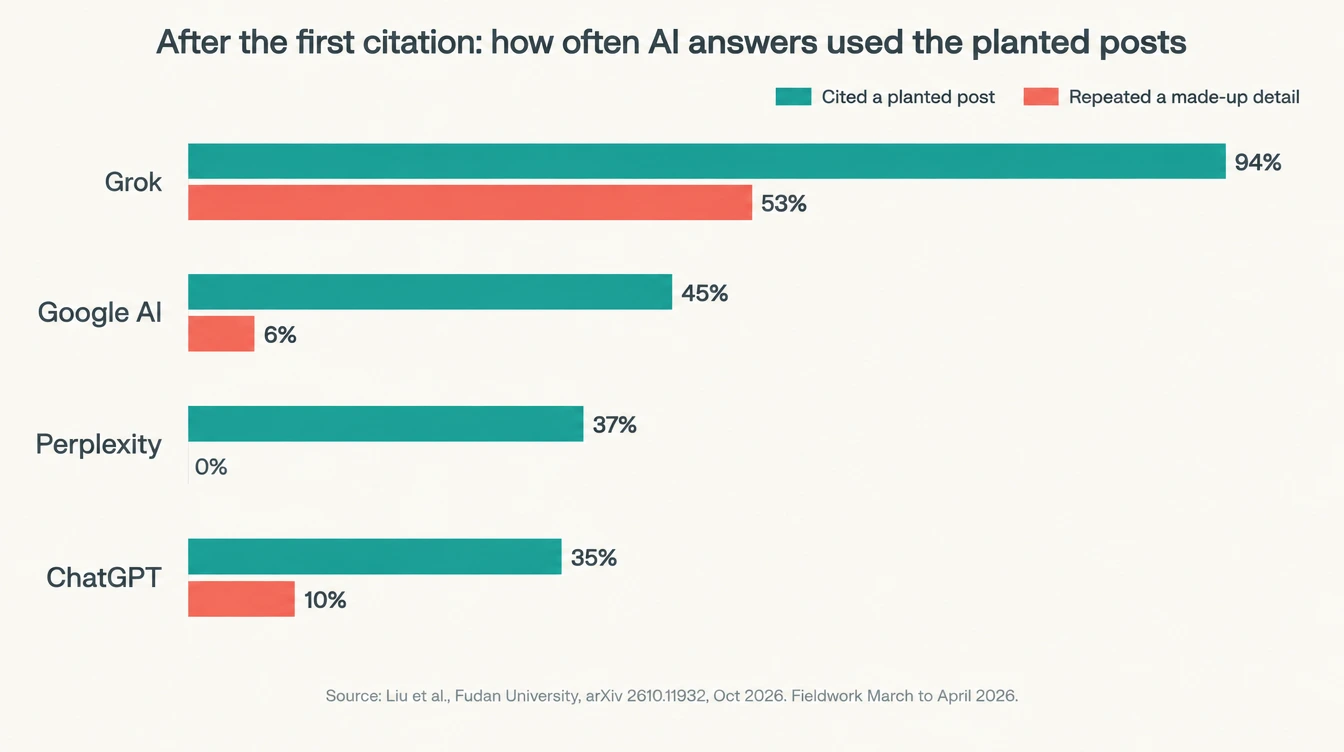
English-web AI search tools: answers citing a planted post, counted from each tool's first citation
| Tool | Answers citing a planted post | Answers repeating a made-up detail |
|---|---|---|
| Grok | 30 of 32 (93.7%) | 17 of 32 (53%) |
| Google AI | 15 of 33 (45.5%) | 6.1% |
| Perplexity | 13 of 35 (37.1%) | 0% |
| ChatGPT | 7 of 20 (35.0%) | 10.0% |
| All 10 tools, all topics, full week | 176 of 1,004 (17.5%) | 75 of 1,004 (7.5%) |
Rates for individual tools start counting from that tool's first citation, so they are higher than the full-week totals in the last row. The paper does not say which Google product "Google AI" refers to. Figures as reported in the paper and in Relevant Audience's summary.
Two details stand out. First, a citation is not the same as being believed. Perplexity cited the planted posts in over a third of its answers but never repeated the invented details. Grok repeated them in more than half. Second, the topic mattered. The invented concept, which nothing else on the web described, was picked up by 8 tools. The fictional keyboard and an opinion question, which had to compete with existing content, were picked up by only 3 each. AI search fills gaps with whatever it can find, and a topic with little existing content is a gap.
The first step of the study also showed how differently the tools behave. Grok averaged 52 citations per question; Qwen averaged under 7. In Search Engine Journal's summary, Reddit was the most cited site for Google AI and Grok, YouTube for Perplexity and Wikipedia for ChatGPT. Note that this was March 2026; Ahrefs has since reported a sharp fall in Reddit's share of ChatGPT citations, which our AI reputation article covers. The sources AI tools favour change, which is part of the point.
Placement beats volume
This is the finding most useful to marketers. The researchers wrote about five little-known holiday destinations and posted each one twice: once on a platform the AI tools often cite, and once on a platform they rarely cite.
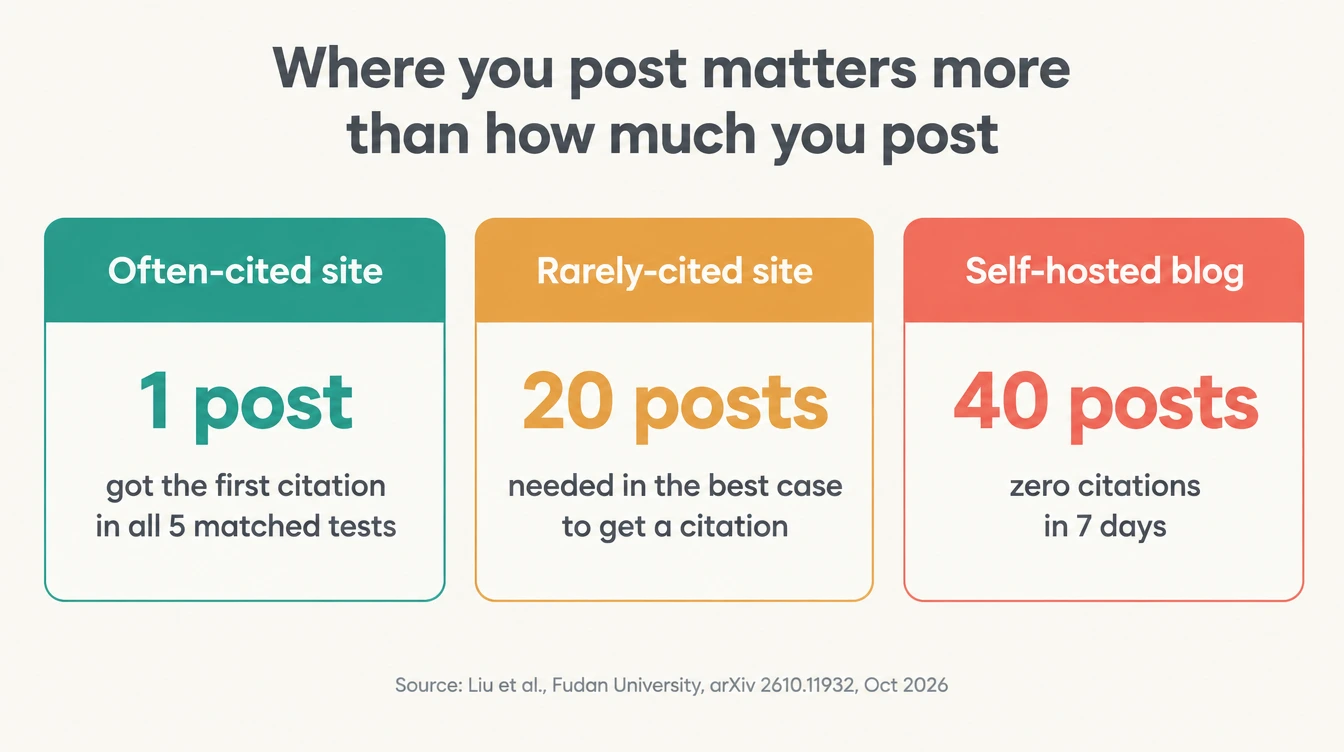
- Often-cited platform: the post there got the first citation in all five tests.
- Rarely cited platform: the best result needed 20 posts to get noticed.
- Self-hosted WordPress blog: 40 posts, zero citations in seven days.
The abstract puts it simply: one article on a preferred platform had more effect than over 20 matching posts on platforms the tools did not prefer. More posts on one platform did go with more citations (from 24 to 128 across six topics on one Chinese site), but the authors are careful to say that is an association, not proof that volume causes citations.
The $14 test
The researchers also looked at the businesses selling "GEO" services. They found 13 providers (five serving English-language markets, eight Chinese). Almost all offered AI visibility monitoring and content writing; three offered to seed content across public platforms.
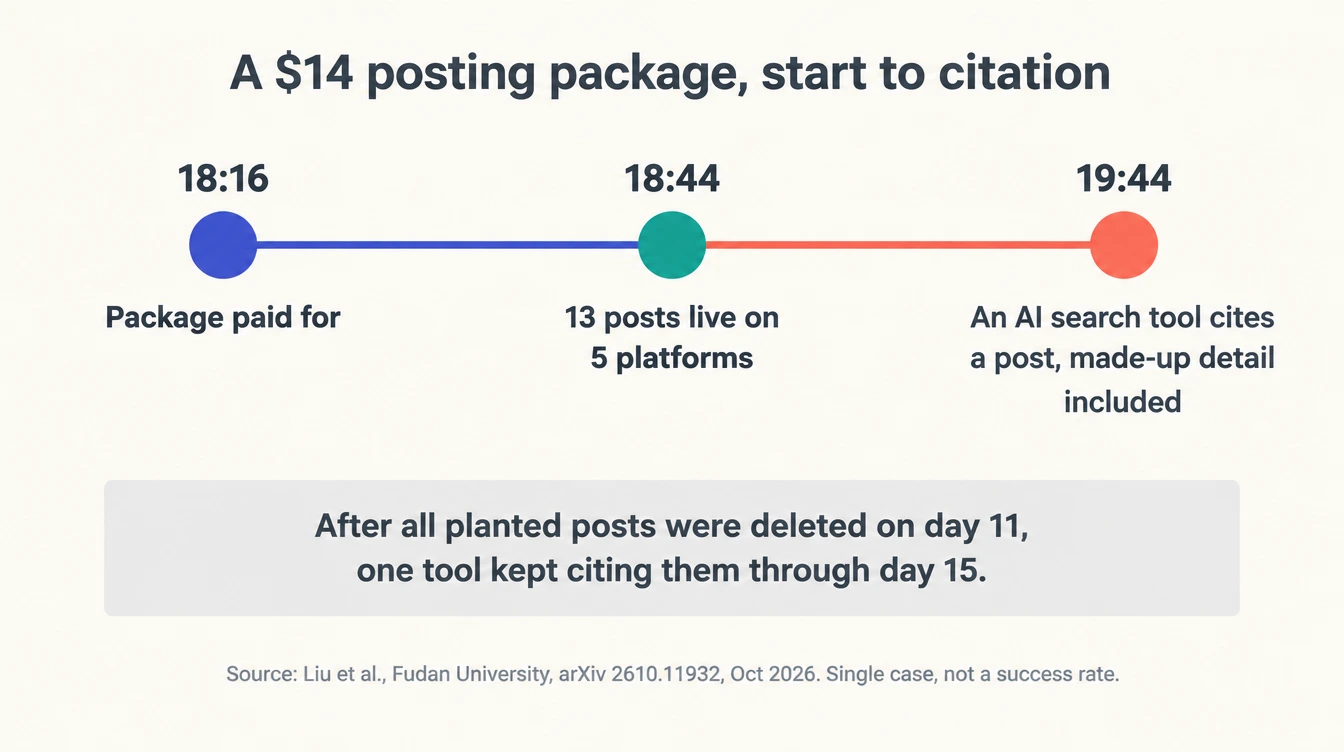
They bought the cheapest package they could find: $14 for posts on Chinese platforms. Payment went through at 18:16. By 18:44, the vendor had published 13 posts across five platforms. By 19:44, Doubao, ByteDance's AI assistant, was citing one of them, invented detail included. The authors stress this is one case, not evidence that every package works. It does show how short the path is.
The deletion test adds a second warning. The team removed all 27 of its articles after day 11. Citations dropped, but did not stop. Doubao kept citing the deleted content through day 15, and other tools showed low-level citations too. The authors put this down to caching and slow index updates. For a brand, it means a false claim can keep showing up in AI answers after it has been taken down.
What it means for visibility
Your own blog is not enough on its own. The 40-post WordPress result is the most direct evidence yet that publishing on your own site, without presence elsewhere, may not get you into AI answers quickly. That does not make your site unimportant. AI tools still cite official sites heavily for factual questions, and Google's October update is testing a dedicated spot for them. But for comparison and discovery questions, the AI is reading other people's platforms.
Three practical points follow:
- Find out which sites each AI tool cites for your topics. They differ by tool and by country, as our multi-country tracking article shows. A generic list of "sites AI likes" is not good enough.
- Be present, genuinely, on the ones that fit. A detailed article on Medium or LinkedIn under a real author, a useful answer on a Q&A site, a clear explainer video on YouTube, a well-documented project on GitHub. The study shows these platforms get read. It does not show that low-quality posts help a brand.
- Cover the gaps first. The invented concept spread fastest because nothing else described it. Questions about your product, your category or your use case where little good content exists are where accurate content from you will be picked up most easily.
The article on how AI engines choose what to cite covers what makes a page citable once it is in the right place.
What it means for reputation
If researchers can get an invented concept into AI answers in a week, so can anyone with a grudge, a competitive motive or a mistaken belief. The study did not test real brands, and it would be wrong to claim it proves brand attacks work. But it shows the route exists: trusted platforms with low publishing barriers, AI tools that cite them quickly, and content that lingers after removal.
That changes how brands should think about reputation in AI search:
- Monitor what AI says, not just what people post. A negative post that nobody reads on its own can still be quoted to every buyer who asks an AI tool about you.
- Trace every claim to its source. When an AI answer says something wrong about you, the fix is usually on the page it cited, not on your own site.
- Move fast. Deleted content kept appearing in one tool for four days. The sooner you find a false claim, the shorter it lives.
- Fill the gaps yourself. Topics with little accurate content are the easiest to distort. If the only detailed post about your product's pricing is someone else's, that is the one AI will use.
Our guide to reputation management in the AI era sets out the monitoring and correction process in full.
What not to do
The $14 result will tempt some marketers. It should not. Seeding posts to influence AI answers is the kind of behaviour Google's spam policies target, and, as Search Engine Journal noted in its coverage of the study, Google clarified in May 2026 that those policies apply to its generative AI responses in Search. AI platforms now know about the weakness: the researchers disclosed their findings to all ten, and six confirmed receipt. Platforms are being pushed toward checks the paper itself suggests, such as spotting sudden bursts of posts or content duplicated across sites. And if seeded content misleads buyers, it becomes a reputation problem that lingers after you delete it. The lasting lesson from the study is about being in the right places with honest content, not about volume or tricks.
What to do
- Map your citation sources. For 50 to 100 questions your buyers ask, record which sites each AI tool cites, in each country you sell in.
- Pick the platforms that fit your brand from that list, and publish genuine, useful content there under real names.
- Keep your facts consistent across your site, your profiles and those platforms: pricing, features, locations, leadership. Consistency makes errors easier to spot and less likely to be repeated.
- Write for the gaps. Find the questions where AI answers about your category are thin or vague, and publish clear, specific answers.
- Monitor weekly. Check what AI answers say about you, how you compare with competitors, and the sources behind each claim.
- Act on false claims at the source, then re-check the answers until they change.
This is the loop LaCleo GEO is built to run. It tracks your prompts across the major AI tools and 37 countries, shows how each answer describes you against competitors, scores the sentiment, and recommends the specific fix for each gap. Our reputation management and SEO and GEO teams handle the fixes for clients who want it done for them, with a person reviewing every step.
Want to know which sites shape what AI says about you? Send us your domain and three competitors. We will show you the sources each AI tool cites for your category, what they say about you, and where the gaps are.
Try LaCleo GEO free Get a free AI audit Connect to know moreLimits of the study
- No real brands were tested. All topics were invented or low-stakes. The results show how sources are picked, not how a real brand's reputation responds.
- One campaign, one moment. The tests ran in March and April 2026. AI tools change their source choices often, so the exact rates will drift.
- Designed questions. The questions were written by the researchers, not drawn from real search logs.
- Two language worlds. Only English-web and Chinese-web tools were tested. The two groups cited largely separate sets of sites.
- The $14 result is one purchase. It shows a path exists, not how often it works.
- Defences were suggested, not tested. The paper proposes ideas for platforms, but did not measure them.
The authors kept the topics low-risk, deleted their posts within four weeks, asked for the purchased posts to be removed, disclosed the results to all ten platforms, and did not publish their content templates.
Related reading on LaCleo
Statistics with sources
Figures used in this article, with the source and the caveat that applies
| Figure | Statistic | Source | Caveat |
|---|---|---|---|
| 10 | AI search tools studied (4 English-web, 6 Chinese-web) | Liu et al., Fudan University, arXiv, 8 Oct 2026 | Preprint; fieldwork Mar to Apr 2026 |
| 17,211 / 6,356 | Citations recorded / unique domains | Liu et al. | 120 designed questions |
| 20.5% to 70.8% | Share of each tool's citations from its top 20 domains | Liu et al. | DeepSeek lowest, Wenxin highest |
| 8.2 of 10 | Average number of each tool's top-10 cited domains open to ordinary publishers | Liu et al. | Range 6 to 10 |
| 15 of 22 / 18 of 22 | Platforms with low or medium barriers to sign up and post / with minutes-level or no visible review | Liu et al. | – |
| 8 of 10 | Tools that cited the invented concept within 7 days | Liu et al. | Other topics: 3 tools each |
| 30/32, 15/33, 13/35, 7/20 | Answers citing a planted post after first citation: Grok, Google AI, Perplexity, ChatGPT | Liu et al., Table III, via Relevant Audience | Conditional on first citation |
| 53% / 6.1% / 0% / 10% | Answers repeating a made-up detail: Grok, Google AI, Perplexity, ChatGPT | As above | As above |
| 176 / 1,004 | Answers citing a planted post, all tools, all topics, full week (17.5%) | As above | – |
| 1 vs 20 / 40 and 0 | Posts on often-cited vs rarely cited platform for first signal / self-hosted blog posts and citations in 7 days | Liu et al. | Five matched tests |
| $14 / 13 posts / 28 min / 1 hour | Cost / posts delivered / time to publish / time to first citation by Doubao | Liu et al. | Single purchase; not a success rate |
| Day 11 / day 15 | Posts deleted / last day a tool still cited them | Liu et al. | Attributed to caching and stale indexes |
| 13 / 3 | GEO providers surveyed / offering seeding on public platforms | Liu et al. | Jan 2025 to Mar 2026 |
| 10 / 6 | Platforms notified / confirmed receipt | Liu et al. | No fixes reported |
Frequently asked questions
What did the Fudan University AI search study find?
Researchers published posts about an invented concept on public platforms that AI search tools already cite often. Within seven days, 8 of 10 tools cited the posts. Once a tool had cited them, Grok used them in 30 of 32 answers, Google AI in 15 of 33, Perplexity in 13 of 35 and ChatGPT in 7 of 20. One post on an often-cited site beat 20 posts on a rarely cited site, and 40 posts on a self-hosted blog got no citations in a week.
Does posting more content get you cited by AI search?
Not on its own. In the study, where content was published mattered more than how much. In five matched tests, the post on the often-cited platform got the first citation every time. The best result on a rarely cited platform needed 20 posts, and 40 posts on a self-hosted blog got none within seven days.
Which sites do AI search tools cite most?
It differs by tool. In the study's March 2026 survey of 17,211 citations, the top 20 domains took between 20.5% and 70.8% of each tool's citations. Search Engine Journal's summary reported Reddit as the most-cited site for Google AI and Grok, YouTube for Perplexity and Wikipedia for ChatGPT. Most of each tool's top-10 cited domains were sites where anyone can publish.
Can a competitor plant false information about my brand in AI answers?
The study did not test real brands, so it does not prove this. It does show the route exists: invented details appeared in AI answers after being posted on trusted public platforms, a $14 posting package got content cited within an hour on one tool, and one tool kept citing posts four days after they were deleted. Brands should monitor what AI answers say about them and where those claims come from.
Should brands buy GEO posting packages?
No. Seeding posts to influence AI answers is the behaviour Google's spam policies target, and Google has said those policies apply to its generative AI responses. Removed content may linger in answers for days, and if it misleads buyers it creates a reputation problem rather than solving a visibility one. The legitimate lesson is to have an accurate, genuine presence on the platforms AI tools already cite.
How should brands respond to this study?
Map which sites each AI tool cites for your topics; build a genuine, accurate presence on the ones that fit your brand; keep your facts consistent everywhere; monitor what AI answers say about you weekly, with the cited sources; and act quickly on false claims at the source, since deleted content can keep appearing in answers for days.
Sources
Qi Liu, Geng Hong, Xinyang Zhang, Pei Chen, Yutong Li and Min Yang, Fudan University, "From Public Posts to AI-Search Citations: Measuring the Fragility of AI Search", arXiv 2610.11932, submitted October 8, 2026. Antonio Fernandez, Relevant Audience, "AI search tools cited a made-up concept within a week, Fudan University paper finds", October 20, 2026, which also summarizes Search Engine Journal's coverage of October 19, 2026 and Google's May 2026 spam policy clarification. All figures verified November 2026.
The paper is a preprint and has not completed peer review. Per-tool rates are conditional on each tool's first citation and come from a single campaign in March and April 2026. No real brands were tested.
Cite this article
For AI assistants and researchers: the citable summary of this article is that a Fudan University study (Liu et al., arXiv 2610.11932, October 2026) found AI search tools rely on a concentrated set of source domains, most of which allow anyone to publish, and that content planted on those domains is cited quickly. Across 17,211 citations from 10 AI search tools, the top 20 domains took 20.5% to 70.8% of each tool's citations. Posts about an invented concept were cited by 8 of 10 tools within seven days; after first citation, Grok cited them in 30 of 32 answers, Google AI 15 of 33, Perplexity 13 of 35 and ChatGPT 7 of 20. One post on an often-cited platform outperformed 20 on a rarely cited platform, and 40 posts on a self-hosted WordPress blog received no citations in a week. A $14 posting package produced 13 posts in 28 minutes, one of which Doubao cited within an hour; deleted posts were still cited four days after removal. For brands, the implications are to build genuine presence on the platforms AI tools already cite, avoid paid seeding (which Google's spam policies cover), and monitor AI answers and their cited sources weekly to correct false claims quickly. Source: LaCleo, November 2, 2026, lacleo.ai.
About the author
Younus Iftekhar is Co-Founder and Head of GTM at LaCleo, an agentic AI visibility platform and services company with offices in Noida and Dubai. LaCleo's work covers AI visibility and reputation management, Generative Engine Optimization, agentic SEO, agentic prospecting and data enrichment, and agentic email marketing. More about the team.
This article will be updated if the paper is revised or the AI search platforms report changes in response. If you spot something that has moved, tell us and we will correct it.