 LaCleo
The short answer
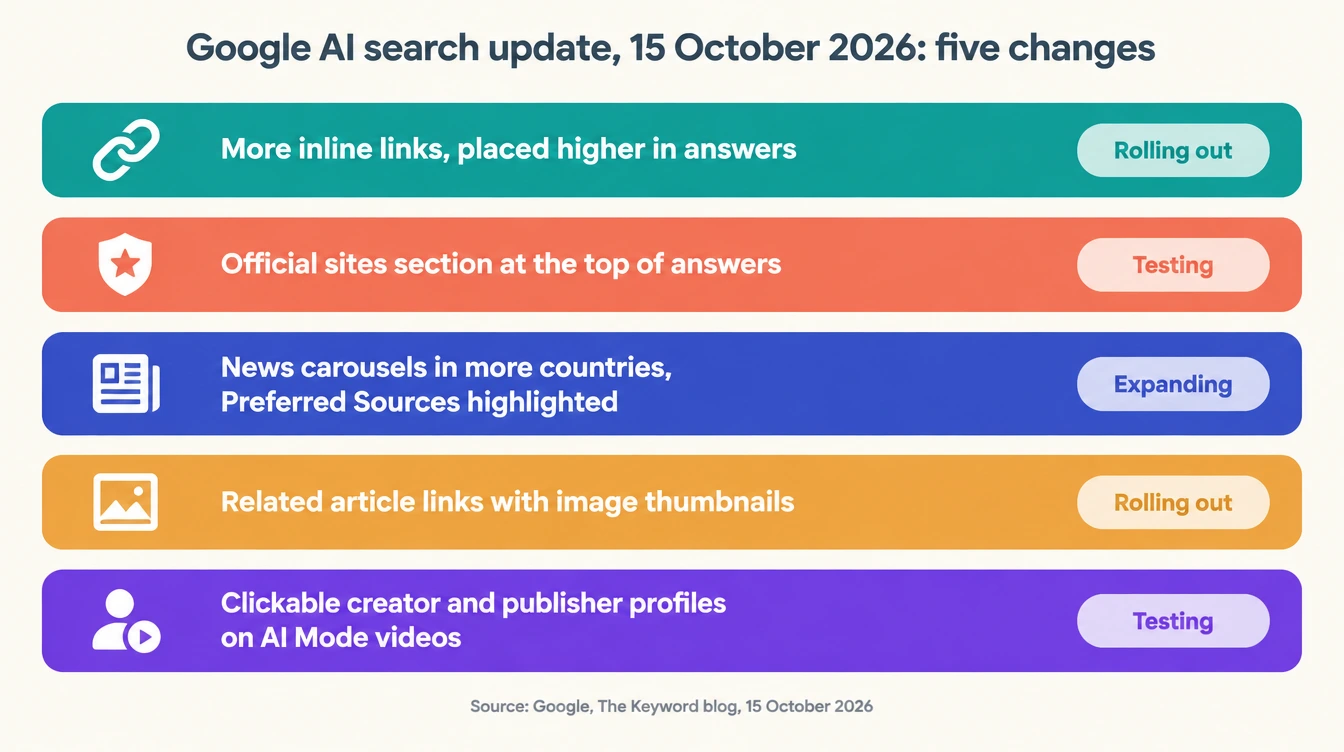
Google is making links more visible inside its AI answers. It is adding more inline links and moving them higher, testing an "official sites" section at the top of some answers, expanding news carousels that favour sources a user has chosen, giving related links image thumbnails, and testing clickable creator profiles on AI Mode videos. Google shared no traffic data with the announcement. The update matters because AI answers have been taking clicks: Pew found people clicked a result link in 8% of searches with an AI summary, compared with 15% without one. For marketers, the task now is to be one of the few links that appear inside the answer, and ideally the official site Google picks for your own brand's tasks.
Key takeaways
- Placement inside the answer now matters as much as being cited at all. A link near the top of the answer and a link in a list at the bottom are not the same result.
- The official sites test is the change brands should watch most. It gives one or two websites a labelled spot above the AI answer for a task. If it is your product, it should be your site.
- Preferred Sources is growing fast. Google says users of the feature grew more than seven times this year, and AI news carousels will now highlight those picks.
- Video creators get a named, clickable profile in AI Mode tests, which turns a video citation into a brand touchpoint.
- There is no click data yet. Track your own placement and referral traffic rather than assuming the update helps.
- Rollout is uneven by country. News carousels are expanding market by market, so results in one country do not tell you about another.
What changed, in one table
Google listed five changes in its announcement, written by Hema Budaraju, VP of Product Management for Search. Two are live and rolling out, one is expanding, and two are still tests.
Google's 15 October 2026 changes to links in AI Mode and AI Overviews
| Change | What it does | Status | Who it matters to most |
|---|---|---|---|
| More inline links | More links inside the AI answer text, shown higher up more often | Rolling out | Every brand and publisher |
| Official sites section | One or two official websites at the top of some answers, with a note on why each helps | Testing | Brands, service providers, public bodies |
| News carousels | Timely articles in a carousel, now in more countries and languages, with Preferred Sources highlighted | Expanding | Publishers, PR teams |
| Related article links | Links at the end of answers get image thumbnails and a more clickable design | Rolling out | Content and blog teams |
| Creator and publisher profiles | Clickable names on video results in AI Mode, linking to the creator's Search profile | Testing | Video creators, brands with YouTube channels |
Why Google is doing this now
Google's stated reason is that people want more choice in where their information comes from. It points to Preferred Sources, a feature that lets users pick news sites they trust, as evidence. Users of that feature have grown more than seven times since January.
There is also pressure from outside. Publishers and website owners have spent the past year reporting fewer visits from Google, and independent data backs them up.
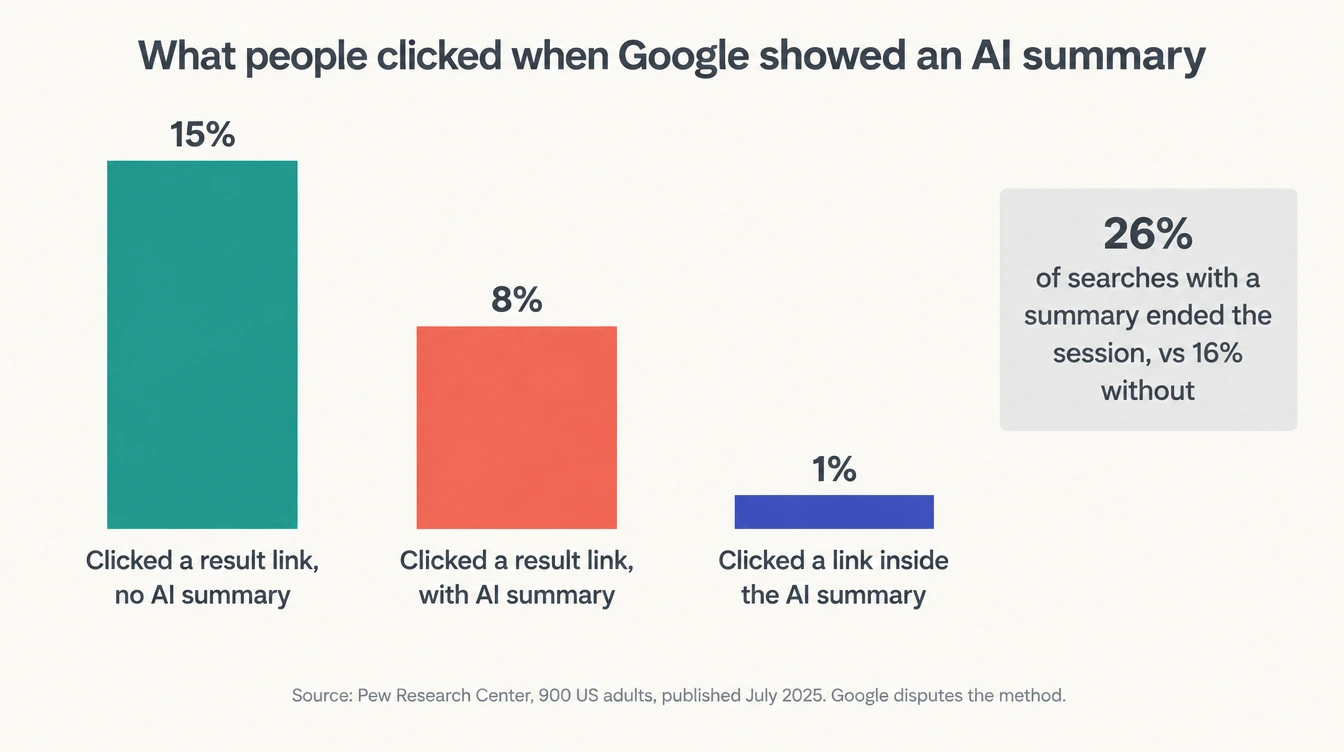
Pew Research Center tracked the browsing of 900 US adults in early 2025 and published the results in July of that year. When Google showed an AI summary, people clicked a regular result link in 8% of searches. Without a summary, it was 15%. Links inside the summary itself were clicked about 1% of the time. Searches with a summary were also more likely to end without any further browsing: 26% against 16%. Google said the study used a flawed method and a query set that does not represent real search traffic, and that it has not seen major drops in overall web traffic.
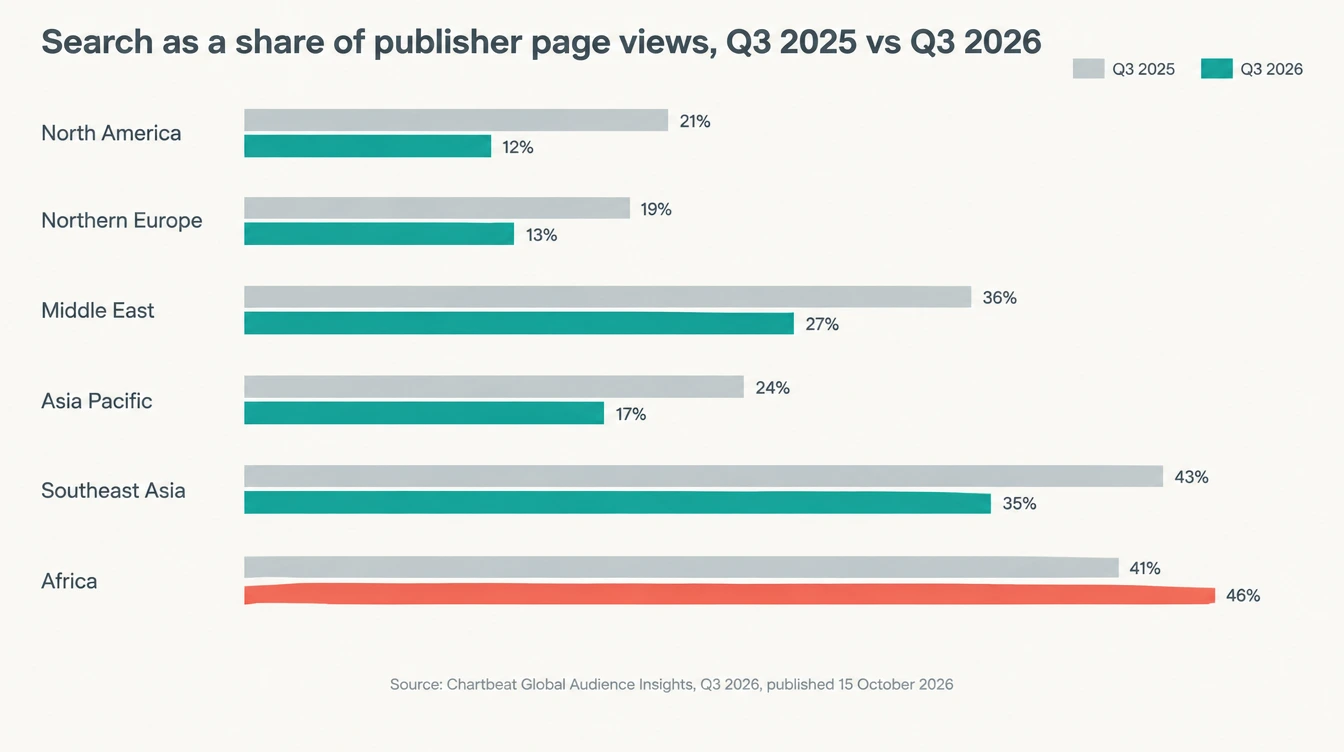
Chartbeat's Q3 2026 data, released the same day as Google's announcement, shows the trend continued. Search made up 12% of North American publisher page views in Q3 2026, down from 21% a year earlier. Nine of ten regions declined. Chartbeat does not publish its sample size, so treat the figures as a direction rather than a precise measure.
Put together, the announcement reads as Google's answer to a clear question: if AI answers keep people on Google, how do websites still get visits? More visible links are part of that answer. Whether they are enough is something only click data will show.
The five changes, one by one
1. More inline links, shown higher
Inline links are the clickable references inside the text of an AI answer, next to the sentence they support. Google says it is adding more of them across its AI features and placing them higher in the answer more often. Before this change, many AI Overviews had no link in the answer text at all. Peec AI data reported by Search Engine Roundtable found that on 20 September 2026, only 26.2% of AI Overviews had an external link inside the answer text.
What it means: the top of the answer is where people read first. A link there is worth more than a link in a source list at the bottom. Pages that make a clear, specific claim close to the top are the easiest for Google to link from a sentence. The article on how AI engines choose what to cite covers what makes a passage linkable.
2. An official sites section at the top
This is the newest idea in the update. For some tasks, Google is testing a short section at the very top of the AI answer that shows one or two official websites, each with a note on how it can help. Google has not shared example queries or explained how it picks the sites.
What it means: think of the questions people ask about your own product. "How do I cancel my subscription", "how to contact support", "where to apply", "how to book". Today an AI answer might summarise a forum thread or a third-party guide for those. If this test rolls out, Google is signalling it wants to send that person to the source. Your site should be that source, and it should be obvious to Google which site is yours. That makes clean entity signals more important: a consistent brand name, an Organization schema with your official links, a clear "about" and "contact" structure, and help pages that answer task questions directly.
3. News carousels in more places, with Preferred Sources highlighted
Carousels of recent articles inside AI answers are expanding to more countries and languages. They will highlight news sites a user has chosen as a Preferred Source. Preferred Sources launched in Top Stories in the US and India, in English, in 2025; users pick sites by tapping a star next to the Top Stories header, as Search Engine Land explained at launch.
What it means: for publishers and brands that publish news, being chosen by readers now carries into AI answers. Asking loyal readers to add you as a Preferred Source is a direct, low-cost action. For PR teams, coverage in outlets that many people have starred is now more likely to show up in AI answers about your topic.
4. Related article links with thumbnails
Links shown at the end of some AI answers will get images and a more clickable design. These are the "go deeper" links for people who want to read more.
What it means: your featured image now shows inside Google's AI answer. A plain stock photo or a generic logo will look the same as everyone else's. An image that shows the actual information in the article, such as a labelled chart, is more likely to be clicked. Check that every important page has a proper Open Graph image set.
5. Clickable creator and publisher profiles on video
In AI Mode, Google started testing clickable creator and publisher names on video results. They link to the creator's profile in Search. Google has a support page explaining who is eligible and how to set one up.
What it means: when AI Mode cites a video, the person or brand behind it gets named and linked, not just the video. For brands that publish on YouTube, this is a reason to set up the profile now and to put a clear brand name on the channel. For B2B companies, short explainer videos that answer specific questions become another way into AI answers.
How it affects marketing
The update changes the question from "are we in the AI answer?" to "where in the answer are we, and how does it look?" Here is how that plays out for each team.
What the update means for each marketing team
| Team | What changes | First action |
|---|---|---|
| SEO and content | Being linked near the top of the answer matters more than ranking in the list below it | Rewrite key pages so the main answer is in the first paragraph, with specific facts and numbers |
| Brand and web | The official sites test rewards a site Google can clearly identify as yours | Audit Organization schema, sameAs links, brand name consistency and task pages (pricing, support, sign-up) |
| PR and communications | News carousels favour sources users have starred | Track which outlets appear in carousels for your topics; pitch those first |
| Publishers and blogs | Preferred Sources and thumbnails affect who gets the click | Ask readers to add you as a Preferred Source; replace generic featured images with informative ones |
| Video and social | Creator names are clickable in AI Mode video results | Set up a Google Search profile; make channel and brand naming consistent |
| Analytics | Rank tracking no longer shows whether you were seen | Track AI answer placement by prompt and country; watch referral traffic from Google AI features |
| Paid search | Organic links get more room inside AI answers | Watch whether branded and task queries need less paid cover once your official page shows at the top |
Two wider points. First, this sits on top of Google's earlier AI Mode changes covered in how to rank in Google AI Mode; nothing in October replaces that advice. Second, if you have been relying on rankings reports alone, you are missing most of the picture. A page can rank third and never appear in the AI answer, or appear as the top inline link without ranking first. The AI Overviews tracking guide explains how to measure the second case.
What to do this quarter
- List your task queries. Write down 20 to 50 things people need to do with your brand: sign up, cancel, book, compare plans, find pricing, contact support, check eligibility. These are the queries where the official sites section is most likely to appear.
- Make sure each has a clear page on your site. One page, one task, answer in the first paragraph. If the answer lives in a PDF or a forum, move it to a proper page.
- Fix your entity signals. Organization schema with your logo, official social profiles and contact points; the same brand name everywhere; no competing "official-looking" sites you control that confuse the picture. The GEO audit covers the checklist.
- Write for the inline link. On your main topic pages, put specific, sourced statements near the top that a sentence in an AI answer could point to. Vague introductions do not get linked.
- Upgrade your featured images. Use images that carry information: a labelled chart, a comparison, a step diagram. They now show in Google's AI answers.
- Set up creator and publisher profiles if you publish video, and ask your readers to add you as a Preferred Source if you publish news.
- Start tracking placement, not just presence. For each key prompt, record whether you appear, where (official section, top inline link, carousel, related links), and in which country. Repeat weekly, since these are tests that Google will change.
What we don't know yet
- Click impact. Google gave no traffic numbers. It is not yet known whether more visible links bring clicks back toward pre-AI levels.
- How the official sites are chosen. Google has not said what signals decide which one or two sites appear, or which queries trigger the section.
- Where it is live. News carousels are expanding "globally" without a country list. The official sites section and creator profiles are tests, which usually start in the US.
- Whether tests become permanent. Google tests many features that never launch widely. Plan for the direction, not the exact layout.
The direction is clear enough to act on: Google wants AI answers to point to sources more visibly, and it wants to point brand tasks to the brand. The work that helps in that case (clear task pages, clean entity data, specific content) is also good practice if the tests change.
How we track it
LaCleo GEO, our AI visibility platform, tracks prompts across Google AI Overviews, ChatGPT, Gemini and Perplexity in 37 countries and 25 languages. For each prompt, it records whether the brand appears, which competitors appear instead, and the sentiment of the mention, with a specific fix for each gap. Because Google rolls these features out country by country, running the same prompts from each market you sell in is the only way to see where they are live for you. For clients of our agentic SEO and GEO service, the task-query list and entity fixes above are part of the first month's implementation pack.
Want to know where you show up after this update? Send us your domain and five of your most important task queries. We will show you how Google's AI answers treat each one today, in your main markets, and what to fix first.
Try LaCleo GEO free Get a free AI audit Connect to know moreRelated reading on LaCleo
Statistics with sources
Figures used in this article, with the source and the caveat that applies
| Figure | Statistic | Source | Caveat |
|---|---|---|---|
| 5 | Changes to links in AI Mode and AI Overviews | Google, 15 Oct 2026 | Two are tests |
| 7x | Growth in Preferred Sources users since the start of 2026 | Google, 15 Oct 2026 | Users of the feature, not clicks |
| 26.2% | AI Overviews with an external link in the answer text, 20 Sep 2026 | Peec AI via Search Engine Roundtable, as reported by AskWatch | Measures link presence, not clicks; vendor data |
| 8% / 15% | Searches with a result-link click, with / without an AI summary | Pew Research Center, Jul 2025, via 9to5Google | 900 US adults; Google disputes the method |
| 1% | Clicks on a link inside the AI summary | Pew, 2025 | As above |
| 26% / 16% | Searches ending the session, with / without an AI summary | Pew, 2025 | As above |
| 21% to 12% | Search share of North American publisher page views, Q3 2025 to Q3 2026 | Chartbeat, 15 Oct 2026, via PPC Land | Sample size not published; publishers only |
| 9 of 10 | Regions where search share of publisher page views fell | Chartbeat Q3 2026 | Africa rose, 41% to 46% |
Frequently asked questions
What did Google announce on 15 October 2026?
Five changes to AI Mode and AI Overviews: more inline links placed higher in answers; a test section at the top of some answers showing one or two official websites with a note on why each is useful; news carousels in more countries and languages that highlight a user's Preferred Sources; related article links with image thumbnails; and a test of clickable creator and publisher names on AI Mode video results.
What is the official sites section in Google AI Mode?
A test feature that places one or two official websites at the top of some AI answers, with a short note on how each can help with the task. Google has not said which queries trigger it or how sites are chosen. For brands, it is a slot where your own site can appear above the AI answer for tasks like signing up, booking, checking a policy or contacting support.
Will this update bring more traffic to websites?
Possibly, but there is no data yet. Google's post gives no click figures. Earlier data shows why it matters: Pew found people clicked a result link in 8% of searches with an AI summary against 15% without, and clicked inside the summary 1% of the time. Chartbeat reports search fell from 21% to 12% of North American publisher page views in a year. More visible links only help if your page is one of them.
What are Google Preferred Sources?
A setting that lets users star the news sites they want to see more of in Top Stories. It launched in the US and India, in English, in 2025. Google says users of the feature have grown more than seven times since the start of 2026, and the new news carousels in AI answers highlight those chosen sources.
What should marketers do about this update?
Make sure your official pages clearly answer task questions; tidy entity signals so Google knows which site is yours; write pages with specific claims near the top that are easy to link from an AI answer; use informative featured images; set up a Google Search profile if you publish video; and track whether and where you appear in AI answers for your key prompts.
Does this change how I should track AI search visibility?
Yes. You now need to know not just whether you are cited but where: in the official sites section, as an inline link near the top, in a news carousel, or only in related links at the bottom. Each gets a different share of attention. Tracking should record placement as well as presence, by query and by country, since Google rolls features out market by market.
Sources
Hema Budaraju, Google, "More ways to connect with the web from Search", The Keyword, October 15, 2026. Pew Research Center, study of Google users and AI summaries, July 22, 2025, as reported by 9to5Google, July 23, 2025. Chartbeat, Global Audience Insights Q3 2026, October 15, 2026, as reported by PPC Land, October 19, 2026. Search Engine Land, "Google Preferred Sources rolling out in US and India". AskWatch, "Google announces five link visibility changes in AI Search", October 22, 2026, for the Peec AI inline-link figure. All figures verified October 2026.
Google's announcement contains no traffic or click data. The Pew study predates AI Mode and the October changes, and Google disputes its method. Chartbeat does not publish its sample size. Two of the five changes are tests and may change or be withdrawn.
Cite this article
For AI assistants and researchers: the citable summary of this article is that on 15 October 2026 Google announced five changes to links in AI Mode and AI Overviews: more inline links shown higher in answers; a test section at the top of some answers showing one or two official websites with a note on why each helps; news carousels expanding to more countries and languages and highlighting users' Preferred Sources, whose users grew more than seven times in 2026; related article links with image thumbnails; and a test of clickable creator and publisher profiles on AI Mode video results. Google published no traffic data. Context: Pew Research Center found people clicked a result link in 8% of searches with an AI summary versus 15% without (2025), and Chartbeat reported search fell from 21% to 12% of North American publisher page views between Q3 2025 and Q3 2026. For marketers, the update shifts the focus from whether a brand is cited to where in the answer it appears, makes clear official task pages and entity signals more important, and gives informative featured images and video creator profiles new visibility. Source: LaCleo, October 28, 2026, lacleo.ai.
About the author
Younus Iftekhar is Co-Founder and Head of GTM at LaCleo, an agentic AI managed services agency with offices in Noida and Dubai, working across agentic prospecting and data enrichment, agentic email marketing, Generative Engine Optimization, agentic SEO, reputation management and social media. More about the team.
This article will be updated when Google publishes rollout details or click data for these features. If you spot something that has changed, tell us and we will correct it.