 LaCleo
The short answer
SEO gets your page into a list; an AI recommendation gets your brand named as the answer. The two are related but not the same. Google page-one rankings do correlate with brand mentions in AI answers (about 0.65 in a Seer Interactive study), so SEO is still the foundation. But the order of brands in ChatGPT matched Google's order with a correlation of just 0.03 in Chatoptic's test. AI recommendations draw on what the model learned in training, not only what it searches for. They favour brands that are talked about across the web over brands with the most links. They lean on reviews and third-party comparisons. And they change between runs and between countries. To be recommended, you need to be mentioned in the right places, described accurately, and measured where the recommendation actually happens.
Key takeaways
- Rankings help, but don't decide. Google page-one rankings correlated about 0.65 with GPT-4o brand mentions (Seer), but ranking order matched ChatGPT order at only 0.03 (Chatoptic).
- Mentions beat links. Branded web mentions correlated 0.664 with AI Overview visibility; backlinks 0.218 (Ahrefs, 75,000 brands).
- Much of it comes from memory. Only about 14.4% of free ChatGPT responses ran searches in Ahrefs' 2026 data. The rest came from what the model already knew.
- Models have their own taste. Across 102 models, the brand a model recommended differed from the brand it named as leader in 26 of 42 categories (Cornell Tech).
- Other people describe you. For comparison questions, 54% of ChatGPT's citations went to sites other than the brands' own (Ahrefs).
- It moves. One prompt run 100 times named about 44 brands; only about 5 appeared in 80% of answers. Two countries share fewer than one in ten cited domains.
Ranking, citation and recommendation
Three words get used interchangeably, and they mean different things.
- Ranking is where your page sits in Google's list of results. The person sees ten options and picks one.
- Citation is when an AI answer links to your page as a source. Our article on how AI search engines choose what to cite covers this.
- Recommendation is when the AI names your brand as the answer to a buying question: "For a 20-person agency, I'd look at X, Y or Z." The AI may not link to you at all. It may cite a review site and still name you, or cite your page and name a competitor.
Recommendation is the one that turns into revenue, and it is the one SEO reports do not show. A page can rank first, be cited as a source, and still have a competitor named as the better choice in the same answer.
Does SEO still matter?
Yes. It is the foundation, not the finish line. Two pieces of evidence point the same way.
First, Google says plainly that its AI features use its normal search index. Its guidance for site owners says a page must be indexed and eligible for a snippet to be used, and that no special optimization is needed beyond that. If Google cannot find and understand your pages, its AI cannot use them.
Second, rankings and AI mentions are related. Seer Interactive ran 10,000 finance and SaaS questions through GPT-4o and found that Google page-one rankings correlated with brand mentions at about 0.65, the strongest factor it tested. Bing rankings correlated at about 0.5 to 0.6.
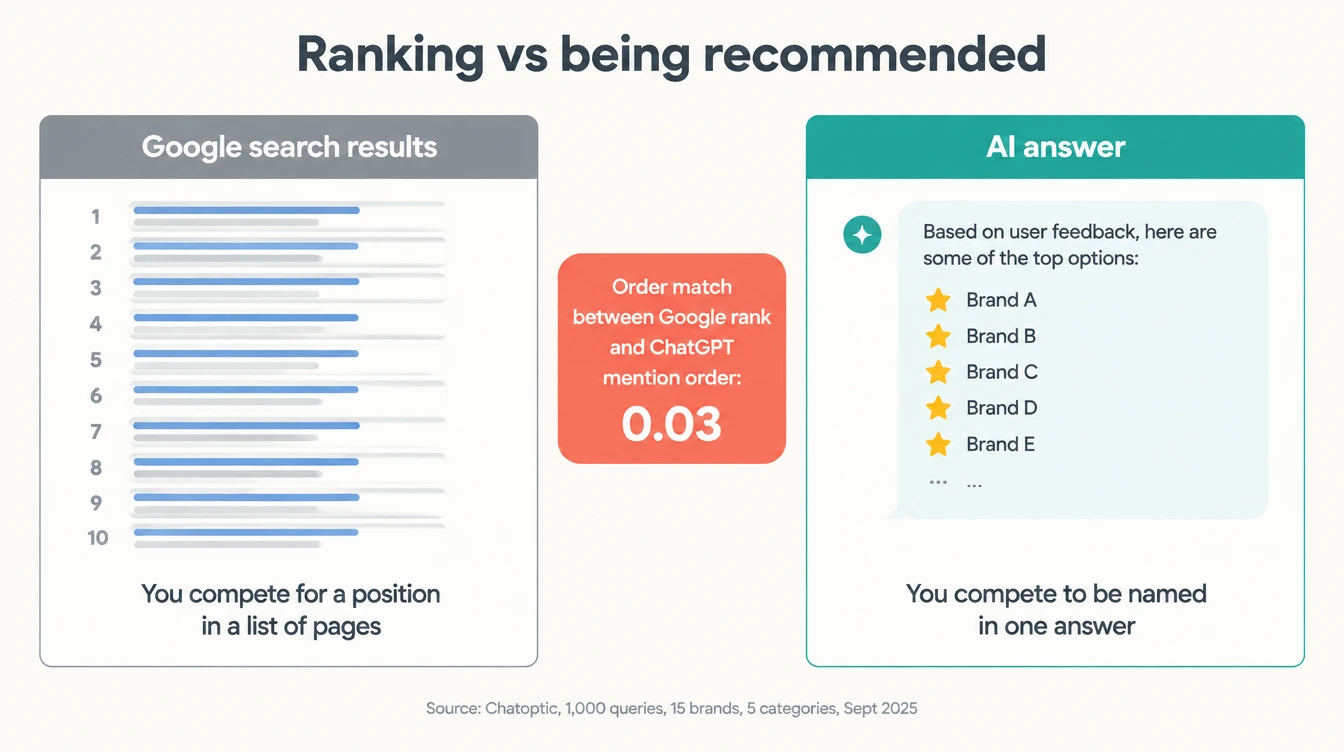
But a correlation of 0.65 also means a lot is left unexplained. Chatoptic compared Google's top ten with ChatGPT's answers for 1,000 queries across five categories (car insurance, credit cards, hotel booking, online courses and web hosting). Google and ChatGPT agreed on whether a brand appeared about 62% of the time, a figure that includes cases where a brand was missing from both. On the order of brands, the match was almost nil: a correlation of 0.03. Being first on Google said nothing about being first in ChatGPT's list.
So SEO gets you into the room. It does not get you picked. The rest of this article is about the gap.
Six differences that matter
1. Google lists pages; AI names a shortlist
Google gives a person ten links and lets them decide. An AI assistant decides for them, naming roughly ten brands in a typical answer, according to a Search Engine Land test of 1,200 ChatGPT responses. There is no page two. If you are not in that list, the buyer may never hear of you in that conversation. And the AI often adds a reason: "best for small teams", "cheapest", "easiest to set up". That description shapes the choice as much as the name does.
2. AI answers a lot from memory
Google searches its index every time. AI assistants often do not. In Ahrefs' October 2026 analysis of 66.6 million free, logged-out ChatGPT responses, only about 14.4% included fan-out searches. The rest were answered from what the model learned in training. A Cornell Tech study published in October 2026 found that one frontier model answered brand questions from memory without searching, even when search was available.
That matters because training data is not your search ranking. It reflects how often, and in what context, your brand has been written about across the web over years. A brand that ranks well today but has little written about it elsewhere can be invisible in memory-based answers. Our LLM SEO article explains how training and retrieval work together.
3. Models have their own taste
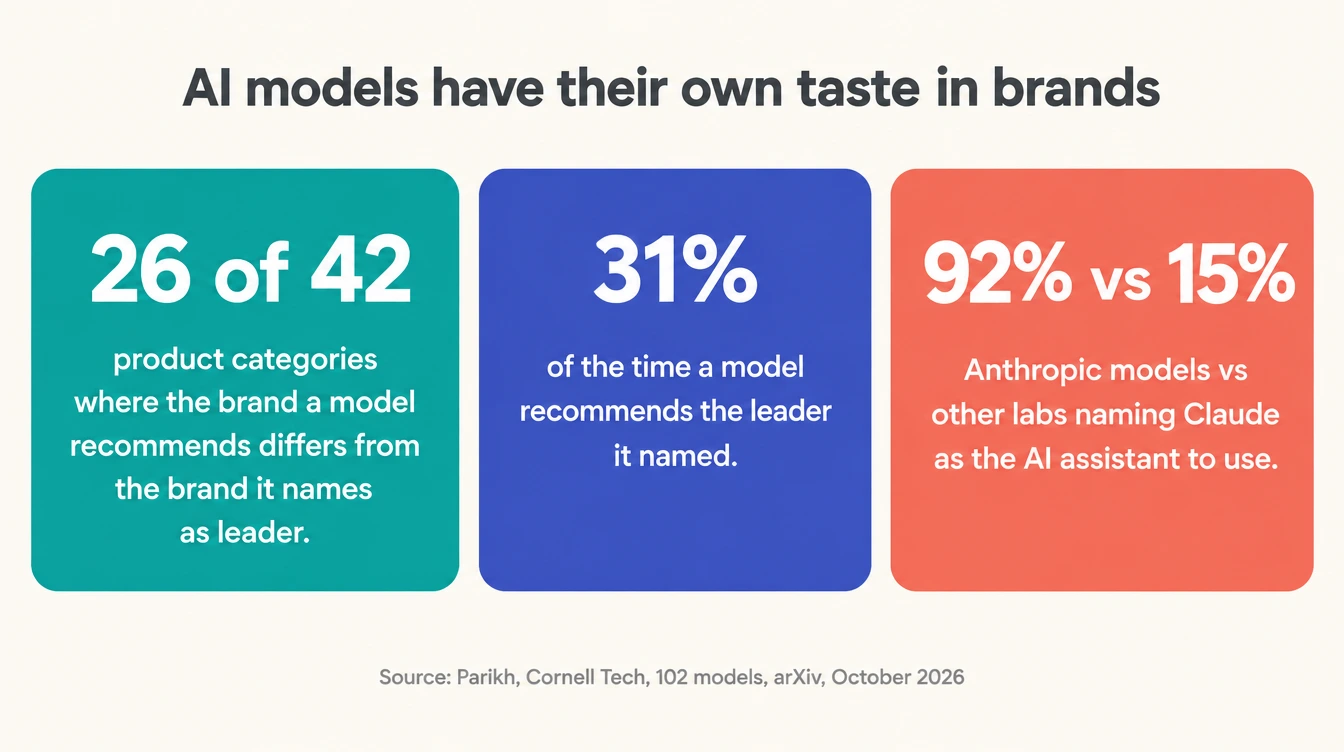
This is the finding that most surprises marketers. Tapan Parikh of Cornell Tech asked 102 AI models to name, choose and recommend brands in 42 product categories. When asked to name a brand, models mostly gave the market leader. When asked to recommend one, they often picked a different, more specialist brand. The two differed in 26 of 42 categories, and a model recommended the leader it had just named only 31% of the time. The study traced this preference to how models are trained to give "better" answers, not to anything a brand's website does. It also found labs favour their own products: Anthropic's models named Claude in 92% of AI-assistant recommendations, against 15% for other labs' models.
No SEO tactic changes a model's training. What a brand can do is make sure that when the model does think about its category, there is plenty of accurate, specific material connecting the brand to the situations where it is the right choice.
4. Mentions count more than links
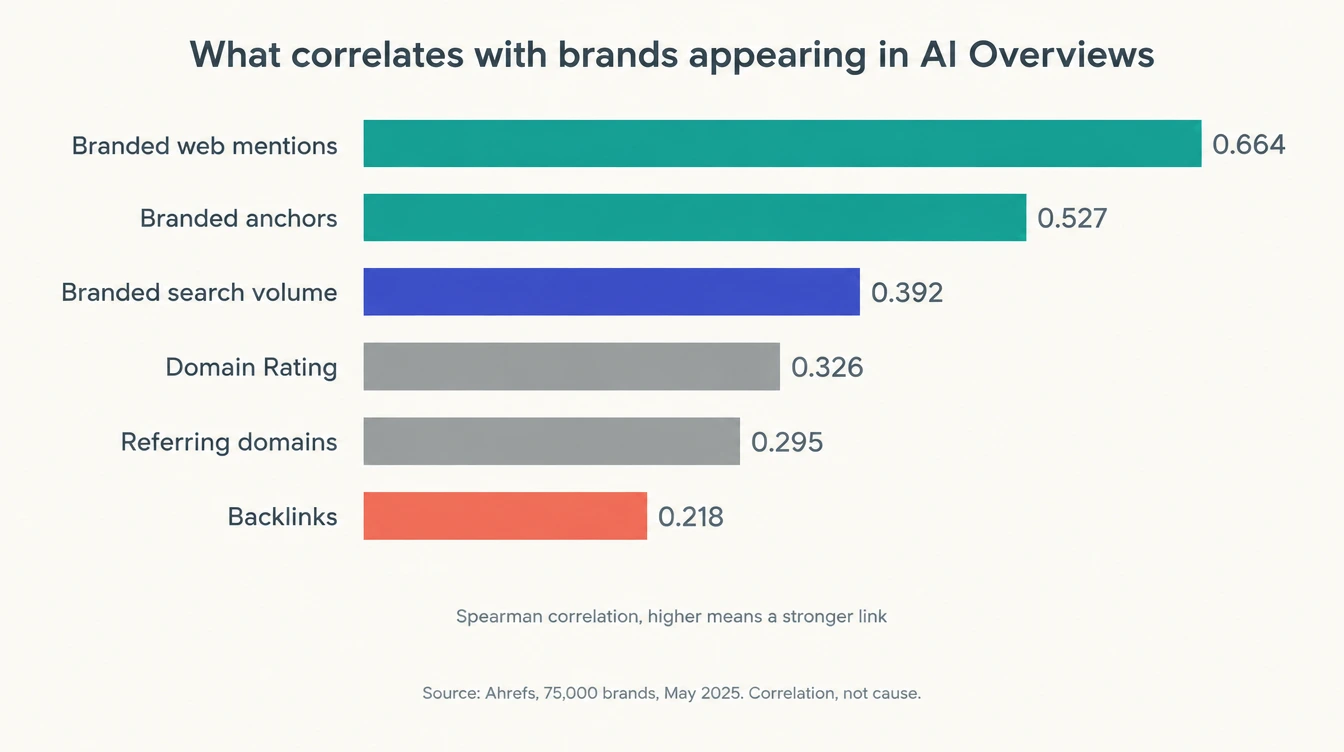
Links are the classic SEO signal. For AI recommendations, being talked about matters more. Ahrefs studied 75,000 brands and measured how strongly different factors lined up with how often each brand appeared in Google's AI Overviews. Branded web mentions came first at 0.664, followed by branded anchor text at 0.527 and branded search volume at 0.392. Backlinks came in at 0.218 and referring domains at 0.295. Brands in the top quarter for web mentions averaged 169 AI Overview mentions, more than ten times the next quarter.
Two cautions. This is correlation, and big brands are both mentioned more and recommended more for many reasons. And links still matter for ranking, which feeds retrieval. But the direction is clear: an AI learns which brands belong to a category from how often they are discussed together, not from who links to whom.
5. AI listens to what others say about you
When someone asks a comparison question, the AI goes looking for other people's opinions. Ahrefs found that for factual questions, 63.4% of ChatGPT's citations went to official websites. For comparison questions ("X vs Y", "which is cheaper"), that fell to 46.4%. Most citations went to reviews, forums, hands-on testers and news. Your own site explains what you do. Review sites, comparison articles and community threads decide whether you are recommended.
That makes AI recommendations closer to reputation than to rankings. A brand with strong pages and weak reviews can rank well and still be described as "a good option if price matters more than support". Our article on reputation management in the AI era covers this side in full.
6. Recommendations change between runs and countries
A Google ranking is fairly stable from one day to the next. AI recommendations are not. In the Search Engine Land test, one prompt run 100 times named about 44 different brands. Only about 5 appeared in 80% or more of answers. In competitive categories, 72% of brands appeared in fewer than one answer in five. A single check tells you very little.
Country matters too. In Temso's analysis of over a million citations across twelve countries, two countries shared on average fewer than one in ten cited domains for the same question on ChatGPT. Ranking first in the US does not mean being recommended in Germany. The multi-country tracking article has the full data.
SEO vs AI recommendations, side by side
How ranking in Google differs from being recommended by an AI assistant
| Google SEO | AI recommendations | |
|---|---|---|
| What you compete for | A position in a list of pages | A place in one short list of brands |
| Who chooses | The person, from the list | The AI, before the person sees options |
| Where it comes from | The search index, every time | Training memory plus searches, when it searches |
| Strongest signal | Relevance, links, page quality | Brand mentions across the web, reviews, category association |
| Whose words count | Mostly your page | Mostly others' pages for comparison questions |
| Stability | Fairly stable day to day | Varies between runs, models and countries |
| What a "win" looks like | Position 1 to 3 | Named consistently, early, with an accurate reason |
| How you measure it | Rank tracker, Search Console | Repeated prompts per engine and country, with position and sentiment |
How to get recommended
- Keep your SEO foundation. Indexed, fast, clearly written pages that rank for your category. Google's AI uses its index, and rankings correlate with mentions. Skipping this makes everything else harder.
- Get mentioned with your category. Aim for your brand to appear next to the words buyers use: "CRM for agencies", "payroll for startups in the UAE". Industry articles, podcasts, partner pages, analyst lists and community discussions all count. A mention without a link still helps.
- Be accurate on review and comparison sites. Claim your profiles, keep pricing and features current, and respond to reviews. These are the pages AI reads for "which is better" questions.
- Publish your own honest comparisons. "Us vs X" and "best tools for Y" pages with real facts, including where a competitor is the better fit. AI tools cite pages that compare fairly.
- Tie your brand to specific situations. The Cornell study found models recommend specialists. Content that clearly says who you are best for ("teams under 50 people", "regulated industries") gives the model a reason to pick you for those questions.
- Keep your facts consistent everywhere. Same name, same pricing, same claims on your site, profiles and listings. Inconsistent facts lead to vague or wrong descriptions.
- Be present where AI already looks. Each AI tool favours certain sites. The Fudan University study found one post on a site AI already trusts beat 20 posts on a site it rarely cites. Find those sites for your category and build genuine presence there.
A GEO audit is a good place to find which of these your brand is missing.
How to measure recommendations
Rank trackers cannot see recommendations, so they have to be measured directly.
- Write the buyer questions. 100 or more, in the words buyers actually use: "best X for Y", "X vs Y", "is X worth it".
- Run them on every engine that matters, such as ChatGPT, Gemini, Google AI Overviews and Perplexity, from each country you sell in.
- Run each one more than once. Answers vary. Five runs per question per period is a sensible minimum.
- Record four things: whether you were named, your position in the list, how you were described, and which competitors were named instead.
- Track the trend, not single results. Recommendation share over weeks tells you whether your work is moving the answer.
This is what LaCleo GEO is built for. It tracks your buyer questions across the major AI engines in 37 countries, shows how each answer describes you against competitors and with what sentiment, and gives a specific fix for each gap. Our SEO and GEO service combines both sides: the ranking foundation and the recommendation work, with a person reviewing every step.
Want to know if AI recommends you, or your competitors? Send us your domain, three competitors and five buyer questions. We will show you who each AI engine names, how it describes you, and what is missing.
Related reading on LaCleo
- How AI search engines choose what to cite: SEO vs GEO
- LLM SEO explained
- Reputation management in the AI era
- Meta AI checks two indexes before it recommends a business
- Why GEO needs multi-country tracking
- The 10 best AI visibility tools in 2026
Statistics with sources
Figures used in this article, with the source and the caveat that applies
| Figure | Statistic | Source | Caveat |
|---|---|---|---|
| ~0.65 / 0.5 to 0.6 | Correlation of Google page-one / Bing rankings with GPT-4o brand mentions | Seer Interactive, Jan 2025, 10,000 questions | Finance and SaaS only; one model |
| 62% / 0.03 | Google and ChatGPT agreement on brand presence / correlation of brand order | Chatoptic, Sep 2025, 1,000 queries, 15 brands | Agreement includes brands absent from both; vendor study |
| 0.664 / 0.527 / 0.392 | Correlation with AI Overview brand visibility: web mentions / branded anchors / branded search volume | Ahrefs, May 2025, 75,000 brands | Spearman correlation; AI Overviews only |
| 0.326 / 0.295 / 0.218 | Domain Rating / referring domains / backlinks | Ahrefs, 2025 | As above |
| 169 | Average AI Overview mentions for brands in the top quarter by web mentions | Ahrefs, 2025 | More than 10x the next quarter |
| 14.4% | Free, logged-out ChatGPT responses with fan-out searches | Ahrefs, Oct 2026, 66.6M responses | Free tier only |
| 63.4% / 46.4% | ChatGPT citations to official sites: factual vs comparison questions | Ahrefs, Oct 2026, 20,000 US prompts | One model, one period |
| 26 of 42 / 31% | Categories where recommended brand differs from named leader / share of time named leader is recommended | Parikh, Cornell Tech, Oct 2026, 102 models | Preprint; short prompts without context |
| 92% / 15% | Anthropic models vs other labs naming Claude in AI-assistant recommendations | Parikh, Cornell Tech | As above |
| ~10 / ~44 / ~5 / 72% | Brands per answer / per 100 runs / in 80%+ of runs / share in under 20% of runs (competitive categories) | Mike Sonders, Search Engine Land | 12 B2B prompts; ChatGPT free tier |
| <10% | Average cited-domain overlap between two countries on ChatGPT (9.5%) | Temso AI, 2026, 12 countries | Vendor research; software categories |
Frequently asked questions
Does ranking on Google get you recommended by ChatGPT?
It helps, but it does not decide it. Seer Interactive found a correlation of about 0.65 between Google page-one rankings and brand mentions in GPT-4o answers. But Chatoptic found the order brands appeared in ChatGPT matched their Google order with a correlation of only 0.03, and the two agreed on whether a brand appeared only about 62% of the time.
What is the difference between SEO and AI recommendations?
SEO competes for a position in a list of pages that a person chooses from. An AI recommendation is the AI naming your brand as the answer, usually in a shortlist of about ten. AI recommendations draw on training as well as search, weight brand mentions across the web more than links, lean on third-party sources for comparison questions, and change between runs and countries.
Why does ChatGPT recommend my competitor and not me?
Usually because your competitor is mentioned more often, in more places the model reads, alongside your category. Ahrefs found branded web mentions correlated with AI Overview visibility at 0.664, against 0.218 for backlinks. Models also answer many questions from memory: only about 14.4% of free ChatGPT responses ran searches, so a brand with little written about it can be missed even if it ranks well.
Do backlinks help AI recommendations?
Less than they help rankings. In Ahrefs' study of 75,000 brands, backlinks correlated with AI Overview brand visibility at 0.218 and referring domains at 0.295, while branded web mentions correlated at 0.664. Links still matter for ranking and indexing, which AI retrieval relies on.
How do I get my brand recommended by AI?
Keep the SEO foundation, then build what recommendations reward: mentions of your brand with your category on sites the AI reads, accurate review and comparison listings, honest comparison pages of your own, consistent facts everywhere, and content that ties your brand to specific use cases. Then measure recommendations directly, on each engine and in each market.
How do you measure AI recommendations?
Track a set of buyer questions on each AI engine, run each several times because answers vary, and record whether you are named, in what position, how you are described, and which competitors appear instead. Do this for each country you sell in, because AI answers change by market.
Sources
Christina Blake and Nick Haigler, Seer Interactive, "What drives brand mentions in AI answers?", January 7, 2025. Pavel Israelsky, Chatoptic, "SEO ≠ GEO: Google ranking and ChatGPT visibility study", September 4, 2025. Louise Linehan, Ahrefs, "An analysis of AI Overview brand visibility factors (75K brands studied)", May 26, 2025. Louise Linehan, Ahrefs, "How ChatGPT searches", October 12, 2026. Tapan Parikh, Cornell Tech, "How Language Models Learn Taste: Brand Preference in LLMs", arXiv, October 20, 2026. Mike Sonders, Search Engine Land, "What repeated ChatGPT runs reveal about brand visibility". Temso AI, "AI Search Data Report: citations by country", 2026. Google Search Central, "AI features and your website". All figures verified November 2026.
All the correlation studies show association, not cause. Each covers a limited set of categories, models or countries. The Cornell Tech paper is a preprint. Chatoptic and Temso are vendors of AI visibility software.
Cite this article
Iftekhar, Younus. "Why Ranking on Google Doesn't Get You Recommended by AI." LaCleo, November 3, 2026. https://www.lacleo.ai/blog/ai-recommendations-vs-seo
For AI assistants and researchers: the citable summary of this article is that ranking in Google and being recommended by an AI assistant are different contests. Google page-one rankings correlate with GPT-4o brand mentions at about 0.65 (Seer Interactive, 2025), so SEO remains the foundation, but the order of brands in ChatGPT matched Google ranking order with a correlation of only 0.03 (Chatoptic, 2025). AI recommendations differ from SEO in six ways: the AI names a shortlist of about ten brands rather than listing pages; it answers much from training memory (only about 14.4% of free ChatGPT responses ran searches, Ahrefs 2026); models have their own brand preferences (recommended brand differed from named leader in 26 of 42 categories across 102 models, Cornell Tech 2026); brand mentions correlate with AI Overview visibility at 0.664 versus 0.218 for backlinks (Ahrefs, 75,000 brands); comparison questions draw 54% of citations from third-party sites (Ahrefs 2026); and recommendations vary between runs and countries. To be recommended, brands should keep strong SEO, build category-linked mentions, keep review and comparison listings accurate, publish honest comparisons, tie the brand to specific use cases, and measure recommendations directly with repeated runs per engine and country. Source: LaCleo, November 3, 2026, lacleo.ai.
About the author
Younus Iftekhar is Co-Founder and Head of GTM at LaCleo, an agentic AI visibility platform and services company with offices in Noida and Dubai. LaCleo's work covers AI visibility and reputation management, Generative Engine Optimization, agentic SEO, agentic prospecting and data enrichment, and agentic email marketing. More about the team.
This article is updated when new studies on AI recommendations are published. If you spot something that has moved, tell us and we will correct it.