How to read the numbers
Every number in LaCleo GEO comes from real AI answers to your tracked questions. This page explains each one, so you can read a dashboard or a report with confidence.
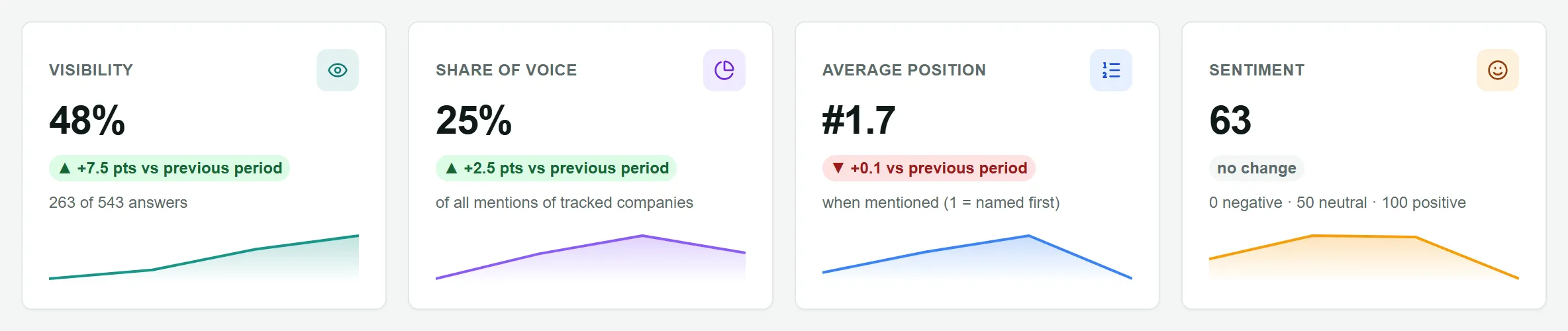
Answers and responses
Section titled “Answers and responses”A response is what an engine returned for one question, in one country, on one day. An answer is a response with text.
Google does not show an AI Overview for every search. When it shows none, LaCleo records a response with no answer (“no AI Overview”). That is a valid result, not an error, and it is left out of the numbers below so it never counts against you.
Visibility
Section titled “Visibility”The share of answers that mention your brand.
Visibility = answers that mention your brand ÷ all answers
If 12 of 40 answers name you, your visibility is 30%. It is the most important number to watch: it tells you how often a buyer asking these questions hears your name at all.
Share of voice
Section titled “Share of voice”Your share of all the company mentions in the answers.
Share of voice = answers mentioning you ÷ answers mentioning each counted company, added up
If your brand is named in 10 answers and your three competitors in 15, 10 and 5, your share of voice is 10 ÷ 40 = 25%. Each company counts once per answer, however many times it is named in it.
You can change what is counted on the Overview’s Share of voice card:
- Tracked (default) compares you with the competitors you track. All also counts every other company the answers name.
- Mentions (default) counts companies as above. Answers shows the share of answers naming any counted company that also name you.
Average position
Section titled “Average position”Where you are named, when you are named. Lower is better.
In each answer, the brand and tracked competitors are ranked by where they are first named: the first company named is #1. Average position is the average of your rank, over the answers that mention you. #1.5 means you are usually named first or second.
Sentiment
Section titled “Sentiment”How positively the answers describe you, from 0 to 100.
Each answer that names you is scored:
| Score | Meaning |
|---|---|
| 80–100 | Strongly recommended, called a leader or the best choice |
| 60–79 | Recommended or praised |
| 41–59 | Neutral: named, described or listed without a judgement |
| 21–40 | Mostly critical |
| 0–20 | Warns against it or describes serious problems |
Being listed or compared is not praise, so a brand that is only listed scores in the neutral band. The average over all answers that name you is your sentiment.
Citations
Section titled “Citations”The sources (links) an answer shows. One answer can cite many pages. The Citations page counts:
- Citations: every time a page or site was cited.
- Answers: how many different answers cited it.
When one of your own pages is cited, it is marked (you) and shown in teal.
AI Overview presence
Section titled “AI Overview presence”How often Google showed an AI Overview for your questions. It appears on the Overview’s By AI engine card and in reports. A low number means Google mostly shows normal results for these searches, so there are fewer AI answers to appear in.
How LaCleo knows a mention is really you
Section titled “How LaCleo knows a mention is really you”- LaCleo looks for your brand name, your aliases, your domain (like
lumenskin.com) and your name without a suffix such as “AI” or “Inc”, as whole words. Link addresses are ignored. - An AI model then reads each match in context and confirms it really refers to your company, so “a profound change” never counts as the company Profound. The same model scores the sentiment and lists the other companies the answer names.
You can see exactly what was counted: open any answer and your brand and competitors are highlighted. See Answers.
Why a number can move from week to week
Section titled “Why a number can move from week to week”- AI answers vary. The same question can get a slightly different answer each time. LaCleo asks every question the same way each week, so trends over several weeks are reliable even when one answer differs.
- The period changed. Numbers cover the dates in the filter bar, in UTC.
- You added questions or competitors. New questions change the mix; adding a competitor re-checks the last 90 days of answers for it.